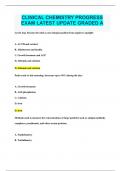
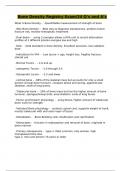
CLINICAL CHEMISTRY PROGRESS EXAM LATEST UPDATE GRADED A
CLINICAL CHEMISTRY PROGRESS EXAM LATEST UPDATE GRADED A Levels may become elevated as one changes position from supine to upright: A. ACTH and cortisol B. Aldosterone and insulin C. Growth hormone and ACP D. Albumin and calcium D. Albumin and calcium Peaks early to late morning; decreases up to 30% during the day: A. Growth hormone B. Acid phosphatase C. Calcium D. Iron D. Iron Methods used to measure the concentrations of large particles such as antigen-antibody complexes, prealbumin, and other serum proteins: A. Nephelometry B. Turbidimetry C. Nepholometry and turbidimetry D. Nephelometry, turbidimetry and absorption spectroscopy C. Nepholometry and turbidimetry The measurement of voltage between two electrodes in a solution forms the basis for a variety of procedures for measuring analyte concentration: A. Potentiometry B. Coulometry C. Amperometry D. Voltammetry A. Potentiometry It is based on fragmentation and ionization of molecules using a suitable source of energy: A. Conductance B. Impedance C. Chromatography D. Mass spectrometry D. Mass spectrometry Generally it is used to detect gamma radiation: A. Crystal scintillation counter B. Liquid scintillation counter C. Crystal and liquid scintillation counter D. None of these A. Crystal scintillation counter A technique for determining the structure of organic compounds; it is nondestructive, although it does require a larger sample volume: A. Mass spectroscopy B. Nuclear magnetic resonanance C. Capillary electrophoresis D. Mass spectroscopy and nuclear magnetic resonance B. Nuclear magnetic resonanance Common causes of hypernatremia, EXCEPT: A. Dehydration B. Diabetes insipidus C. Cushing's disease or syndrome D. Syndrome of inappropriate ADH (SIADH) secretion D. Syndrome of inappropriate ADH (SIADH) secretion In all forms of hyponatremia, the chloride ion concentration is also generally ____ because chloride is the chief counterion for sodium. A. High B. Low C. Variable D. Cannot be determined B. Low Low anion gaps: A. Uremia/renal failure B. Uremia/renal failure, ketoacidosis and salicylate poisoning C. Hypoalbuminemia and severe hypercalcemia D. Hypoalbuminemia, hypercalcemia
Written for
- Institution
- CLINICAL CHEMISTRY PROGRESS
- Course
- CLINICAL CHEMISTRY PROGRESS
Document information
- Uploaded on
- January 11, 2024
- Number of pages
- 35
- Written in
- 2023/2024
- Type
- Exam (elaborations)
- Contains
- Questions & answers
Subjects
-
clinical chemistry progress exam latest update gra

Also available in package deal