

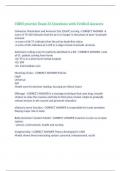
CRRN practice Exam 33 Questions with Verified Answers,100% CORRECT
CRRN practice Exam 33 Questions with Verified Answers Galveston Orientation and Amnesia Test (GOAT) scoring - CORRECT ANSWER -A score of 76-100 indicates that the pt is no longer in the phase of post- traumatic amnesia -a score of 66-75: indicates that the pt has boderline status -a score of 66: indicates pt is still in a stage of post-traumatic amnesia Admission coding score for patients admitted to a IRF - CORRECT ANSWER -code of 01: patient coming from home -02: PT is in a short-term herbal hospital -03: SNF -04: intermediate care Meaning of plus - CORRECT ANSWER Policies Legal Universal Self Model uses for decision-making, focusing on ethical issues Efflerage - CORRECT ANSWER Is a massage technique that uses long, smooth strokes to relax the muscles and help to find areas of pain. Helps to gradually release tension in the muscle and promote relaxation olfactory nerve function - CORRECT ANSWER Is responsible for taste sensation Playing major role in taste Betty Newman's System Model - CORRECT ANSWER A person is seen as an open system. - person, environment, health and nursing Imogene King - CORRECT ANSWER Theory developed in 1960 Model shows three interacting system: personal, interpersonal, social PLISST Model of Addressing Sexual Functioning - CORRECT ANSWER Ask- about any sexual health concerns Advice- assist the client in j set standing sexual health condena are common Assess: assessing the pts needs by looking at his or her history Assist: make educational materials and targeted interventions available Arrange follow up: re-evaluate the pts needs and needs through tx Dysautonomia symptoms "storming" - CORRECT ANSWER Change in posturing B/p increase Elevated temp Sweating Increase HR Increase RR Agitation Large pupils diabetes insipidus - CORRECT ANSWER polyuria, polydipsia, leading to dehydration, agitation, seizures. SIADH - CORRECT ANSWER Hypo NA 135 Na 110= seizures and coma Low Osmolality Concentrated urine Low urine output What would be a mild TBI? - CORRECT ANSWER LOC20min GCS of 13-15 Loss of memory Physical s/s: HA, confusion, lightheaded, blurred vision, ringing in the ears, bad taste in the mouth, change in sleep patterns, mood changes What would classify as moderate TBI - CORRECT ANSWER GCS of 9-12 Numbness and weakness of extremities. Same as mild. In children: persistent crying, inability to console, refuse eating/ nursing obstructive respiratory disorders - CORRECT ANSWER COPD Asthma Cystic Fibrosis Any disorder that affects the airways and their ability to transport 02 to the lungs or CO2 away stage one of sleep - CORRECT ANSWER light sleep 5-10% sleep time in this Phase Stage 2 of sleep cycle - CORRECT ANSWER Slowing of activity with occasional bursts of activity About 50% in this sleep Decrease: HR,RR, metabolic rate, muscle tone Stage 3 of Sleep cycle - CORRECT ANSWER deep sleep begins, brain begins to generate slow delta waves RR continues to decrease Stage 4 of Sleep cycle - CORRECT ANSWER deepest level of normal sleep; REM sleep - CORRECT ANSWER a stage of sleep characterized by rapid eye movements and a high level of brain activity -dream sleeping - Werickes' area - CORRECT ANSWER impaired language comprehension. Despite this impaired comprehension, speech may have a normal rate, rhythm, and grammar. The most common cause of Wernicke's aphasia is an ischemic stroke affecting the posterior temporal lobe of the dominant hemisphere. Word Salad Broca's area - CORRECT ANSWER non-fluent aphasia in which the output of spontaneous speech is markedly diminished and there is a loss of normal grammatical structure. Specifically, small linking words, conjunctions, such as and, or, and but, and the use of prepositions are lost. limited language Braden Scale - CORRECT ANSWER A Braden scale score below 16 indicates increased risk for pressure ulcer development. While the specific factors increasing risk might include incontinence or noncompliance, the score alone does not provide that information. The score does not indicate whether the patient's skin is intact or not, just that there is elevated risk for skin breakdown. Domains - CORRECT ANSWER 1. Nurse led intervention 2. Promotion of successful living 3. Leadership 4. interprofessional care Hydrocolloid dressings - CORRECT ANSWER Lower infection rates, impermeable to bacteria, absorbs exudate. don't use for heavily draining wounds. Time to sit up after tube feed - CORRECT ANSWER 30-45 minutes AD manefestations - CORRECT ANSWER Autonomic hyperreflexia is a medical emergency that occurs in persons with T6 spinal cord injury and above. It is characterized by hypertension, flushing and perspiration above the level of injury, bradycardia, and goose-flesh below the level of the lesion. These signs and symptoms are caused by the body's attempt to compensate for the brain's inability to interpret and accurately take action on a stimulus Ranchos Los Amigos - CORRECT ANSWER Foot Drop - CORRECT ANSWER Dorsiflexion is flexion of the foot upward - compared to plantar flexion, which is flexion of the toes and foot toward the sole. Failure of dorsiflexion results in foot drop, where the toes catch on the ground during the swing phase of walking. The quadriceps are not involved in foot drop, although weakness of the quadriceps can be a result of prolonged bed rest. Foot-drop is not a normal outcome of any condition Diffuse axonal injury - CORRECT ANSWER DAI is a widespread brain injury, from deceleration and rotational forces, that does not visualize on CT or MRI. Gunshot wound, contusion, and SDH are all focal injuries, not DAI Lewin's Change Theory - CORRECT ANSWER Moving Explanation According to the Lewin Theory of Change, change occurs in 3 stages, beginning with unfreezing, in which the behavior equilibrium needs to be destabilized or unfrozen before the old behavior can be unlearned and new behavior adopted. In the 2nd stage of moving, the group moves toward the change to more acceptable behavior. The last stage is refreezing, where the change is moved to a state of equilibrium and stabilized to prevent regression. Regression is not a stage in Lewin's theory. It is what can happen in the 2nd stage of moving, before refreezing and stabilization occur. The law that allows former employees to continue coverage up to 18 months after voluntary or involuntary separation from an employer is called: - CORRECT ANSWER The Consolidated Omnibus Reconciliation Act (COBRA) allows former employees to continue coverage after separation from an employer. The legislation in the other items may be important in general health care or rehabilitation, but it is not specific to continuation of insurance coverage. Uninhibited neurogenic bowel - CORRECT ANSWER The most likely condition that would cause Mrs. Cunningham's bowel incontinence would be uninhibited neurogenic bowel due to her frequent smearing, urge incontinence and brain injury ad stroke. She does need assistance to transfer but this is not a cause of the urgency, but rather an inability to make it to the bathroom in time. Value-based purchasing program - CORRECT ANSWER Value-based purchasing program Explanation The value-based purchasing program for PAC was created to provide incentive payments for quality, not just quantity, of care. CMS withholds a portion of Medicare reimbursement on the organization's performance on quality measures. The IMPACT act was created to compare quality across PAC settings. The CARE tool was designed to standardize assessments of patients. Bundled payments provide one payment for the entire episode of care from acute through post-acute care. Black, T. & Deutsch, A. (2015). Quality and safety: Performance measurement and accountability
Document information
- Uploaded on
- January 11, 2024
- Number of pages
- 5
- Written in
- 2023/2024
- Type
- Exam (elaborations)
- Contains
- Questions & answers


