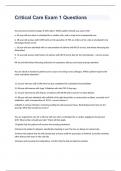
Critical Care Exam 1 Questions well answered 2023/2024
Critical Care Exam 1 Questions You have just received change of shift report. Which patient should you assess first? a. 62 year-old man who is scheduled for a cardiac cath, and is ready to be transported now b. 58 year-old woman with COPD with an O2 saturation of 92% on 2 liters of O2, who is scheduled to be discharged home on O2 c. 36 year-old man admitted with an exacerbation of asthma with RR 36 at rest, and whose wheezing has diminished d. 72 year-old woman with history of asthma with HR 90 and is due for her beta-blocker - correct answer C RR 36 and diminished wheezing indicative of respiratory distress and needs prompt attention You are about to handover patient care to your on-coming nurse colleague. Which patient requires the most immediate attention? 1.) 62 year-old man with COPD who has just completed his scheduled bronchodilator 2.) 68 year-old woman with type 2 diabetes who had CVA 2 days ago 3.) 72 year-old woman with history of asthma with HR 90 and is due for her beta-blocker 4.) 48 year-old man admitted with cellulitis of his right hand after a construction accident, currently on IV antibiotics, with a temperature of 101.8 - correct answer 4 Cellulitis is serious infection, involving swelling of subcutaneous tissue, fluid displacement due to 3rd spacing. What else would you assess? You are assigned to care for a 58 year-old man who is scheduled for a cardiac angiogram during your shift. What actions should you take? Check all that apply. 1-Explain that the patient will receive short-acting anesthesia 2-Review the patient's allergies, specifically checking to see if he has an allergy to contrast dye 3-Inform the patient that his wife should stay at home until the procedure is finished, as family members often distract the team in the cath lab 4-Review and reconcile his medications. Confirm that he did not take his warfarin 5-Check the patient's most recent labs paying particular attention to the PT INR - correct answer 2, 4, 5 Contrast dyes contain iodine and allergy could lead to anaphylactic response; might receive light sedation but needs to be awake and able to follow directions A 62 year-old man, who is s/p coronary artery bypass surgery, is about to be transferred from the ICU to the cardiac stepdown unit. What is the most effective way for the ICU (reporting) nurse and cardiac stepdown (receiving) nurse to ensure that essential patient information is conveyed? 1- A face-to-face verbal report with both nurses present in a quiet room 2- The ICU nurse will provide an audio-recorded report for future reference and documentation 3- The ICU nurse will document essential transfer information in the patient's medical record 4- The ICU nurse will accompany the patient to the stepdown unit and provide a face-to-face report, using a unit-approved, standardized guide - correct answer 4 What is the most common outcome associated with poorly managed hospital discharge? - correct answer Adverse Drug events The nurse is tracking data on a group of patients with heart failure, who have been discharged from the unit where you work and are now being followed in clinic. What is the best indicator that the nursing interventions of monitoring and teaching have been effective? 1- Eighty-five percent of patients have not gained weight 2- Seventy-five percent of family caregivers have reported watching an educational DVD 3- Five percent of patients have been readmitted to the hospital in the last 90 days 4- Eighty percent report that they are taking their medications - correct answer 3 All are important but lower resource utilization is best indicator and one used by accrediting agencies, payors, etc. You are the nurse preparing to discharge a 46 year-old man with hypertension who was started on chlorothiazide. You ask the patient to share with you his understanding of his new medication. Which of the following statements indicates your teaching has been effective? Select all that apply. 1- I will weigh myself every day at the same time. 2- I will notify Charles, the nurse practitioner in my primary care doctor's office if I gain 3 pounds or more, have increased swelling in my feet and ankles, or feel more tired than usual. 3- I will reduce my medication if I feel very thirsty or dizzy.
Written for
- Institution
- BMC ICU
- Course
- BMC ICU
Document information
- Uploaded on
- January 10, 2024
- Number of pages
- 17
- Written in
- 2023/2024
- Type
- Exam (elaborations)
- Contains
- Questions & answers
Subjects
-
critical care exam 1 questions

Also available in package deal