

1.5.1 OCR A Level Computer Science Questions & Answers 100% Verified!
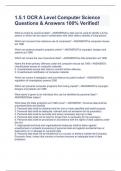
What is meant by personal data? - ANSWERSAny data can be used to identify a living person or which can be used in combination with other data to identify a living person. Which act concerns the malicious use of computers? - ANSWERSThe computer misuse act 1990 Which act protects people's property online? - ANSWERSThe copyright, designs and patents act 1988 Which act covers the use of personal data? - ANSWERSThe data protection act 1998 Name the three primary offences under the computer misuse act 1990 - ANSWERS1. Unauthorised access to computer materials. 2. Unauthorised access with intent to commit further offences. 3. Unauthorised modification of computer material. Which act covers investigation and surveillance by public bodies? - ANSWERSThe regulation of investigatory powers 2000 Which act prevents computer programs from being copied? - ANSWERSThe copyright, designs and patents act 1988 What name is given to an individual who can be identified by personal data? - ANSWERSData subject What does the Data protection act 1998 cover? - ANSWERS1. Personal data shall be processed fairly and lawfully 2. Personal data shall be obtained only for one or more specified and lawful purpose 3. Personal data shall be adequate, relevant and not excessive for its purpose(s) 4. Personal data shall be accurate and where necessary kept up to date 5. Personal data shall not be kept for longer than is necessary for its purpose(s) 6. Personal data shall be processed in accordance with the rights of data subjects under this Act 7. Appropriate technical and organisational measures shall be taken against unauthorised or unlawful processing of personal data and against accidental loss or destruction of, or damage to, personal data 8. Personal data shall not be transferred to a country or territory outside the European Economic Area, unless that country or territory ensures an adequate level of data protection
Document information
- Uploaded on
- January 10, 2024
- Number of pages
- 2
- Written in
- 2023/2024
- Type
- Exam (elaborations)
- Contains
- Questions & answers


