

COMPLEX CMS REVIEW QUESTIONS AND ANSWERS
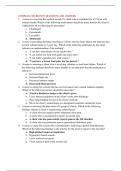
1. A nurse is reviewing the medical record of a client who is scheduled for a CTscan with contrast media. Which of the following medications should the nurse instruct the client to withhold for 48 hr following the procedure? a. Clopidogrel b. Furosemide c. Carvedilol d. Metformin 2. A nurse is providing discharge teaching to a client who has heart failure and instructs him to limit sodium intake to 2 g per day. Which of the following statements by the client indicates an understanding of the teaching? a. “I can have mayonnaise on my sandwiches.” b. “I can season my food with garlic and onion salts.” c. “I can drink vegetable juice with a meal.” d. “I can have a frozen fruit juice bar for dessert.” 3. A nurse is assessing a client who is receiving valsartan to treat heart failure. Which of the following findings should the nurse identify as an indication that the medication is effective? a. Increased potassium level b. Increased heart rate c. Decreased urinary output d. Decreased blood pressure 4. A nurse is caring for a client who has cervical cancer and a sealed radiation implant. Which of the following actions should the nurse take? a. Attach a dosimeter badge to the client’s gown b. Leave unused equipment in the client’s room until discharge c. Place long-handled forceps at the client’s bedside d. Move the client’s soiled linens to a designated container outside the room 5. A nurse is assessing the pain status of a group of clients. Which of the following findings indicate a client is experiencing referred pain? a. A client who has angina reports substernal chest pain b. A client who is postoperative reports incisional pain c. A client who has pancreatitis reports pain in the left shoulder d. A client who has peritonitis reports generalized abdominal pain 6. A nurse is caring for a client who is postoperative following a partial thyroidectomy. Which of the following findings is the priority for the nurse to report to the provider? a. High pitched sound on inspiration b. Hypoactive bowel sounds c. Loose tracheal secretions d. Client report of pain at the incision site 7. A nurse is caring for a client who is receiving chemotherapy and requests information about acupuncture to relieve some of the side effects. Which of the following findings should the nurse identify as a contraindication to receiving the alternative therapy? a. Urticaria b. Lymphedema c. Mouth sores d. Headaches 8. A nurse is providing discharge teaching to a client who has an ileostomy. Which of the following client statements indicates an understanding of the teaching? a. “I will empty my bag when it is full.” b. “I will eat a high-fiber diet.” c. “I expect my stools to be loose.” d. “I will take a laxative when I’m constipated.” 9. A nurse is caring for a client who has bladder cancer and WBC count of 900/mm. Which of the following actions should the nurse take? a. Use contact isolation while providing care b. Instruct the client to avoid eating raw fruit c. Apply pressure to venipuncture sites of 10 minutes d. Move the client to a negative pressure room 10. A nurse is providing discharge teaching to a client who has chronic urinary tract infection. The client has a prescription for ciprofloxacin 250 mg PO twice daily. Which of the following instructions should the nurse include in the teaching? a. Monitor heart rate once daily b. Drink 2 to 3 L of fluids daily c. Take a laxative to prevent constipation d. Take an antacid 30 minutes before taking the medication 11. A nurse is performing a cranial nerve assessment on a client following a head injury. Which of the following findings should the nurse expect if the client has impaired function of the vestibulocochlear nerve (cranial nerve VIII)? a. Deviation of the tongue from midline b. Loss of peripheral vision c. Disequilibrium with movement d. Instability to smell 12. A nurse is caring for a client who has IV in the left forearm and whose infusion pump has alarmed several times. Which of the following actions should the nurse take first? a. Flush the IV catheter b. Reposition the client’s arm c. Ensure the tubing connections are secure d. Check the IV site for redness 13. A nurse is caring for a client who has severe burn injury. The nurse should recognize which of the following as an indication of hypovolemic shock? a. PaCO2 37 mm Hg b. Potassium 5.2 mEq/L c. Urine output 45 mL/hr d. Capillary refill 1.5 seconds 14. A nurse is providing instructions about foot care for a client who has peripheral arterial disease. The nurse should identify which of the following statements by the client indicates an understanding of the teaching? a. “I rest in my recliner with my feet elevated for about an hour every afternoon.” b. “I apply a lubrication lotion to the cracked areas on the soles of my feet every evening.” c. “I use my heating pad on a low setting to keep my feet warm.” d. “I soak my feet in hot water before trimming my toenails.” 15. A nurse is caring for a client who is taking digoxin 0.125 mg PO daily and is at risk for developing digoxin toxicity. The nurse should monitor the client for an imbalance of which of the following electrolytes because it can increase the risk for digoxin toxicity? a. Calcium b. Potassium c. Magnesium d. Phosphate 16. A nurse is monitoring a client who is receiving 2 units of packed RBCs. which of the following manifestations indicates a hemolytic transfusion reaction? a. Bradycardia b. Chills c. Back pain d. Hypertension 17. A nurse is reviewing the medical record of a client who has pneumonia. Which of the following serum laboratory values should the nurse expect? a. WBC count 15,000/mm b. Sodium 130 mg/dL c. BUN 8 mg/dL d. Hematocrit 35% 18. A nurse is preparing to assist the provider with thoracentesis for a client who has a left pleural effusion. Which of the following interventions is the priority for the nurse? a. Determine whether the client has an allergy to local anesthetics b. Reinforce the importance of lying still during the procedure c. Administer a sedative medication d. Describe the sensations the client will feel during the procedure 19. A nurse is assessing a client who has increased intracranial pressure. The nurse should recognize which of the following is the first sign of deteriorating neurological status? a. Cheyne-stokes respirations b. Altered level of consciousness c. Decorticate posturing d. Pupillary dilation 20. A nurse on a medical unit is planning care for a group of clients. Which of the following clients should the nurse attend to first? a. A client who has chronic obstructive pulmonary disease and oxygen saturation at 89% b. A client who has multiple sclerosis and reports ataxia and vertigo c. A client who has thrombocytopenia and reports a nosebleed d. A client who has left-sided paralysis and slurred speech from a prior stroke 21. A nurse is teaching a client about the use of an incentive spirometer. Which of the following instructions should the nurse include in the teaching? a. Exhale slowly through pursed lips b. Position the mouthpiece 2.5 cm (1 in) from the mouth c. Hold breaths about 3 to 5 seconds before exhaling d. Place hands on the upper abdomen during inhalation 22. A nurse in an emergency department is caring for a client who is to receive a tissue plasminogen activator for the treatment of an ischemic stroke. In which order should the nurse complete the following actions? a. Weigh the client b. Check for contraindications c. Administer the tPA d. Transfer the client to the CCU 23. A nurse is preparing to administer peritoneal dialysis to a client. Which of the following actions should the nurse take? a. Hang the drainage bag below the client’s abdomen b. Chill the dialysate before administration c. Place the client in high-fowler’s position d. Use clean technique to access the catheter 24. A nurse is caring for a client following a total knee arthroplasty. The client reports a pain level of 6 on a pain scale of 0 to 10. Which of the following interventions should the nurse take? a. Perform range-of-motion exercises to the client’s knee b. Gently massage the area around the client’s incision c. Apply an ice pack to the client’s knee d. Place pillows under the client’s knee 25. A nurse is administering packed RBCs to a client. The client reports chills, lower back pain, and nausea 10 minutes after the infusion begins. Which of the following actions should the nurse take? a. Check the client’s vital signs b. Stop the infusion c. Collect a urine sample d. Administer oxygen to the client 26. A nurse is teaching a group of clients who has cancer about radiation therapy. Which of the following activities should the nurse include in the teaching? a. Limit engaging in sport activities that can cause bruising b. Limit socializing in large crowds c. Decrease intake of fresh fruit or vegetables d. Decrease time spent outdoors 27. A nurse is preparing to administer a unit of packed RBCs to a client. Which of the following actions should the nurse plan to take? a. Obtain the client’s first set of vital signs 1 hr after initiating the transfusion b. Administer the unit of packed RBCs over 1 hr c. Initiate venous access with a 21-gauge needle d. Use y tubing with 0.9% sodium chloride when administering the transfusion 28. A PACU nurse is monitoring the drainage from a client’s NG tube following abdominal surgery. Which of the following findings in the first postoperative hour should the nurse report to the provider? a. 150 mL of serosanguinous drainage b. 200 mL of brown drainage c. 75 mL of greenish-yellow drainage d. 100 mL of red drainage 29. A nurse is planning care for a client who is 1 day postoperative following an open cholecystectomy. Which of the following interventions should the nurse include in the plan of care? a. Apply compression stockings to the lower extremities b. Avoid use of anticoagulants c. Discourage leg exercises while in bed d. Place pillows under the client’s knee 30. A nurse is performing skin cancer screening on a group of clients. Which of the following findings should the nurse identify as an indication of melanoma? a. Reddened lesions with dilated blood vessels b. Scaly lesions with a crusted appearance c. Flat lesions with irregular borders d. Raised lesions with a rolled border
Document information
- Uploaded on
- January 9, 2024
- Number of pages
- 30
- Written in
- 2023/2024
- Type
- Exam (elaborations)
- Contains
- Questions & answers


