APES Unit 4 Study Guide 2024/2025 Latest Update
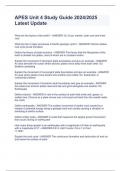
What are the layers of the earth? - ANSWER 15; Crust, mantle, outer core and inner core What are the 3 major processes in Earths geologic cycle? - ANSWER Tectonic plates, rock cycle & soil formation Define the theory of plate tectonics - ANSWER The theory that the lithosphere of the earth is divided into plates, most of which are in constant motion Explain the movement of divergent plate boundaries and give an example - ANSWER An area beneath the ocean where tectonic plates move away from each other. Ex: Seafloor spreading Explain the movement of convergent plate boundaries and give an example - ANSWER An area where plates move toward one another and collide. Ex: Subduction or continental collision Explain the movement of transform fault boundaries and give an example - ANSWER Are where two tectonic plates meet and slip and grind alongside one another. Ex: Earthquake Define volcano - ANSWER A vent in the surface of earth that emits ash, gases, or molten lava. (Occurs as a plate moves over a hot spot and heat from the mantle melts the crust) Define earthquake - ANSWER The sudden movement of earths crust caused by a release of potential energy along a geologic fault and usually causing a vibration or trembling at earths surface. Define richter scale - ANSWER A scale that measures the largest ground movement that occurs during an earthquake How many times greater is an earthquake with a magnitude of 8 than an earthquake with a magnitude of 5? - ANSWER 8-5=3. Add 3 zeros. Put a 1 in front. >1,000< Explain the rock cycle - ANSWER The continuous formation and destruction of rock on and below the surface of earth What are the 3 types of rocks and how are they formed? - ANSWER 1) Igneous rock-formed from cooling magma 2) Sedimentary rock-Formed when dissolved minerals seep through sediment layers and act as a kind of glue, crystallizing and binding sediment particles together. (MAJOR SINK FOR PHOSPHORUS) 3) Metamorphic rock- Formed by great heat and/or pressure that reshapes crystals within the rock and changes its appearance and physical properties What is a mineral - ANSWER A solid chemical substance with a uniform, often crystalline, structure that forms under specific temperatures and pressures. What is the difference between physical and chemical weathering? Give examples of each - ANSWER 1)Physical weathering is the mechanical breakdown of rocks and minerals. Ex: Wind or rain 2)Chemical weathering is the breakdown of rocks and minerals by chemical reactions, the dissolving of chemical elements from rock, or both. Ex: Acid rain Explain the formation of acid rain - ANSWER Sulfur is emitted into the atmosphere and reacts with oxygen to create sulfur dioxide. It then turns into sulfuric acid which lowers the pH of the rain. Explain erosion - ANSWER The removal of material from one place and its transport to another by the action of wind or water In
Written for
- Institution
- APES
- Module
- APES
Document information
- Uploaded on
- January 6, 2024
- Number of pages
- 6
- Written in
- 2023/2024
- Type
- Exam (elaborations)
- Contains
- Questions & answers
Subjects
-
apes unit 4 study guide latest update
-
apes unit 4 study guide stuvia
-
what are the layers of the earth answer 15 cr
-
define the theory of plate tectonics answer the

Also available in package deal