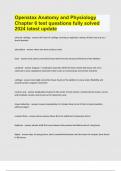
Openstax Anatomy and Physiology Chapter 6 test questions fully solved 2024 latest update
articular cartilage thin layer of cartilage covering an epiphysis; reduces friction and acts as a shock absorber articulation where two bone surfaces meet bone hard, dense connective tissue that forms the structural elements of the skeleton canaliculi (singular = canaliculus) channels within the bone matrix that house one of an osteocyte's many cytoplasmic extensions that it uses to communicate and receive nutrients cartilage semi-rigid connective tissue found on the skeleton in areas where flexibility and smooth surfaces support movement central canal longitudinal channel in the center of each osteon; contains blood vessels, nerves, and lymphatic vessels; also known as the Haversian canal closed reduction manual manipulation of a broken bone to set it into its natural position without surgery compact bone dense osseous tissue that can withstand compressive forces diaphysis tubular shaft that runs between the proximal and distal ends of a long bone diploë layer of spongy bone, that is sandwiched between two the layers of compact bone found in flat bones endochondral ossification process in which bone forms by replacing hyaline cartilage endosteum delicate membranous lining of a bone's medullary cavity epiphyseal line completely ossified remnant of the epiphyseal plate epiphyseal plate (also, growth plate) sheet of hyaline cartilage in the metaphysis of an immature bone; replaced by bone tissue as the organ grows in length epiphysis wide section at each end of a long bone; filled with spongy bone and red marrow external callus collar of hyaline cartilage and bone that forms around the outside of a fracture flat bone thin and curved bone; serves as a point of attachment for muscles and protects internal organs fracture broken bone fracture hematoma blood clot that forms at the site of a broken bone hematopoiesis production of blood cells, which occurs in the red marrow of the bones hole opening or depression in a bone hypercalcemia condition characterized by abnormally high levels of calcium hypocalcemia condition characterized by abnormally low levels of calcium internal callus fibrocartilaginous matrix, in the endosteal region, between the two ends of a broken bone intramembranous ossification process by which bone forms directly from mesenchymal tissue irregular bone bone of complex shape; protects internal organs from compressive forces lacunae (singular = lacuna) spaces in a bone that house an osteocyte long bone cylinder-shaped bone that is longer than it is wide; functions as a lever medullary cavity hollow region of the diaphysis; filled with yellow marrow modeling process, during bone growth, by which bone is resorbed on one surface of a bone and deposited on another nutrient foramen small opening in the middle of the external surface of the diaphysis, through which an artery enters the bone to provide nourishment open reduction surgical exposure of a bone to reset a fracture orthopedist doctor who specializes in diagnosing and treating musculoskeletal disorders and injuries osseous tissue bone tissue; a hard, dense connective tissue that forms the structural elements of the skeleton ossification (also, osteogenesis) bone formation ossification center cluster of osteoblasts found in the early stages of intramembranous ossification osteoblast cell responsible for forming new bone osteoclast cell responsible for resorbing bone osteocyte primary cell in mature bone; responsible for maintaining the matrix osteogenic cell undifferentiated cell with high mitotic activity; the only bone cells that divide; they differentiate and develop into osteoblasts osteoid uncalcified bone matrix secreted by osteoblasts osteon (also, Haversian system) basic structural unit of compact bone; made of concentric layers of calcified matrix osteoporosis disease characterized by a decrease in bone mass; occurs when the rate of bone resorption exceeds the rate of bone formation, a common occurrence as the body ages perforating canal (also, Volkmann's canal) channel that branches off from the central canal and houses vessels and nerves that extend to the periosteum and endosteum perichondrium membrane that covers cartilage periosteum fibrous membrane covering the outer surface of bone and continuous with ligaments primary ossification center region, deep in the periosteal collar, where bone development starts during endochondral ossification projection bone markings where part of the surface sticks out above the rest of the surface, where tendons and ligaments attach proliferative zone region of the epiphyseal plate that makes new chondrocytes to replace those that die at the diaphyseal end of the plate and contributes to longitudinal growth of the epiphyseal plate red marrow connective tissue in the interior cavity of a bone where hematopoiesis takes place remodeling process by which osteoclasts resorb old or damaged bone at the same time as and on the same surface where osteoblasts form new bone to replace that which is resorbed
Written for
- Institution
- OpenStax Anatomy and Physiology
- Course
- OpenStax Anatomy and Physiology
Document information
- Uploaded on
- January 6, 2024
- Number of pages
- 6
- Written in
- 2023/2024
- Type
- Exam (elaborations)
- Contains
- Questions & answers
Subjects
-
openstax anatomy and physiology chapter 6 test

Also available in package deal