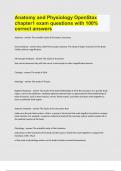
Anatomy and Physiology OpenStax chapter1 exam questions with 100% correct answers.
Anatomy The scientific study of the body's structures. Gross Anatomy Also called Macroscopic anatomy. The study of larger structures in the body. Visible without magnification. Microscopic Anatomy The study of structures that can be observed only with the use of a microscope or other magnification devices Cytology The study of Cells. Histology The study of Tissues. Regional Anatomy The study of the interrelationships of all of the structures in a specific body region, such as the abdomen. Studying regional anatomy helps us appreciate the interrelationships of body structures, such as how muscles, nerves, blood vessels, and other structures work together to serve a particular body region. Systemic Anatomy The study of the structures that make up a discrete body system—that is, a group of structures that work together to perform a unique body function. For example, a systemic anatomical study of the muscular system would consider all of the skeletal muscles of the body. Physiology The scientific study of the chemistry and physics of the structures of the body and the ways in which they work together to support the functions of life. Much of the study of physiology centers on the body's tendency toward homeostasis. Homeostasis The state of steady internal conditions maintained by living things. The study of physiology certainly includes observation, both with the naked eye and with microscopes, as well as manipulations and measurements. Neurophysiology The study of the brain, spinal cord, and nerves and how these work together to perform functions as complex and diverse as vision, movement, and thinking. Fundamental Levels of Organization subatomic particles, atoms, molecules, organelles, cells, tissues, organs, organ systems, organisms and biosphere Molecules The chemical building blocks of all body structures. Cell The smallest independently functioning unit of a living organism. Even bacteria, which are extremely small, independently-living organisms, have a cellular structure. Each bacterium is a single cell. All living structures of human anatomy contain cells, and almost all functions of human physiology are performed in cells or are initiated by cells. Organelles flexible membranes that enclose cytoplasm, a water-based cellular fluid together with a variety of tiny functioning units Tissue A group of many similar cells (though sometimes composed of a few related types) that work together to perform a specific function. Organ A anatomically distinct structure of the body composed of two or more tissue types. Each organ performs one or more specific physiological functions. Organism The highest level of organization. A living being that has a cellular structure and that can independently perform all physiologic functions necessary for life. In multi cellular organisms, including humans, all cells, tissues, organs, and organ systems of the body work together to maintain the life and health of the organism. Organ System A group of organs that work together to perform major functions or meet physiological needs of the body. Integumentary System Hair, Skin, Nails. Encloses internal body structures. Site of many sensory receptors. LARGEST BODY SYSTEM. Skeletal System Cartilage, Bones, Joints. Supports the body, enables movement with muscular system Muscular system Skeletal Muscles, Tendon. Enables movement (with skeletal system), Helps Maintain body temperature. Nervous system Brain, Spinal Cord, Peripheral Nerves. Detects and processes sensory information, and activates bodily responses. Endocrine System Pituitary gland, thyroid gland, pancreas, adrenal glands, testes and ovaries. Secretes hormones, regulates bodily processes. Cardiovascular System Heart, blood Vessels. Delivers oxygen and nutrients to tissues. Equalizes temperatures in the body. Lymphatic System Thymus, Lymph nodes, Spleen, Lymphatic Vessels. Returns fluid to blood and defends against pathogens. Respiratory System Nasal Passage, Trachea, lungs. Removes carbon dioxide from the body and delivers oxygen to blood. Digestive System Stomach, liver, gallbladder, large intestine, small intestine. Processes food for use by the body. Removes wastes from undigested food. Urinary System Kidneys, Urinary Bladder, Controls water balance in the body. Removes wastes from blood and excretes them. Male Reproductive System Epididymis, Testes. Produces sex hormones and gametes, delivers gametes to females. Female Reproductive System Mammary glands, Ovaries, Uterus. Produces Sex hormones, supports embryo/fetus until birth, and Produces milk for infants. Anabolism The process in which smaller simpler molecules are combined into larger more complex substances. Combining small molecules in the food you eat into complex chemicals it needs. Catabolism The process in which larger more complex molecules are broken down into smaller simpler molecules. Release energy. Metabolism Catabolism and anabolism combined. The sum of all reactions that take place in the body. Adenosine triphosphate (ATP) The chemical compound every cell in your body uses to store and release energy. The cell stores energy (anabolism) of ATP then is broken down (catabolism) and a controlled amount of energy is released for the cell to perform its job. Responsiveness the ability of an organism to adjust to changes in its internal and external environments. (move towards food is external, sweat and dilated blood vessels to decrease body temperature). Development all of the changes the body goes through in life. includes differentiation. Also includes Growth and repair. Differentiation Unspecialized cells become specialized in structure and function to perform certain tasks in the body. Growth The increase in body size. Also increase size in existing cells Reproduction The formation of a new organism from parent organisms. Prevents the end of complex organisms. Oxygen Atmospheric air is only about 20% oxygen. but is a key component to keeping people alive and reactions that produce ATP. Brain damage is likely within 5 min. without oxygen and death is likely within 10 minutes. Nutrient A substance in foods and beverages that is essential to human survival. Water, energy yielding and body building nutrients, and micronutrients (vitamins and minerals). Water The most critical nutrient. Can only survive a few days without water. 70% of an adult's body mass. Regulates our internal temperature, cushions, protects, and lubricates joints and many other body structures. MACRONUTRIENT
Written for
- Institution
- OpenStax Anatomy and Physiology
- Course
- OpenStax Anatomy and Physiology
Document information
- Uploaded on
- January 6, 2024
- Number of pages
- 13
- Written in
- 2023/2024
- Type
- Exam (elaborations)
- Contains
- Questions & answers
Subjects
-
anatomy and physiology openstax chapter1 exam

Also available in package deal