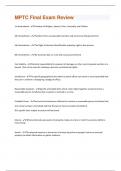
MPTC Final Exam Review questions and (VERIFIED) answers rated A
1st Amendment - Freedom of Religion, Speech, Press, Assembly, and Petition 4th Amendment - Freedom from unreasonable searches and seizures by the government 5th Amendment - The Right to Remain Silent/Double Jeopardy, right to due process 8th Amendment - No excessive bail, or cruel and unusual punishment Civil Liability - Potential responsibility for payment of damages or other court-imposed sanction in a lawsuit. (You can be sued for violating a persons constitutional rights). Jurisdiction - The specific geographical area where a police officer can arrest or serve (provided that they are in uniform or displaying a badge of office). Reasonable Suspicion - Specific articulable facts which, when taken together, would convince a reasonable person to believe that a suspect is involved in a crime. Probable Cause - Facts and circumstances sufficient to convince a reasonable person to believe that: A) A crime has been committed and that the person to be arrested committed it. B) A specific item subject to seizure will be found Seizure - When police take possession of property, make an arrest, or restrict a persons ability to move freely. Search - The physical invasion or intrusions of privacy by police on people, homes or personal property to obtain information or gather evidence.Frisk - A warrantless and limited search of a persons outer garments and area of control by police to discover weapons. Arrest Warrant Requirements - 1. Name of person to be arrested 2. The crime allegedly committed by person named 3. A command that the person named in the warrant be brought before the court 4. Signature of the official issuing the warrant. Arrest without a warrant - A) for a felony in the officer's presence or with probable cause B) A crime committed in the officer's presence that amounts to a breach of the peace. C) Certain misdemeanors committed in the past when arrest is authorized by statute. D) Certain misdemeanors committed in an officer's presence Search incident to arrest - A search of a person and their area of control after arrest looking for fruits, instrumentalities, and evidence of the crime for which they have been arrested. Consent search - When a person waives their 4th amendment rights for officers to search places where the person consenting has a reasonable expectation of privacy. CONSENT MUST BE VOLUTARY AND INFORMED! Plain View Doctrine - Police may seize evidence of a crime without a warrant that is in plain view and no reasonable expectation of privacy exists. Curtilage - The area immediately surrounding a dwelling Exigent Circumstances - Exigent circumstance exist when there is probable cause and: A) Likelihood of danger to police or other without immediate action. B) Likelihood of imminent removal or destruction of evidence C) Risk of flight.Inventories - Administrative, non investigatory searches pursuant to written departmental procedures and justified as a means of protecting property.
Geschreven voor
- Instelling
- MPTC
- Vak
- MPTC
Documentinformatie
- Geüpload op
- 4 januari 2024
- Aantal pagina's
- 3
- Geschreven in
- 2023/2024
- Type
- Tentamen (uitwerkingen)
- Bevat
- Vragen en antwoorden
Onderwerpen

Ook beschikbaar in voordeelbundel