Oncology NCLEX Questions & Answers | Verified Test | LATEST UPDATED
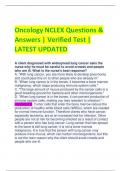
Oncology NCLEX Questions & Answers | Verified Test | LATEST UPDATED A client diagnosed with widespread lung cancer asks the nurse why he must be careful to avoid crowds and people who are ill. What is the nurse's best response? A. "With lung cancer, you are more likely to develop pneumonia and could pass this on to other people who are already ill." B. "When lung cancer is in the bones, it becomes a bone marrow malignancy, which stops producing immune system cells." C. "The large amount of mucus produced by the cancer cells is a good breeding ground for bacteria and other microorganisms." D. "When lung cancer is in the bones, it can prevent production of immune system cells, making you less resistant to infection." - ANSWER D. Tumor cells that enter the bone marrow reduce the production of healthy white blood cells (WBCs), which are needed for normal immune function. Therefore clients who have cancer, especially leukemia, are at an increased risk for infection. Other people are not at risk for becoming infected as a result of contact with a person who has lung cancer. Lung cancer that has spread to the bone is still lung cancer; it is not a bone marrow malignancy. It is true that the person with lung cancer may produce more mucus, which can harbor microorganisms, but this is not the main reason why the client should avoid crowds and people who are ill. Which precaution is most important for the nurse to teach a client receiving radiation therapy for head and neck cancer? A. Avoid eating red meat during treatment. B. Pace your leisure activities to prevent fatigue. C. See your dentist twice yearly for the rest of your life. D. Avoid using headphones or headsets until your hair grows back. - ANSWER C. Radiation therapy that is directed in or around the oral cavity has a variety of actions that increase the risk for dental caries (cavities) and tooth decay. The salivary glands are affected, which changes the composition of the person's saliva and often causes "dry mouth." This result allows rapid bacterial overgrowth, which leads to cavity formation. In addition, the radiation damages the integrity of the enamel and also damages some of the living cells in the tooth. All contribute to an increased risk for dental infections and cavities. A client receiving high-dose chemotherapy who has bone marrow suppression has been receiving daily injections of epoetin alfa (Procrit). Which assessment finding indicates to the nurse that today's dose should be held and the health care provider notified? A. Hematocrit of 28% B. Total white blood cell count of 6200 cells/mm3 C. Blood pressure change from 130/90 mm Hg to 148/98 mm Hg D. Temperature change from 99° F (37.2 C) to 100 F (37.8 C) - ANSWER C. Epoetin alfa and other erythropoiesis-stimulating agents (ESAs) such as darbepoetin alfa (Aranesp) and epoetin alfa (Epogen, Procrit) increase the production of many blood cell types, not just erythrocytes, which increases the client's risk for hypertension, blood clots, strokes, and heart attacks, especially among older adults. Dosing is based on individual client hemoglobin and hematocrit levels to ensure that just enough red blood cells are produced to avoid the need for transfusion but not to bring hemoglobin or hematocrit levels up to normal. The increased blood pressure is an indication to stop this therapy immediately. Which action is most important for the nurse to implement to prevent nausea and vomiting in a client who is prescribed to receive the first round of IV chemotherapy? A. Keep the client NPO during the time chemotherapy is infusing. B. Administer antiemetic drugs before administering chemotherapy. C. Ensure that the chemotherapy is infused over a 4- to 6-hour period. D. Assess the client for manifestations of dehydration hourly during the infusion period. - ANSWER B. When emetogenic chemotherapy drug
Written for
- Institution
- Oncology NCLEX Q
- Course
- Oncology NCLEX Q
Document information
- Uploaded on
- January 4, 2024
- Number of pages
- 36
- Written in
- 2023/2024
- Type
- Exam (elaborations)
- Contains
- Questions & answers
Subjects
-
oncology nclex questions answers verified
-
oncology nclex questions answers verified tes
Also available in package deal