Examination example (red = for 6 stp course only)
1. You have brain tissue available. You would like to perform a gel-based proteome
analyses on this material (identification of the proteins in the brain tissue). How would
you do the sample preparation? Give a flowchart of the different steps you will
perform and motivate. Do not forget to write down the buffers you will use and why.
2. Attached are some chromatograms of an amino acid sequencing experiment. Read the
sequence of this maleylated tryptic peptide.
3. Explain a QTOF instrument:
a. What is the main advantage and disadvantage compared to a triple quadrupole
instrument?
b. How is the TOF mass analyzer adapted for a continuous stream of ions?
c. How can we make the TOF analyzer more accurate?
d. Which type(s) of MS/MS mode(s) can be performed with this instrument?
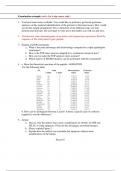
4. a. Draw the theoretical spectrum of the peptide AGHL/INYR
Use the following table:
b. How can we distinguish between L and I? Is there a specific type of collision
required to see this difference?
5. Article:
a. Discuss why the authors have used a combination of 2D-GE, LC/MS and
SILAC to study apoptosis. Point out the advantages and disadvantages.
b. Please explain Figure 2.
c. Explain how the authors can conclude that apoptosis induces basic
modifications of the lamins.
Success!!
, Answer key
1. 20 points.
Show general flowchart
The student must discuss the following aspects :
- Homogenisation of tissue: motivation for proposed method
- Used buffer for homogenisation and cell lysis: correctness and motivation
- Explanation for the different components of the buffer to improve solubility of the
proteins. the student must also keep in mind compatibility with the techniques that
will follow (2D GE).
- Gel-based analysis: 2D GE: explanation technique and motivation
- Identification of proteins: chosen technique for protein staining. (eg. silver staining
of or fluorescence): explanation and motivation
2. 20 points.
The sequence of the given peptide must be correct
3. 20 points
a. At least the following advantage: faster because of TOF hence better for high-
throughput. Accuracy is also better with QTOF. At least the following
disadvantage: MRM not possible. QTOF is also less suitable for PTM research
(e.g. by neutral loss)(5 points)
b. Discuss orthogonal installation of TOF (5 points)
c. Discuss post-source decay and heterogeneous dispersion of kinetic energy with
MALDI, delayed extraction, reflectron (5 points)
d. At least: precursor ion scanning. In principle also product ion scanning (TOF
tube doesn’t scan but identifies all ions). Not: neutral loss, MRM(5 points)
4. 20 points
Correct y OR b-series: 10/20. Correct y AND b-series: 20/20
5. 20 points
a. (6.6 points)
Use of 2D GE: resolution (and explanation), visual, PTMs visible
Use of SILAC: quantitative differential analysis, starting from cell cultures (+
explanation). Samples are pooled early thereby minimizing technical
variations.
1. You have brain tissue available. You would like to perform a gel-based proteome
analyses on this material (identification of the proteins in the brain tissue). How would
you do the sample preparation? Give a flowchart of the different steps you will
perform and motivate. Do not forget to write down the buffers you will use and why.
2. Attached are some chromatograms of an amino acid sequencing experiment. Read the
sequence of this maleylated tryptic peptide.
3. Explain a QTOF instrument:
a. What is the main advantage and disadvantage compared to a triple quadrupole
instrument?
b. How is the TOF mass analyzer adapted for a continuous stream of ions?
c. How can we make the TOF analyzer more accurate?
d. Which type(s) of MS/MS mode(s) can be performed with this instrument?
4. a. Draw the theoretical spectrum of the peptide AGHL/INYR
Use the following table:
b. How can we distinguish between L and I? Is there a specific type of collision
required to see this difference?
5. Article:
a. Discuss why the authors have used a combination of 2D-GE, LC/MS and
SILAC to study apoptosis. Point out the advantages and disadvantages.
b. Please explain Figure 2.
c. Explain how the authors can conclude that apoptosis induces basic
modifications of the lamins.
Success!!
, Answer key
1. 20 points.
Show general flowchart
The student must discuss the following aspects :
- Homogenisation of tissue: motivation for proposed method
- Used buffer for homogenisation and cell lysis: correctness and motivation
- Explanation for the different components of the buffer to improve solubility of the
proteins. the student must also keep in mind compatibility with the techniques that
will follow (2D GE).
- Gel-based analysis: 2D GE: explanation technique and motivation
- Identification of proteins: chosen technique for protein staining. (eg. silver staining
of or fluorescence): explanation and motivation
2. 20 points.
The sequence of the given peptide must be correct
3. 20 points
a. At least the following advantage: faster because of TOF hence better for high-
throughput. Accuracy is also better with QTOF. At least the following
disadvantage: MRM not possible. QTOF is also less suitable for PTM research
(e.g. by neutral loss)(5 points)
b. Discuss orthogonal installation of TOF (5 points)
c. Discuss post-source decay and heterogeneous dispersion of kinetic energy with
MALDI, delayed extraction, reflectron (5 points)
d. At least: precursor ion scanning. In principle also product ion scanning (TOF
tube doesn’t scan but identifies all ions). Not: neutral loss, MRM(5 points)
4. 20 points
Correct y OR b-series: 10/20. Correct y AND b-series: 20/20
5. 20 points
a. (6.6 points)
Use of 2D GE: resolution (and explanation), visual, PTMs visible
Use of SILAC: quantitative differential analysis, starting from cell cultures (+
explanation). Samples are pooled early thereby minimizing technical
variations.