
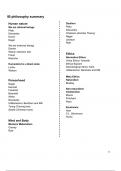
IB philosophy summary
Human nature Dualism
We are rational beings Plato
Plato Descartes
Descartes Chalmers (Zombie Theory)
Hume Nagel
Nagel Jackson
Ryle
We are irrational beings
Darwin
Wason selection test
Freud
Ethics
Nietzche Normative Ethics
Virtue Ethics: Aristotle
Humankind is a blank slate Ethical Egoism
Locke Deontological ethics: Kant
Watson Utilitarianism: Bentham and Mill
Meta Ethics
Personhood Naturalism
Nagel Bradley
Dennett
Non-naturalism
Frankfurt
Intuitionism
Beckwith
Moore
White
Pritchard
Descartes
Ross
Utilitarianism: Bentham and Mill
Turing (Turning test) Emotivism
Searle (Chinese room) Ayer
C.L. Stevenson
Hume
Mind and Body
Monism/ Materialism
Carnap
Ryle
0
,Political philosophy
What is the justification of political authority?
Marx
Anarchism
Wolff (anarchism)
Locke
Mill
Freedom
Mill
Hayek
Berlin
Rousseau
Rights
Locke
Hobbes
Dworkin
Norick
H.L.A. Hart
Social contract
Hobbes
Locke
Rousseau
Hume
Rawls
Communitarianism: Aristotle and Hegel
Plato
Anarchism
1
,Human nature
We are rational beings
Plato
Plato asserts that main is a rational being that is driven by his ability to reason and be rational.
According to him, all human beings have a soul that is composed of three parts (tripartite soul): the
reason part , the spirited part, and the appetitive part.
- The ‘reason’ part belongs to humans only and it controls all the other parts of the soul
- The ‘reason’ part has access to the truth because it enables us to think rationally
- Men have access to the forms, and therefore they have access to the unchanging
truth. Therefore men are able to use rationality to grasp the absolute and see the world
objectively (and not just subjectively) -> Cave allegory
Chariot allegory
Plato draws an allegory between the human soul and a chariot. The chariot is led by two horses, a
black horse and a white horse. The black horse represents the appetitive part of the soul, and the
white part is the spirited part of the soul. The two horses fly in different directions and are controlled
by the charioteer, who holds the reins and makes sure that there is balance within the soul between
emotion and desire so that the human being can achieve happiness and wellbeing.
_______________
Poisoned water example
Reason also makes us overcome desires and emotions such as anger.
Plato makes an example: imagine there is poisoned water in a cup, but we are extremely thirsty. Our
desires would lead us to drink the water no matter the consequences, but our reason would tell us
not to drink it because the consequence would be death. This example shows a situation in which
reason and desires are in contrast, and reason is able to control our impulses for our preservation.
_______________
Criticisms
● One might argue that you don’t drink the poisoned water because of your desire to live,
and your desire to not die (rather than your rationality). In this case it appears that our
rational self is acting upon a desire itself and therefore that our rationality is NOT an
objective and autonomous entity, but simply a more powerful and refined set of
impulses. It may simply be a way to get the things that we want most in the most
effective way possible.
● His argument has demonstrated that we are capable of making decisions which
sacrifice short term gain in favor of long term benefits. This is not the same as showing
1
, that rationality is divine or something over and above what other creatures can do. We
can respond that it is just a more complex form of self-interested instinct.
● Darwin: our instincts are for survival. We are not following our rationality when we are
in a dangerous situation, but we are simply following our innate instincts that avoid us
from dying. We are animal beings, and therefore we are built to diverge from danger
naturally.
● The forms are unjustifiable
Forms
Plato believed in the existence of Forms, which are the real representations of reality and objects
that we perceive through the senses. They are found in the supersensible/ metaphysical realm. Only
philosophers have access to the forms because they possess the virtue of wisdom. We gain
knowledge from the forms via dialectic.
Criticisms
● The forms are unclear: what exactly are they?
● Plato uses allegories to explain the forms, and this shows that perhaps he also doesn't
understand what the forms are precisely because he can’t explain them directly.
● How can we tell between normal people and philosopher kings?
● (Aristotle) you cannot separate particulars (objects) from specifics (forms), because the
real world only consists of particulars (objects perceived by the senses)
Descartes
● Reason is the only source of knowledge
● All our ideas are innate and they have been given to us by God
● We discover basic truths by intuitions, making connections between the things that we
know.
Foundationalism
Descartes understood that he couldn’t trust anyone or anything around him, and thus he started
looking for something that he could always rely on: ‘foundations’. Foundations are pieces of
knowledge that you can always rely on (cartesian certainty).
In order to find the foundations, Descartes eliminates three sources of uncertain knowledge:
1. The senses: The senses can deceive us, and thus they are not reliable. Everything that
we perceive is subjective, and is not necessarily true. As a result, senses do not
provide certainty.
2
Human nature Dualism
We are rational beings Plato
Plato Descartes
Descartes Chalmers (Zombie Theory)
Hume Nagel
Nagel Jackson
Ryle
We are irrational beings
Darwin
Wason selection test
Freud
Ethics
Nietzche Normative Ethics
Virtue Ethics: Aristotle
Humankind is a blank slate Ethical Egoism
Locke Deontological ethics: Kant
Watson Utilitarianism: Bentham and Mill
Meta Ethics
Personhood Naturalism
Nagel Bradley
Dennett
Non-naturalism
Frankfurt
Intuitionism
Beckwith
Moore
White
Pritchard
Descartes
Ross
Utilitarianism: Bentham and Mill
Turing (Turning test) Emotivism
Searle (Chinese room) Ayer
C.L. Stevenson
Hume
Mind and Body
Monism/ Materialism
Carnap
Ryle
0
,Political philosophy
What is the justification of political authority?
Marx
Anarchism
Wolff (anarchism)
Locke
Mill
Freedom
Mill
Hayek
Berlin
Rousseau
Rights
Locke
Hobbes
Dworkin
Norick
H.L.A. Hart
Social contract
Hobbes
Locke
Rousseau
Hume
Rawls
Communitarianism: Aristotle and Hegel
Plato
Anarchism
1
,Human nature
We are rational beings
Plato
Plato asserts that main is a rational being that is driven by his ability to reason and be rational.
According to him, all human beings have a soul that is composed of three parts (tripartite soul): the
reason part , the spirited part, and the appetitive part.
- The ‘reason’ part belongs to humans only and it controls all the other parts of the soul
- The ‘reason’ part has access to the truth because it enables us to think rationally
- Men have access to the forms, and therefore they have access to the unchanging
truth. Therefore men are able to use rationality to grasp the absolute and see the world
objectively (and not just subjectively) -> Cave allegory
Chariot allegory
Plato draws an allegory between the human soul and a chariot. The chariot is led by two horses, a
black horse and a white horse. The black horse represents the appetitive part of the soul, and the
white part is the spirited part of the soul. The two horses fly in different directions and are controlled
by the charioteer, who holds the reins and makes sure that there is balance within the soul between
emotion and desire so that the human being can achieve happiness and wellbeing.
_______________
Poisoned water example
Reason also makes us overcome desires and emotions such as anger.
Plato makes an example: imagine there is poisoned water in a cup, but we are extremely thirsty. Our
desires would lead us to drink the water no matter the consequences, but our reason would tell us
not to drink it because the consequence would be death. This example shows a situation in which
reason and desires are in contrast, and reason is able to control our impulses for our preservation.
_______________
Criticisms
● One might argue that you don’t drink the poisoned water because of your desire to live,
and your desire to not die (rather than your rationality). In this case it appears that our
rational self is acting upon a desire itself and therefore that our rationality is NOT an
objective and autonomous entity, but simply a more powerful and refined set of
impulses. It may simply be a way to get the things that we want most in the most
effective way possible.
● His argument has demonstrated that we are capable of making decisions which
sacrifice short term gain in favor of long term benefits. This is not the same as showing
1
, that rationality is divine or something over and above what other creatures can do. We
can respond that it is just a more complex form of self-interested instinct.
● Darwin: our instincts are for survival. We are not following our rationality when we are
in a dangerous situation, but we are simply following our innate instincts that avoid us
from dying. We are animal beings, and therefore we are built to diverge from danger
naturally.
● The forms are unjustifiable
Forms
Plato believed in the existence of Forms, which are the real representations of reality and objects
that we perceive through the senses. They are found in the supersensible/ metaphysical realm. Only
philosophers have access to the forms because they possess the virtue of wisdom. We gain
knowledge from the forms via dialectic.
Criticisms
● The forms are unclear: what exactly are they?
● Plato uses allegories to explain the forms, and this shows that perhaps he also doesn't
understand what the forms are precisely because he can’t explain them directly.
● How can we tell between normal people and philosopher kings?
● (Aristotle) you cannot separate particulars (objects) from specifics (forms), because the
real world only consists of particulars (objects perceived by the senses)
Descartes
● Reason is the only source of knowledge
● All our ideas are innate and they have been given to us by God
● We discover basic truths by intuitions, making connections between the things that we
know.
Foundationalism
Descartes understood that he couldn’t trust anyone or anything around him, and thus he started
looking for something that he could always rely on: ‘foundations’. Foundations are pieces of
knowledge that you can always rely on (cartesian certainty).
In order to find the foundations, Descartes eliminates three sources of uncertain knowledge:
1. The senses: The senses can deceive us, and thus they are not reliable. Everything that
we perceive is subjective, and is not necessarily true. As a result, senses do not
provide certainty.
2


