Engels
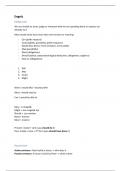
Modal verbs
We use modals to asses, judge or interpret what we are speaking about or express our
attitude to it
Most modal verbs have more than one function or meaning
- Can (polite request)
- Could (ability, possibility, polite requests)
- Would (less direct, more tentative, more polite)
- May (possibility)
- Must (obligations)
- Should (advice, expectation/logical deduction, obligations; ought to)
- Have to (obligations)
1. Will
2. May
3. Could
4. Might
Want: I would like/ I would prefer
Must: I would need to
Can: I would be able to
May = is mogelijk
Might = zou mogelijk zijn
Should = zou moeten
Need = hoeven
Must = moeten
Present: modal + verb ( you should do it)
Past: modal + have + 3rd form (you should have done it)
Passive form
Active sentence: Peter builds a house -> who does it
Passive sentence: A house is built by Peter -> what is done
, - Instructions
- Explaining procedures
- To focus on attention and the action not the person
- In headlines and newspaper reports
Tense Active Passive
Present simple Change Are changed
Present continuous Are changing Are being changed
Past simple Changed Were changed
Past continuous Were changing Were being changed
Present perfect Have changed Have been changed
Past perfect Had changed Had been changed
Future Will change Will be changed
Will have changed Will have been changed
Modal verbs Should change Should be changed
Should have changed Should have been changed
Can change Can be changed
A: Students study personalizes diets
P: Personalizes diets are studied by students
Conjunctions
= voegwoord (linking word)
- Addition of ideas: besides, further, in addition, furthermore, moreover, also, another
reason, in the same way
- Contrasting ideas: however, rather, on the other hand, nevertheless, in contrast,
yet, still, in contrast, on the contrary, in comparison, although, despite, in spite of
- Results or consequences: hence, since, therefore, as a result, accordingly,
consequently, due to, hence
- Sequences: firstly, secondly, last, then, next, finally, in conclusion
(despite, although komen vaak in de toets) -> vertalen!
Reading strategies
- Take a look at the subject of the text
o What do you already know
- Scan the text
Modal verbs
We use modals to asses, judge or interpret what we are speaking about or express our
attitude to it
Most modal verbs have more than one function or meaning
- Can (polite request)
- Could (ability, possibility, polite requests)
- Would (less direct, more tentative, more polite)
- May (possibility)
- Must (obligations)
- Should (advice, expectation/logical deduction, obligations; ought to)
- Have to (obligations)
1. Will
2. May
3. Could
4. Might
Want: I would like/ I would prefer
Must: I would need to
Can: I would be able to
May = is mogelijk
Might = zou mogelijk zijn
Should = zou moeten
Need = hoeven
Must = moeten
Present: modal + verb ( you should do it)
Past: modal + have + 3rd form (you should have done it)
Passive form
Active sentence: Peter builds a house -> who does it
Passive sentence: A house is built by Peter -> what is done
, - Instructions
- Explaining procedures
- To focus on attention and the action not the person
- In headlines and newspaper reports
Tense Active Passive
Present simple Change Are changed
Present continuous Are changing Are being changed
Past simple Changed Were changed
Past continuous Were changing Were being changed
Present perfect Have changed Have been changed
Past perfect Had changed Had been changed
Future Will change Will be changed
Will have changed Will have been changed
Modal verbs Should change Should be changed
Should have changed Should have been changed
Can change Can be changed
A: Students study personalizes diets
P: Personalizes diets are studied by students
Conjunctions
= voegwoord (linking word)
- Addition of ideas: besides, further, in addition, furthermore, moreover, also, another
reason, in the same way
- Contrasting ideas: however, rather, on the other hand, nevertheless, in contrast,
yet, still, in contrast, on the contrary, in comparison, although, despite, in spite of
- Results or consequences: hence, since, therefore, as a result, accordingly,
consequently, due to, hence
- Sequences: firstly, secondly, last, then, next, finally, in conclusion
(despite, although komen vaak in de toets) -> vertalen!
Reading strategies
- Take a look at the subject of the text
o What do you already know
- Scan the text