
BBS1004 Summary
By Grace Marshall and Marius Sauca
PBL Case 1- Neurotransmission
Learning Goals
- How is an action potential generated and propagated
- Neurotransmitter mediated synaptic transmission, lifecycle of a neurotransmitter
- Criteria to define substance as a neurotransmitter
- Classified into different categories- difference between small molecule NT’s and peptides
- Structure and function of ionotropic and metabotropic neurotransmitter receptors
- Vesicular release is Ca2+ dependant, and intracellular Ca2+ can be modulated by different ways
- Synaptic vesicle lifecycle and and mechanism
- What is the difference between resting potential and action potential?
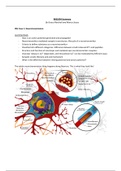
The whole neurotransmission thing happens along Neurons. This is what they look like!
,When the neuron is in its resting phase, there's an electric potential between the outside and the inside
of the membrane. This electric potential has a value of around - 75mV.
This mV value is very similar to the Ek, because the membrane is more permeable to potassium than
sodium. This is due to how several sodium channels are closed or gated, and also that there are wayyy
more non-gated potassium channels than non-gated sodium ones.
The Ek is the equilibrium potential of potassium. An equilibrium potential is defined as the electrical
difference at which there is no net movement of ions for that particular ion.
This is linked to how Na+, Cl- and Ca2+ are all in much higher concentrations outside of the cell, whilst K+
is in higher concentrations inside the cell.
To maintain this, Sodium/ Potassium pumps actively transport 3Na+ ions out and 2K+ ions into the cell. K+
ions diffuse back out of the cell, but the membrane is less permeable to Na+ ions, so fewer Na+ ions
diffuse back in as the voltage gated Na+ channels are closed.
When an action potential occurs:
- The membrane is polarised at -75mV
- Ligand gated Na+ ion channels open so some Na+ ions diffuse into the cell (steep conc. gradient)
- This depolarises the membrane to the threshold potential of -55mV
- This is still only the stimulation response, not a full action potential
- At this potential difference, voltage- gated sodium channels open and there is a large influx of
Na+ ions entering the cell (the All- or- Nothing response)
, - This causes the potential difference across the membrane to reach +40mV (action potential)
- The membrane is now way more permeable to Na than K, so the mV is closer to the ENa
compared to the Ek
- At this pd, the voltage gated Na+ ion channels close, and the voltage gated K+ channels open
- Repolarisation occurs, as K+ diffuses out of the cell
- The membrane becomes hyperpolarised as the potential difference reaches -90mV
- Again, this is due to the new permeability to K+, so the membrane potential reflects that
of the Ek
- The hyperpolarization stage is the “relative” refractory period
- This makes it super duper unlikely for another action potential to happen
immediately afterwards. The movement of the ions in and out of the cell inhibit
it.
- Subtly different from the absolute refractory period, which is the middle
of the depolarisation/repolarisation peak, where nothing you do will
create another action potential (because there’s already one
happening)
- The original potential difference of the cell membrane is restored; resting potential
- This is thanks to the closing of the voltage gated K+ channels. Thanks!
On a physical level, when an action potential arrives, the process is as follows (for a chemical synapse
only. Electrical synapses are different). When a nerve impulse arrives at the presynaptic terminal of one
neuron, neurotransmitter-filled vesicles migrate through the cytoplasm and fuse with the presynaptic
terminal membrane.
, The neurotransmitter molecules are then released through the presynaptic membrane and into the
synaptic cleft.
They travel across the synaptic cleft to the postsynaptic membrane of the target- in this case, the
adjoining neuron, where they then bind to receptors.
Receptor activation results in either the opening or the closing of ion channels in the membrane of the
second cell, which alters the cell’s permeability.
The change in permeability results in depolarization, causing the cell to produce its own action potential,
thereby initiating an electrical impulse. In other cases, the change leads to hyperpolarization, which
prevents/delays the generation of an action potential by the second cell.
How to identify a Neurotransmitter in the wild
There are several criteria that have been established for a neurotransmitter:
- Must be synthesized by and release from neurons. The presynaptic neuron should contain a
transmitter and the appropriate enzymes need to synthesize that neurotransmitter. (synthesis
in the axon terminal is NOT an absolute requirement).
- The substance should be released from nerve terminals in a chemically- or pharmacologically
identifiable form, and in a quantity that can produce a response in the target cell.
- A neurotransmitter should reproduce at the postsynaptic cell the specific events that are seen
after stimulation of the presynaptic neuron.(Everything that happens in the presynaptic neuron
is reproduced in the postsynaptic cell, like long term changes)
- The effects of a known neurotransmitter should be blocked by competitive antagonists of the
receptor for the transmitter in a dose-dependent manner.
- Mechanism for its removal or inactivation of the neurotransmitter from the postsynaptic cleft
must exist
By Grace Marshall and Marius Sauca
PBL Case 1- Neurotransmission
Learning Goals
- How is an action potential generated and propagated
- Neurotransmitter mediated synaptic transmission, lifecycle of a neurotransmitter
- Criteria to define substance as a neurotransmitter
- Classified into different categories- difference between small molecule NT’s and peptides
- Structure and function of ionotropic and metabotropic neurotransmitter receptors
- Vesicular release is Ca2+ dependant, and intracellular Ca2+ can be modulated by different ways
- Synaptic vesicle lifecycle and and mechanism
- What is the difference between resting potential and action potential?
The whole neurotransmission thing happens along Neurons. This is what they look like!
,When the neuron is in its resting phase, there's an electric potential between the outside and the inside
of the membrane. This electric potential has a value of around - 75mV.
This mV value is very similar to the Ek, because the membrane is more permeable to potassium than
sodium. This is due to how several sodium channels are closed or gated, and also that there are wayyy
more non-gated potassium channels than non-gated sodium ones.
The Ek is the equilibrium potential of potassium. An equilibrium potential is defined as the electrical
difference at which there is no net movement of ions for that particular ion.
This is linked to how Na+, Cl- and Ca2+ are all in much higher concentrations outside of the cell, whilst K+
is in higher concentrations inside the cell.
To maintain this, Sodium/ Potassium pumps actively transport 3Na+ ions out and 2K+ ions into the cell. K+
ions diffuse back out of the cell, but the membrane is less permeable to Na+ ions, so fewer Na+ ions
diffuse back in as the voltage gated Na+ channels are closed.
When an action potential occurs:
- The membrane is polarised at -75mV
- Ligand gated Na+ ion channels open so some Na+ ions diffuse into the cell (steep conc. gradient)
- This depolarises the membrane to the threshold potential of -55mV
- This is still only the stimulation response, not a full action potential
- At this potential difference, voltage- gated sodium channels open and there is a large influx of
Na+ ions entering the cell (the All- or- Nothing response)
, - This causes the potential difference across the membrane to reach +40mV (action potential)
- The membrane is now way more permeable to Na than K, so the mV is closer to the ENa
compared to the Ek
- At this pd, the voltage gated Na+ ion channels close, and the voltage gated K+ channels open
- Repolarisation occurs, as K+ diffuses out of the cell
- The membrane becomes hyperpolarised as the potential difference reaches -90mV
- Again, this is due to the new permeability to K+, so the membrane potential reflects that
of the Ek
- The hyperpolarization stage is the “relative” refractory period
- This makes it super duper unlikely for another action potential to happen
immediately afterwards. The movement of the ions in and out of the cell inhibit
it.
- Subtly different from the absolute refractory period, which is the middle
of the depolarisation/repolarisation peak, where nothing you do will
create another action potential (because there’s already one
happening)
- The original potential difference of the cell membrane is restored; resting potential
- This is thanks to the closing of the voltage gated K+ channels. Thanks!
On a physical level, when an action potential arrives, the process is as follows (for a chemical synapse
only. Electrical synapses are different). When a nerve impulse arrives at the presynaptic terminal of one
neuron, neurotransmitter-filled vesicles migrate through the cytoplasm and fuse with the presynaptic
terminal membrane.
, The neurotransmitter molecules are then released through the presynaptic membrane and into the
synaptic cleft.
They travel across the synaptic cleft to the postsynaptic membrane of the target- in this case, the
adjoining neuron, where they then bind to receptors.
Receptor activation results in either the opening or the closing of ion channels in the membrane of the
second cell, which alters the cell’s permeability.
The change in permeability results in depolarization, causing the cell to produce its own action potential,
thereby initiating an electrical impulse. In other cases, the change leads to hyperpolarization, which
prevents/delays the generation of an action potential by the second cell.
How to identify a Neurotransmitter in the wild
There are several criteria that have been established for a neurotransmitter:
- Must be synthesized by and release from neurons. The presynaptic neuron should contain a
transmitter and the appropriate enzymes need to synthesize that neurotransmitter. (synthesis
in the axon terminal is NOT an absolute requirement).
- The substance should be released from nerve terminals in a chemically- or pharmacologically
identifiable form, and in a quantity that can produce a response in the target cell.
- A neurotransmitter should reproduce at the postsynaptic cell the specific events that are seen
after stimulation of the presynaptic neuron.(Everything that happens in the presynaptic neuron
is reproduced in the postsynaptic cell, like long term changes)
- The effects of a known neurotransmitter should be blocked by competitive antagonists of the
receptor for the transmitter in a dose-dependent manner.
- Mechanism for its removal or inactivation of the neurotransmitter from the postsynaptic cleft
must exist



