A Philosophical Investigation into the Existence of a Universal Human Nature
Philosophical Analysis of Non-Philosophical Material
IB Philosophy SL
Word Count: 1992
Links to Syllabus: Core Theme – What is a Human Being?
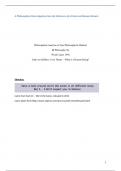
Stimulus:
Lyrics from Sum 41 – We’re the Same, released in 2011
Lyrics taken from http://www.azlyrics.com/lyrics/sum41/werethesame.html
1
, The possibility of a universal nature shared by mankind is an issue arising from the chosen
stimulus, which is the chorus of Sum 41’s song “We’re the Same”. The song’s lyrics assert
that human beings are identical in varying ways, which generates the idea that although
observations of humans can be different they are fundamentally selfsame. The idea of the
universality of certain attributes among humanity is one denied by the philosophical
approach of Existentialism, which makes the claim that “existence precedes and rules
essence” (Sartre, 1943), meaning that humans exist first then proceed to carve their own
essence. Alternatively, Essentialism claims that essence precedes existence, and that
humans have an essence which their existence allows them to carry out.
When considering an existentialist response to my chosen stimulus, twentieth century
philosopher Jean Paul Sartre and his views on human nature can be evaluated. Sartre
established his existentialist views in a time where Christianity was prominent post World
War II and the belief in a supreme God widely shared. His works such as Being and
Nothingness and Existentialism is a Humanism reflect the viewpoint that each and every
human is “thrown into the world” (Sartre, 1943) with no designated purpose or nature but
with a free will, though Sartre presents no proof for this assumption. Sartre’s views emanate
from his method of thought called phenomenology. Phenomenology is the study and
reflection of the phenomena of consciousness from a first person’s point of view, and was
founded by Edmund Husserl. Although criticised for merely providing analogous claims
rather than solid proofs, Sartre utilised phenomenology and discovered that there are two
kinds of reality that are revealed from our conscious experiences. The first of these is
consciousness itself, and the second is consciousness of other objects. Sartre refers to the
first reality as being-for-itself, whilst branding the second reality as being-in-itself.
Sartre distinguishes between being-in-itself and being-for-itself in Being and Nothingness.
The term “being-in-itself” means that the object has a mode of existence that simply exists,
not in any conscious way and not with the need to make any choices or decisions. On the
other hand, being-for-itself entails a conscious life in the phenomenological sense often
referred to as intentionality – a consciousness from being aware of itself as a being-for-itself
2
Philosophical Analysis of Non-Philosophical Material
IB Philosophy SL
Word Count: 1992
Links to Syllabus: Core Theme – What is a Human Being?
Stimulus:
Lyrics from Sum 41 – We’re the Same, released in 2011
Lyrics taken from http://www.azlyrics.com/lyrics/sum41/werethesame.html
1
, The possibility of a universal nature shared by mankind is an issue arising from the chosen
stimulus, which is the chorus of Sum 41’s song “We’re the Same”. The song’s lyrics assert
that human beings are identical in varying ways, which generates the idea that although
observations of humans can be different they are fundamentally selfsame. The idea of the
universality of certain attributes among humanity is one denied by the philosophical
approach of Existentialism, which makes the claim that “existence precedes and rules
essence” (Sartre, 1943), meaning that humans exist first then proceed to carve their own
essence. Alternatively, Essentialism claims that essence precedes existence, and that
humans have an essence which their existence allows them to carry out.
When considering an existentialist response to my chosen stimulus, twentieth century
philosopher Jean Paul Sartre and his views on human nature can be evaluated. Sartre
established his existentialist views in a time where Christianity was prominent post World
War II and the belief in a supreme God widely shared. His works such as Being and
Nothingness and Existentialism is a Humanism reflect the viewpoint that each and every
human is “thrown into the world” (Sartre, 1943) with no designated purpose or nature but
with a free will, though Sartre presents no proof for this assumption. Sartre’s views emanate
from his method of thought called phenomenology. Phenomenology is the study and
reflection of the phenomena of consciousness from a first person’s point of view, and was
founded by Edmund Husserl. Although criticised for merely providing analogous claims
rather than solid proofs, Sartre utilised phenomenology and discovered that there are two
kinds of reality that are revealed from our conscious experiences. The first of these is
consciousness itself, and the second is consciousness of other objects. Sartre refers to the
first reality as being-for-itself, whilst branding the second reality as being-in-itself.
Sartre distinguishes between being-in-itself and being-for-itself in Being and Nothingness.
The term “being-in-itself” means that the object has a mode of existence that simply exists,
not in any conscious way and not with the need to make any choices or decisions. On the
other hand, being-for-itself entails a conscious life in the phenomenological sense often
referred to as intentionality – a consciousness from being aware of itself as a being-for-itself
2