Western Civilization Test #1
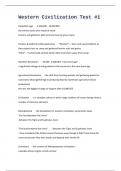
Paleolithic Age - 2,500,000 - 10,000 BCE the earliest tools were made of stone hunters and gatherers (did not know how to grow crops) Hunters & Gatherers (Mesopotamia) - *Women* -> bore and raised children so they stayed close to camp and gathered berries nuts and grains *Men* -> hunted wild animals which often took them away from camp Neolithic Revolution - 10,000 - 4,000 BCE "new stone age" a significant change in living patterns that occurred in the new stone age Agricultural Revolution - the shift from hunting animals and gathering plants for sustenance (food gathering) to producing food by systematic agriculture (food production) this was the biggest change to happen after 10,000 BCE Civilization - is a complex culture in which large numbers of human beings share a number of common elements Mesopotamia - the foundation for western civilization; pessimistic views "the land between the rivers" -between the Tigris and Euphrates rivers "The land between the rivers" - -between the Tigris and Euphrates rivers - they considered the fertile crescent because even though it didn't rain there the rivers would over flow their banks and deposit their fertile silt Sumerians - the creators of Mesopotamian civilizations a people whose origins remain unclear by 3000 BCE they had established a number of independent cities in southern Mesopotamia: Eridu, Ur, Uruk, Umma, & Lagash City-States - by 3,000 BCE Sumerians cities grew larger and exercise political and economic control over the surrounding country side forming city-states -basic units of Sumerian civilization -continuous war between states over land and water Uruk - occupied an area of approximately 1,000 acres encircled by a wall 6 miles long with defense towers located every 30-35 feet along the wall -oldest city in the world -main center for Mesopotamia trade -urbanization -> industrialization Uruk Vase - the markings show us that there was social hierarchy Cuneiform - the oldest Mesopotamian texts date to around 3,000 BCE and were written by the Sumerians, who used cuneiform (wedged-shaped) system of writing Code of Hammurabi - collection of 282 laws reveals a society with a system of strict justice penalties for criminal offenses were severe and varied according to the social class of the victim its important because it is said to be history's first comprehensive set of laws Ziggurats - the temple which was dedicated to the chief god or goddess of the city -they believed the god or goddess owned the city -homes to the priests who supervised the temples, this gave the priests power City vs. Rural in Mesopotamia - -primarily agricultural -later commerce and industry became important as well -farmers made up 90% of the population -traders traveled by land with the invention of the week -could exchange their crops for goods in town markets Epic of Gilgamesh - the physical environment which was: ferocious flood, heavy down pours, scorching winds and humidity resulted in famines that convinced Mesopotamians that the world was being controlled by super natural forces that they identified with the gods -this was shown in the Epic of Gilgamesh Egypt - founded the same time as Mesopotamia; optimistic views -Agriculture and farming sustained Egypt better than the urban city states did in Mesopotamia. -They were a unified kingdom. Hymn to the Nile - a poem that the Egyptian people recognized the Niles significance. -Believed the treatment of the Nile affected the afterlife. "The gift of the Nile" - Egypt depends on the Nile as a life line. They are able to produce goods, agriculture, papyrus. Essential for trade. Geography of Egypt - Civilization centered on the life giving water and flood silt of the Nile Delta, where the Nile River splits. -Most lived in Lower Egypt.
Written for
- Institution
- Western Civilization
- Course
- Western Civilization
Document information
- Uploaded on
- December 29, 2023
- Number of pages
- 7
- Written in
- 2023/2024
- Type
- Exam (elaborations)
- Contains
- Questions & answers

Also available in package deal