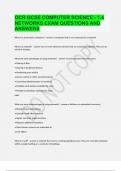
OCR GCSE COMPUTER SCIENCE - 1.4 NETWORKS EXAM QUESTIONS AND ANSWERS.
What is a stand-alone computer? a computer that is not connected to a network What is a network? two or more electronic devices that are connected together. They can be wired or wireless Brainpower Read More Previous Play Next Rewind 10 seconds Move forward 10 seconds Unmute 0:01 / 0:15 Full screen What are some advantages of using networks? • Communication between users • Sharing of files • Sharing of peripheral devices • Monitoring user activity • Access control or other security features • Centralised administration of machines • Multiple work stations available for users • Possible to distribute workload for large tasks What are some disadvantages of using networks? • Reliance on networked resources, • Risk of viruses and hacking, • Specialist staff often required • Higher cost than single machines • Requires additional hardware • Client-Server systems are vulnerable to server failure What is a LAN? a network that covers a small geographical area. They are normally contained within a single building or a small site of buildings. What areas do LANs cover? home, schools and small-businesses Who are LAN's owned by? The structure is normally owned by the individual or the organisation What is a WAN? A WAN is a network that covers a large geographical area. It is often a collection of connected LANs. What is the largest WAN? internet What areas do WANs cover? could cover a city, a country, several branches of an organisation, possible even several countries Who are WAN's owned by? Parts of the structure will often be owned by other people, often quite a number What are the differences and similarities between a LAN and a WAN? A LAN covers a small geographical area whereas a WAN covers a wide geographical area. All of the telecommunications hardware used in a LAN is owned by the organisation whereas a telecommunications company provides infrastructure for a WAN. what is transmission media? a communication channel that carries the information from the sender to the receive There are several different types of cables that can be used; these include: Coaxial cable, Twisted pair cable, Fibre-optic cable What is a coaxial cable? a type of cable that has a central copper wire that is surrounded by an insulating layer. Many coaxial cables then have a final outer layer that acts like a jacket. What are twisted pair cables? a type of cable that has two separately insulated copper wires that are twisted around each other inside an outer layer. This is the most common type of cable that is used in a network what are fibre-optic cables? a type of cable that has lots of very fine glass threads inside an outer layer. Carries data much faster than other media. Many fast broadband connections use fibre optic cable instead of copper. What are two reasons why fibre optic cable is the preferred choice? • Fibre optic cables transmit data through light so do not suffer from electrical interference. • Data can be transmitted over very large distances without any loss of signal quality. • They are able to transmit data at a higher bandwidth. What is a network interface card (NIC)? a circuit board built into a device that allows it to be connected to a network. what hardware device is needed to connect the transmission media to the computer so that data can be transmitted around the network? NIC (Network Interface Card) What is a network connection device? A network connection device allows computers to connect to a network What are the four types of network connection devices? hubs, switches, wireless access points, routers What is a WAP? a switch that allows devices (that has Wi-Fi capabilities) to connect to the network wirelessly. In many home networks the WAP is built into the router What is a switch? connects devices on a LAN only operates within a single network A smart hub which sends the data to the intended client only What are switches often used for? to join together sections of a LAN network in larger networks what device is used to connect our devices to the internet? routers What is a router? a hardware device that is essential for connecting computer networks together. It is responsible for forwarding packets of data from one network to another How does a router work? It will scan a packet of data that enters the device to see whether its destination is the network that it is currently travelling in or another network. It will then forward the packet on to its destination What is the purpose of a router? To transmit data between at least two different networks What is 'The Cloud'? the remote storage of data and software that we can access that exits on the internet, rather than on local secondary storage list the uses of the cloud server hosting, applications, file storage and sharing, streaming services
Written for
- Institution
- OCR GCSE COMPUTER SCIENCE
- Course
- OCR GCSE COMPUTER SCIENCE
Document information
- Uploaded on
- December 28, 2023
- Number of pages
- 6
- Written in
- 2023/2024
- Type
- Exam (elaborations)
- Contains
- Unknown
Subjects
-
ocr gcse computer science 14 networks

Also available in package deal