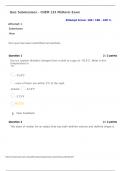
CHEM133 Week 7 Midterm Exam (Spring) Questions and Answers APU
1. Question: Dry ice (carbon dioxide) changes from a solid to a gas at –78.5°C. What is this temperature in °F? 2. Question: The state of matter for an object that has both definite volume and definite shape is 3. Question: In 1828, the diameter of the U.S. dime was changed to approximately 18 mm. What is this diameter when expressed in nanometers? 4. Question: A piece of antimony with a mass of 17.41 g is submerged in 46.3 cm3 of water in a graduated cylinder. The water level increases to 48.9 cm3. The correct value for the density of antimony from these data is: 5. Question: Using the rules of significant figures, calculate the following: 6. Question: Li2S is named 7. Question: Which element can form more than one kind of monatomic cation? 8. Question: A sample of pure calcium fluoride with a mass of 15.0 g contains 7.70 g of calcium. How much calcium is contained in 45.0 g of calcium fluoride? 9. Question: Elements A and Q form two compounds, AQ and A2Q3. The mass ratio (mass Q)/(mass A) for AQ is 0.574. What is the mass ratio (mass Q)/(mass A) for A2Q3? 10. Question: What is the chemical formula for strontium hydroxide? 11. Question: You have a sample of zinc (Zn) and a sample of aluminum (Al). You have an equal number of atoms in each sample. Which of the following statements concerning the masses of the samples is true? 12. Question: How many moles of hydrogen chloride are contained in a 52.6 g sample of this gas? 13. Question: A 17.0 g sample of HF is dissolved in water to give 2.0 x 10² mL of solution. The concentration of the solution is: 14. Question: How many C atoms are in 5.50 g of C? 15. Question: Calculate the atomic mass of element "X", if it has 2 naturally occurring isotopes with the following masses and natural abundances: X-45 44.8776 amu 32.88% X-47 46.9443 amu 67.12% 16. Question: What is the stoichiometric coefficient for oxygen when the following equation is balanced using the lowest whole-number coefficients 17. Question: Aluminum metal reacts with iron(II) sulfide to form aluminum sulfide and iron metal. What is the stoichiometric coefficient for aluminum when the chemical equation is balanced using the lowest whole-number stoichiometric coefficients? 18. Question: Consider the following reaction: 19. Question: What is the oxidation number change for the iron atom in the following reaction? 20. Question: A 57.17 g sample of Ba(OH)2 is dissolved in enough water to make 1.800 L of solution. How many mL of this solution must be diluted with water in order to make 1.000 L of 0.100 M Ba(OH)2? 21. Question: proton is roughly 1800 times more massive than an electron. If a proton and an electron are traveling at the same speed, 22. Question: A common way of initiating certain chemical reactions with light involves the generation of free halogen atoms in solution. 23. Question: What is the frequency of a helium-neon laser light with a wavelength of 632.8 nm? 24. Question: That is the wavelength of light that is emitted when an excited electron in the hydrogen atom falls from n = 5 to n = 1? 25. Question: The electron configuration for the carbon atom is: 26. Question: Perform the following calculations: 27. Question: The density of mercury, the only metal to exist as liquid at room temperature, is 13.6 g/cm3 . 28. Question: Lithium, is used in dry cells and storage batteries and in high temperature lubricants, it has two naturally occurring isotopes, 6Li and 7Li. Calculate the atomic mass of lithium. 29. Question: Name the following compounds: 30. Question: How many grams of NaCl are contained in of a 0.125 M solution of sodium chloride? 31. Question: What is the molarity of a solution that contains 8.4 g NaOH in 240.0 mL of solution. 32. Question: The reaction that produces iron from ore is shown below: 33. Question: The reaction that produces iron from ore is shown below: 34. Question: For the electronic transition from n = 5 to n = 2 in the hydrogen atom. 35. Question: Consider the electronic transition from n = 7 to n = 4 in the hydrogen atom.
Written for
- Institution
-
American Public University
- Course
-
CHEM133 (CHEM133)
Document information
- Uploaded on
- December 25, 2023
- Number of pages
- 26
- Written in
- 2022/2023
- Type
- Exam (elaborations)
- Contains
- Questions & answers
Subjects
-
chem133 week 7 midterm exam spring
-
chem133 week 7 midterm exam spring solution
-
chem133 week 7 midterm exam spring solved
-
chem133 week 7 midterm exam spring answers
-
chem133 week 7 midterm exam spring a

Also available in package deal