

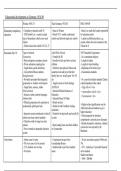
Educational developments in Germany 1918-89
Weimar 1918-33 Nazi Germany 1933-45 FRG 1949-89
Elementary/compulsory - Compulsory education until 14 - Same as Weimar - Basic Law made the Lander responsible
education - 1920 School Law - created a single - March 1933 - ended confessional for education policy
type of elementary school across each schools and allowed single-sex schools - Lander ran different policies, e.g.
Lander secular schools far more common in the
- Federal school laws failed 1921,25, 27 N than the S
Education after 10 Types of schools: Adolf Hitler Schools 1955 Dusseldorf Agreement:
Gymnasium - Founded by HJ - No. examination subjects
- Most prestigious secondary schools - Enrolled w/class and lower m/class - Length of studies
- Private education requiring fees children - Length of school holidays
- Taught latine, greek and history - Needed to pass physical fitness and - Beginning of the school year
- Unis preferred theses students academic tests and prove that their - Examination standards
Realgymnasium family line was ‘racially pure’ for 130
- Provided curriculum that integrated yrs - No. years that students attended 2ndary
gymnasium w/ modern world aspects - Taught courses in Nazi ideology school depended on the school
- Taught latin, sciences, maths NAPOLAS → high school = 4yrs
Oberrealschule - National Political Institutes of → intermediate school = 6yrs
- Sciences, maths, modern languages Education → Gymnasium = 8yrs
Aufbanschule - Educated future SS l/ship
- Offered gymnasium style education to - Mainly m/class
- Highest school qualification was the
academically gifted poor kids - Similar to trad’tl military training
Abitur that allowed students to get a
academies
higher education
- Inspection system introduced so that all - Needed to be physically and racially fit
- Failed proposals to introduce
schools met state school standards to enter
comprehensive schools across Germany
- Churches could no longer run state
- Brandt attempted to introduce a federal
schools - Most leading Nazis sent their children
systems but was rejected by the
- Never created an integrated education to Gymansiums
Bundesrat
system
Universities - Abitur exam for entry - Corporations became Nazi - 24 new universities opened 1960s and
- 45% were sons of civil servants Comradeship Houses 70s
- 2.3% students were w/class - Students had to join Nazi students’ - 1971 - federal gov’t provided financial
- No reform union aid to students
Student enrolment:
- 1960 = 200,000
Weimar 1918-33 Nazi Germany 1933-45 FRG 1949-89
Elementary/compulsory - Compulsory education until 14 - Same as Weimar - Basic Law made the Lander responsible
education - 1920 School Law - created a single - March 1933 - ended confessional for education policy
type of elementary school across each schools and allowed single-sex schools - Lander ran different policies, e.g.
Lander secular schools far more common in the
- Federal school laws failed 1921,25, 27 N than the S
Education after 10 Types of schools: Adolf Hitler Schools 1955 Dusseldorf Agreement:
Gymnasium - Founded by HJ - No. examination subjects
- Most prestigious secondary schools - Enrolled w/class and lower m/class - Length of studies
- Private education requiring fees children - Length of school holidays
- Taught latine, greek and history - Needed to pass physical fitness and - Beginning of the school year
- Unis preferred theses students academic tests and prove that their - Examination standards
Realgymnasium family line was ‘racially pure’ for 130
- Provided curriculum that integrated yrs - No. years that students attended 2ndary
gymnasium w/ modern world aspects - Taught courses in Nazi ideology school depended on the school
- Taught latin, sciences, maths NAPOLAS → high school = 4yrs
Oberrealschule - National Political Institutes of → intermediate school = 6yrs
- Sciences, maths, modern languages Education → Gymnasium = 8yrs
Aufbanschule - Educated future SS l/ship
- Offered gymnasium style education to - Mainly m/class
- Highest school qualification was the
academically gifted poor kids - Similar to trad’tl military training
Abitur that allowed students to get a
academies
higher education
- Inspection system introduced so that all - Needed to be physically and racially fit
- Failed proposals to introduce
schools met state school standards to enter
comprehensive schools across Germany
- Churches could no longer run state
- Brandt attempted to introduce a federal
schools - Most leading Nazis sent their children
systems but was rejected by the
- Never created an integrated education to Gymansiums
Bundesrat
system
Universities - Abitur exam for entry - Corporations became Nazi - 24 new universities opened 1960s and
- 45% were sons of civil servants Comradeship Houses 70s
- 2.3% students were w/class - Students had to join Nazi students’ - 1971 - federal gov’t provided financial
- No reform union aid to students
Student enrolment:
- 1960 = 200,000


