Pesticide Applicator's License - Forest Pest Control (Category 4a)Questions With accurate Solutions.
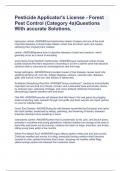
Hypoxylon canker -ANSWERmost destructive canker of aspen and one of the most important diseases in Great Lakes States; enters tree at branch stubs and causes yellowing then irregular bark collapse canker -ANSWERgeneral term to describe diseases of bark and cambium, which generally occur as a result of wounding wood decay fungi (Northern hardwoods) -ANSWERcause hardwood lumber to lose quality because the tree's response to wounding is to form a barrier zone that discolors cambium then is colonized by microorganisms and this fungi fungal pathogens -ANSWERmost prevalent cause of tree disease; causes seed rots, seedling damping off, root rots, foliage diseases, cankers, vascular wilts, diebacks, galls, and tumors, trunk rots, and decays of aging trees Armillaria (Shoestring) Root Rot -ANSWER"honey mushroom"; causes an economically important root and butt rot of forest, orchard, and ornamental trees and shrubs, shown by reduced vigor, yellowing of foliage, and crown dieback; flattened rhizomorphs (shoestrings) appear between bark and wood Oak Wilt -ANSWERvascular wilt disease that kills trees in the oak genus by plugging water-conducting cells; spreads through root grafts and fresh wounds via insect vectors; no cure for infected trees Dutch Elm Disease -ANSWERvascular wilt disease transmitted by European and native elm bark beetles; evidenced by wilting, yellowing, and browning of leaves; diseased branches develop brown streaking in wood scleroderris canker -ANSWERcanker that is problematic to red, jack, and Scotch pines, primarily in nurseries and young plantations; infected needles turn orange at the base in early May and brown out by summer; cankers form later on twigs, branches, and trunks, killing young trees within a few months White Pine Blister Rust -ANSWERFungus affects eastern white pine and wild current; Colonizes needles and moves in to twig, eventually forming cankers which become covered in resin; girdled branches form brown, drooping red needles called flags; yellow-orange spores are released from cankered areas Lophodermium needle cast -ANSWERChristmas tree plantation disease that especially affects Scotch pine and appears as brown spots with yellow margins then black, football-shaped fruiting bodies on infected needles Sphaeropsis Blight -ANSWERChristmas tree plantation disease that especially affects Scotch pine and Austrian pine, killing current-year shoots, evidenced by small, black fruiting bodies that erupt from dead needles and shoot tissue (sunken cankers may also form){ Phytophthora root rot -ANSWERChristmas tree plantation disease that especially affects Frasier fir; associated with wet soils and poor drainage; infection causes decay of roots, leading to growth cessation and then chlorosis, drooping, and browning of branches Swiss Needlecast -ANSWERChristmas tree plantation disease that especially affects Douglas fir; needles turn yellow green mottled with brown or entirely brown; later black fuzzy fruiting bodies are visible in rows of stomata on needle undersides Rhabdocline needlecast -ANSWERChristmas tree plantation disease that especially affects Douglas fir, causing browning and early needle loss; evidenced by yellow spots on needles in fall that turn yellowish brown to reddish brown in spring Rhizosphaera needlecast -ANSWERChristmas tree plantation disease that especially affects white and blue spruce; causes needles to turn purplish brown and fall prematurely; fruiting bodies are black and fuzzy and protrude along stomata Forest Tent Caterpillar -ANSWERpest of maple-beech and aspen-birch forests; important defoliators of aspen, maple, birch, oak, ash, and willow; trees rarely killed but growth loss can be significant Gypsy Moth -ANSWERpest of aspen-birch and oak-hickory forests; defoliators of many hardwoods including oak, birch, aspen, but also some conifers; seldom kill hardwoods but can kill conifers if completely stripped; can be treated with microbial pesticides during 1st-3rd instars two-lined chestnut borer -ANSWERpest of oak-hickory forests that infects low vigor oak trees stressed by drought or other factors causing branch dieback and possibly tree death within 2-4 years (because tunneling of larvae in sapwood girdles and kills branches); healthy trees rarely affected European elm bark beetle -ANSWERpest of elm-ash-soft maple forests; primarily responsible for spread of Dutch elm disease; egg-laying gallery oriented parallel to wood grain, with larvae tunnels radiating away from gallery
Written for
- Institution
- Pesticide Applicator\'s License
- Course
- Pesticide Applicator\'s License
Document information
- Uploaded on
- December 23, 2023
- Number of pages
- 3
- Written in
- 2023/2024
- Type
- Exam (elaborations)
- Contains
- Questions & answers
Subjects
-
pesticide applicators license forest pest contr
-
pesticide applicators license stuvia

Also available in package deal