ATI: Gerontology Study guide 2023/2024
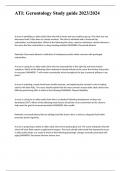
A nurse is admitting an older adult client who fell at home and was unable to get up. The client was not discovered until 3 days later by a family member. The client is admitted with a fractured hip, malnutrition, and dehydration. Which of the following lab values, noted on admission, should indicate to the nurse that the malnutrition is a long standing problem?ANSWERS- Decreased albumin Rationale: Decreased albumin is indicative of inadequate protein intake common with prolonged malnutrition A nurse is caring for an older adult client who has osteoarthritis of the right hip and lower lumbar vertebrae. Which of the following client statements should indicate to the nurse that further instruction is necessary?ANSWERS- "I will remain consistently active throughout the day to prevent stiffness in my joints." A nurse is orienting a newly hired home health assistant, and explaining the assistant's role in helping client's with their ADLs. The nurse should explain that the most common reason older adult clients have difficulty performing ADLs is which of the following?ANSWERS- Physical disability A nurse is caring for an older adult client who is on bedrest following development of deep vein thrombosis (DVT). Which of the following food choices should the nurse recommend to the client to help meet the goal of increased peristalsis?ANSWERS- Bran muffin Rationale: Increased dietary fiber by adding foods like bran to diet, as well ass adequate fluid intake promotes bowel regularity. A nurse is preparing to admit an older adult client to the postsurgical unit. The nurse anticipates that the client will most likely require supplemental oxygen. The nurse should understand that hypoxemia occurs in older adult clients as a result of which of the following physiologic changes normally associated with aging?ANSWERS- Decreased alveolar surface area Rationale: Aging change is an increase in the size of the alveolar ducts and respiratory bronchioles, leading to decreased alveolar surface area = less gas exchange = increased hypoxemia risk A nurse is obtaining a health history from a client admitted following a cerebrovascular accident (CVA). The nurse notes that the client has a history of GERD. The nurse should understand that this past medical history puts the client at increased risk of which of the following?ANSWERS- Aspiration pneumonia A nurse in a post-surgical unit is admitting an older adult client from the recovery department following abdominal surgery for a bowel obstruction. Of which of the following information regarding pain management should the nurse be aware? Older adult clientsANSWERS- are sensitive to the analgesic effect of opiates. A nurse is writing a plan of care for a client who had a cerebrovascular accident (CVA). Which of the following should the nurse identify as a priority goal for a client following a CVA?ANSWERS- Airway will remain clear as evidenced by clear breath sounds. Rationale: CVA = high risk for airway obstruction and aspiration r/t loss of muscle control. Client should be in side-lying position A nurse is administering an antihistamine to an older adult client. Which of the following is an appropriate nursing statement?ANSWERS- "Antihistamines should be used cautiously in clients who have glaucoma." Rationale: Most antihistamines have an anticholinergic effect. Glaucoma incidence is increased in older adult clients. A nurse is part of a committee that is developing age-appropriate care standards. Which of the following should the nurse know is the focus for older adult clients, based on Erikson's developmental tasks?ANSWERS- Integrity Rationale: Integrity vs despair is the stage for older adults in which they reflect on their lives and roles. A nurse is caring for a client who has Alzheimer's disease. The client has been oriented to name and place and is able to perform ADLs with minimal supervision. When the client refuses to take morning anti hypertensive medications, the nurse's first action should be to do which of the following?ANSWERS- Ask the client to express her reasons for refusing the morning medications and document the event. Rationale: Before intervening or making a judgement about client's competence, the nurse should complete an assessment of the client. Perhaps the clients reason for refusal is as simple as having a sore throat of being afraid to swallow. A nurse working in a medical unit is caring for a male client who has dementia. The nurse notes that the client becomes agitated and confused in his room at night. The client, who has an unsteady gait, removes all of his clothes and wanders about naked in his room and the hallway. Which of the following actions should the nurse take first?ANSWERS- Move the client to a room closer to the nurse's station. A nurse is assessing an older adult client who states, "I haven't seen a doctor in years. I walk 5 miles a day and I'm as healthy as a horse." Which of the following findings, obtained while taking the client's history and performing a physical examination, should the nurse explain to the client requires further evaluation?ANSWERS- The client's fingerstick blood glucose is 160 mg/dL. Rational: 160mg/dl is elevated and may be early signs of DM A nurse at an assisted living center is conducting an orientation session for newly hired assistive personnel (AP). Because several of the older adult residents are hearing impaired, the nurse includes instruction for promoting communication. Which of the following instructions should the nurse include?ANSWERS- Maintain eye contact with the clients and speak slowly. Rationale: Many older adults with hearing impairment use lip-reading and gestures to help understand. A nurse is caring for an overweight, older adult resident who has gout. The client has been refusing to eat stating, "I can't stand the food." The client's primary care provider has approved the family to bring food from home if they maintain a purine restricted diet. Which of the following foods, if brought by the client's family, should the nurse realize is unsafe for the client to eat?ANSWERS- Lentil soup Rationale: Purinre-restricted diet is designed to decrease elevated blood and urinary uric acid levels. Lentils are beans which are a rich source of purines. A nurse is caring for an older adult client. Which of the following should the nurse recognize as a physiologic change normally associated with aging that could affect drug dosage in this client?ANSWERS- Decreased gastric motility Rationale: Decreased gastric motility = meds stay in GI tract for longer periods of time, leading to slow absorption of the drug. Allow longer time for medication onset ad peak by extending the length of time between doses. A nurse at a community outreach clinic should recognize which of the following as an example of co morbidity in an older adult client who is homeless?ANSWERS- Dementia and tuberculosis Rationale: co morbidity refers to medical condition known to co-exist. A nurse at a community center is speaking to a group of healthy older adult clients about health promotion. Which of the following examinations should the nurse recommend that all clients over 50 years of age have performed annually?ANSWERS- Glaucoma examination Rationale: Annual exam for glaucoma is recommended A nurse at an ophthalmology clinic is caring for a client. The nurse is interviewing a client who was referred by her primary care provider for suspicion of cataract. Which of the following client reports should the nurse recognize is consistent with the primary care provider's suspicion?ANSWERS- Halos and rainbows when looking at lights Rationale: A cataract is a cloudy or opaque area in the lens of the eye. A nurse at a geriatric clinic is assessing a client who is at the clinic for the second time this week reporting a decreased energy level, ins
Written for
- Institution
- Aatii
- Course
- Aatii
Document information
- Uploaded on
- December 22, 2023
- Number of pages
- 7
- Written in
- 2023/2024
- Type
- Exam (elaborations)
- Contains
- Questions & answers
Subjects
-
ati gerontology study guide

Also available in package deal