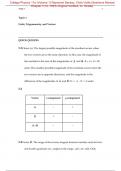
Topic 1 © 2018 Cengage Learning. All Rights Reserved. May not be scanned, copied or duplicated, or posted to a publicly accessible website, in whole or in part. 1 Topic 1 Units, Trigonometry, and Vectors QUICK QUIZZES 1.1 Choice (c). The largest possible magnitude of the resultant occurs when the two vectors are in the same direction. In this case, the magnitude of the resultant is the sum of the magnitudes of !
A and !
B: R = A + B = 20 units. The smallest possible magnitude of the resultant occurs when the two vectors are in opposite directions, and the magnitude is the difference of the magnitudes of !
A and !
B: R = | A − B | = 4 units. 1.2 Vector x-component y-component !
A − + !
B + − !
A+
B − − 1.3 Vector !
B. The range of the inverse tangent function includes only the first and fourth quadrants (i.e., angles in the range −π/2 < θ < π/2). Only College Physics 11e (Volume 1) Raymond Ser way, Chris Vuille (Solutions Manual Chapter 1-14, 100% Original Verified, A+ Grade) Topic 1 © 2018 Cengage Learning. All Rights Reserved. May not be scanned, copied or duplicated, or posted to a publicly accessible website, in whole or in part. 2 vector !
B has an orientation in this range. ANSWERS TO EVEN NUMBERED CONCEPTUAL QUESTIONS 1.2 Atomic clocks are based on the electromagnetic waves that atoms emit. Also, pulsars are highly regular astronomical clocks. 1.4 (a) ~0.5 lb ≈ 0.25 kg or ~10−1 kg (b) ∼4 lb ≈ 0.25 kg or ~100 kg (c) ~4 000 lb ≈ 2 000 kg or ~103 kg 1.6 Let us assume the atoms are solid spheres of diameter 10−10 m. Then, the volume of each atom is of the order of 10−30 m3. (More precisely, volume = 4πr3/3.) Therefore, since 1 cm3 = 10−6 m3, the number of atoms in the 1 cm3 solid is on the order of 10−−30 = 1024 atoms. A more precise calculation would require knowledge of the density of the solid and the mass of each atom. However, our estimate agrees with the more precise calculation to within a factor of 10. 1.8 Choice (d). For an angle θ from 0 ° to 360 °, the sine and cosine functions take the values −1≤sinθ≤1 and −1≤cosθ≤1 1.10 In the metric system, units differ by powers of ten, so it’s very easy Topic 1 © 2018 Cengage Learning. All Rights Reserved. May not be scanned, copied or duplicated, or posted to a publicly accessible website, in whole or in part. 3 and accurate to convert from one unit to another. 1.12 Both answers (d) and (e) could be physically meaningful. Answers (a), (b), and (c) must be meaningless since quantities can be added or subtracted only if they have the same dimensions. 1.14 The correct answer is (a). The second measurement is more precise but, given the number of repor ted significant figures, each measurement is consistent with the other. 1.16 The components of a vector will be equal in magnitude if the vector lies at a 45 ° angle with the two axes along which the components lie. ANSWERS TO EVEN NUMBERED PROBLEMS 1.2 (a) L / T2 (b) L 1.4 All three equations are dimensionally incorrect. 1.6 (a) kg ⋅ m/s (b) Ft = p 1.8 58 1.10 (a) 22.6 (b) 22.7 (c) 22.6 is more reliable 1.12 (a) 3.00 × 10⁸ m/s (b) 2.997 9 × 10⁸ m/s (c) 2.997 925 × 108 m/s 1.14 (a) 346 m2 ± 13 m3 (b) 66.0 m ± 1.3 m Topic 1 © 2018 Cengage Learning. All Rights Reserved. May not be scanned, copied or duplicated, or posted to a publicly accessible website, in whole or in part. 4 1.16 (a) 797 (b) 1.1 (c) 17.66 1.18 132 m2 1.20 3.09 cm /s 1.22 (a) 5.60 × 10² km = 5.60 × 10⁵ m = 5.60 × 107 cm (b) 0.491 2 km = 4.912 × 104 cm (c) 6.192 km = 6.192 × 10³ m = 6.192 × 105 cm (d) 2.499 km = 2.499 × 10³ m = 2.499 × 105 cm 1.24 10.6 km /L 1.26 9.2 nm /s 1.28 2.9 × 10² m3 = 2.9 × 108 cm3 1.30 2.57 × 10⁶ m3 1.32 ~108 steps 1.34 ~108 people with colds on any given day 1.36 (a) 4.2 × 10⁻¹⁸ m3 (b) ~10−1 m3 (c) ~1016 cells 1.38 10−14 kg 1.40 2.2 m 1.42 8.1 cm 1.44 Δs= r12+r22−2r1r2cos(θ1−θ2)
A and !
B: R = A + B = 20 units. The smallest possible magnitude of the resultant occurs when the two vectors are in opposite directions, and the magnitude is the difference of the magnitudes of !
A and !
B: R = | A − B | = 4 units. 1.2 Vector x-component y-component !
A − + !
B + − !
A+
B − − 1.3 Vector !
B. The range of the inverse tangent function includes only the first and fourth quadrants (i.e., angles in the range −π/2 < θ < π/2). Only College Physics 11e (Volume 1) Raymond Ser way, Chris Vuille (Solutions Manual Chapter 1-14, 100% Original Verified, A+ Grade) Topic 1 © 2018 Cengage Learning. All Rights Reserved. May not be scanned, copied or duplicated, or posted to a publicly accessible website, in whole or in part. 2 vector !
B has an orientation in this range. ANSWERS TO EVEN NUMBERED CONCEPTUAL QUESTIONS 1.2 Atomic clocks are based on the electromagnetic waves that atoms emit. Also, pulsars are highly regular astronomical clocks. 1.4 (a) ~0.5 lb ≈ 0.25 kg or ~10−1 kg (b) ∼4 lb ≈ 0.25 kg or ~100 kg (c) ~4 000 lb ≈ 2 000 kg or ~103 kg 1.6 Let us assume the atoms are solid spheres of diameter 10−10 m. Then, the volume of each atom is of the order of 10−30 m3. (More precisely, volume = 4πr3/3.) Therefore, since 1 cm3 = 10−6 m3, the number of atoms in the 1 cm3 solid is on the order of 10−−30 = 1024 atoms. A more precise calculation would require knowledge of the density of the solid and the mass of each atom. However, our estimate agrees with the more precise calculation to within a factor of 10. 1.8 Choice (d). For an angle θ from 0 ° to 360 °, the sine and cosine functions take the values −1≤sinθ≤1 and −1≤cosθ≤1 1.10 In the metric system, units differ by powers of ten, so it’s very easy Topic 1 © 2018 Cengage Learning. All Rights Reserved. May not be scanned, copied or duplicated, or posted to a publicly accessible website, in whole or in part. 3 and accurate to convert from one unit to another. 1.12 Both answers (d) and (e) could be physically meaningful. Answers (a), (b), and (c) must be meaningless since quantities can be added or subtracted only if they have the same dimensions. 1.14 The correct answer is (a). The second measurement is more precise but, given the number of repor ted significant figures, each measurement is consistent with the other. 1.16 The components of a vector will be equal in magnitude if the vector lies at a 45 ° angle with the two axes along which the components lie. ANSWERS TO EVEN NUMBERED PROBLEMS 1.2 (a) L / T2 (b) L 1.4 All three equations are dimensionally incorrect. 1.6 (a) kg ⋅ m/s (b) Ft = p 1.8 58 1.10 (a) 22.6 (b) 22.7 (c) 22.6 is more reliable 1.12 (a) 3.00 × 10⁸ m/s (b) 2.997 9 × 10⁸ m/s (c) 2.997 925 × 108 m/s 1.14 (a) 346 m2 ± 13 m3 (b) 66.0 m ± 1.3 m Topic 1 © 2018 Cengage Learning. All Rights Reserved. May not be scanned, copied or duplicated, or posted to a publicly accessible website, in whole or in part. 4 1.16 (a) 797 (b) 1.1 (c) 17.66 1.18 132 m2 1.20 3.09 cm /s 1.22 (a) 5.60 × 10² km = 5.60 × 10⁵ m = 5.60 × 107 cm (b) 0.491 2 km = 4.912 × 104 cm (c) 6.192 km = 6.192 × 10³ m = 6.192 × 105 cm (d) 2.499 km = 2.499 × 10³ m = 2.499 × 105 cm 1.24 10.6 km /L 1.26 9.2 nm /s 1.28 2.9 × 10² m3 = 2.9 × 108 cm3 1.30 2.57 × 10⁶ m3 1.32 ~108 steps 1.34 ~108 people with colds on any given day 1.36 (a) 4.2 × 10⁻¹⁸ m3 (b) ~10−1 m3 (c) ~1016 cells 1.38 10−14 kg 1.40 2.2 m 1.42 8.1 cm 1.44 Δs= r12+r22−2r1r2cos(θ1−θ2)