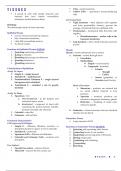
TISSUES §
§
Cilia – propel materials
Goblet Cells – specialized mucus-‐‑producing
§ A group of cells with similar structure and cells
function that have similar extracellular
substances located between them. Cell Connections
§ Tight Junctions -‐‑ bind adjacent cells together
Histology and form permeability barriers; prevent the
The microscopic study of tissue structure passage of materials between epithelial cells
§ Desmosomes – mechanical links that bind cells
Epithelial Tissue together
§ Covers external and internal surfaces; Ø Hemidesmosomes -‐‑ anchor cells to the
§ Has a basement membrane, basement membrane
§ Little EM (extracellular matrix), § Gap Junctions – allow small molecules and ions
§ No blood vessels. to pass
Functions of Epithelial Tissues (PAPSA) Glands
1. Protecting underlying structures. Glands – secrete substances onto a surface
2. Acting as a barrier. a. Exocrine – secrete through ducts
3. Permitting the passage of substances. Ø Unicellular
4. Secreting substances. Ø Multicellular
5. Absorbing substances. v Simple – non branched
v Compound -‐‑ branched
Classification of Epithelium • Tubular
Accdg. To Layers o Straight
1. Simple E. – single layered o Coiled
2. Stratified E. – multi-‐‑layered • Acinus (grapelike) or
3. Pseudostratified Columnar E – single layered Alveolus (small cavity)
but appears to be stratified
4. Transitional E – stratified x can be greatly Mode of Secretion
stretched Ø Merocrine – products are released but
no actual cellular material is lost;
Accdg. To Shape pancreas
1. Squamous – flat Ø Apocrine – secretory products are
a. Non-‐‑keratinized -‐‑ in the deepest and released as fragments; mammary glands
outermost layers, moist Ø Holocrine -‐‑ shedding of entire cells;
b. Keratinized -‐‑ composed of dead cells sebaceous glands
containing the protein keratin; durable,
moisture-‐‑resistant, dry character. b. Endocrine -‐‑ release hormones that are absorbed
2. Cuboidal – cube-‐‑like directly into the blood
3. Columnar – tall and thin
Connective Tissue
Functional Characteristics § Large amounts of EM
Cell Layers and Cell Shapes
§ Simple E. -‐‑ diffusion, filtration, secretion, or Functions of Connective Tissue (EC2S2PT)
absorption; found in organs: to move materials 1. Enclosing and separating other tissues.
§ Stratified E. -‐‑ protection 2. Connecting tissues to one another.
§ Squamous Cells -‐‑ diffusion and filtration 3. Supporting and moving parts of the body.
§ Cuboidal and Columnar Cells – secretion and 4. Storing compounds.
absorption 5. Cushioning and insulating.
6. Transporting.
Free Surfaces 7. Protecting.
§ Smooth free surface – reduces friction
§ Microvilli – increase the free surface are
M o r a n o , M . A .
§
Cilia – propel materials
Goblet Cells – specialized mucus-‐‑producing
§ A group of cells with similar structure and cells
function that have similar extracellular
substances located between them. Cell Connections
§ Tight Junctions -‐‑ bind adjacent cells together
Histology and form permeability barriers; prevent the
The microscopic study of tissue structure passage of materials between epithelial cells
§ Desmosomes – mechanical links that bind cells
Epithelial Tissue together
§ Covers external and internal surfaces; Ø Hemidesmosomes -‐‑ anchor cells to the
§ Has a basement membrane, basement membrane
§ Little EM (extracellular matrix), § Gap Junctions – allow small molecules and ions
§ No blood vessels. to pass
Functions of Epithelial Tissues (PAPSA) Glands
1. Protecting underlying structures. Glands – secrete substances onto a surface
2. Acting as a barrier. a. Exocrine – secrete through ducts
3. Permitting the passage of substances. Ø Unicellular
4. Secreting substances. Ø Multicellular
5. Absorbing substances. v Simple – non branched
v Compound -‐‑ branched
Classification of Epithelium • Tubular
Accdg. To Layers o Straight
1. Simple E. – single layered o Coiled
2. Stratified E. – multi-‐‑layered • Acinus (grapelike) or
3. Pseudostratified Columnar E – single layered Alveolus (small cavity)
but appears to be stratified
4. Transitional E – stratified x can be greatly Mode of Secretion
stretched Ø Merocrine – products are released but
no actual cellular material is lost;
Accdg. To Shape pancreas
1. Squamous – flat Ø Apocrine – secretory products are
a. Non-‐‑keratinized -‐‑ in the deepest and released as fragments; mammary glands
outermost layers, moist Ø Holocrine -‐‑ shedding of entire cells;
b. Keratinized -‐‑ composed of dead cells sebaceous glands
containing the protein keratin; durable,
moisture-‐‑resistant, dry character. b. Endocrine -‐‑ release hormones that are absorbed
2. Cuboidal – cube-‐‑like directly into the blood
3. Columnar – tall and thin
Connective Tissue
Functional Characteristics § Large amounts of EM
Cell Layers and Cell Shapes
§ Simple E. -‐‑ diffusion, filtration, secretion, or Functions of Connective Tissue (EC2S2PT)
absorption; found in organs: to move materials 1. Enclosing and separating other tissues.
§ Stratified E. -‐‑ protection 2. Connecting tissues to one another.
§ Squamous Cells -‐‑ diffusion and filtration 3. Supporting and moving parts of the body.
§ Cuboidal and Columnar Cells – secretion and 4. Storing compounds.
absorption 5. Cushioning and insulating.
6. Transporting.
Free Surfaces 7. Protecting.
§ Smooth free surface – reduces friction
§ Microvilli – increase the free surface are
M o r a n o , M . A .