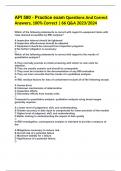
API 580 - Practice exam Questions And Correct
Answers, 100% Correct | 66 Q&A 2023/2024
Which of the following statements is correct with regard to equipment items with
risks deemed acceptable by RBI analysis?
A Inspection interval should be tightened
B Inspection effectiveness should be adjusted
C Equipment should be removed from inspection programs
D No further mitigation is necessary
D
Which of the following statements is correct with regard to the results of
quantitative analysis?
A They normally provide an initial screening with which to rank units for
attention.
B They are usually numeric and should be comparable
C They must be included in the documentation of any RBI evaluation
D They are more accurate that the results of a qualitative analysis.
B
In RBI, residual factors for loss of containment include all of the following except:
A Human Error
B Unknown mechanisms of deterioration
C Inspection efforts
D Secondary effects from nearby units.
C
Compared to quantitative analysis, qualitative analysis using broad ranges
generally requires:
A a lower level of judgement, skill, and understanding.
B Greater accuracy in data input to compensate for lower precision of the models
C Higher level of judgment, skill, and understanding
D Better training in understanding the impact of data quality
C
In RBI investigation, consequence analysis is intended to provide a measure of
the:
A Mitigations necessary to reduce risk.
B Overall risk of a potential failure
C Maximum liability for a failure
D Significance of a potential failure.
D
, Risk reduction is:
A Synonymous with risk management
B Synonymous with inspection optimization
C Part of risk management
D Achieved only by inspection
C
The value of a qualitative approach is that:
A the risk assessment process is much faster
B It uses logic models that depict combinations of events
C It enables completion of a risk assessment in the absence of detailed data.
D It produces relative risk numbers rather than absolute risk numbers.
C
RBI contributes to reduction of overall life-cycle costs by:
A using less expensive inspection techniques
B Increasing the number of internal inspections
C Increasing the number of non-intrusive inspections.
D Enhancing the prediction of failure caused by deterioration mechanisms
D
Which of the following is the most important to the success of risk management
by emergency isolation?
A. Operations surveillance
B. Chain-wheel-operated gate valves
C. Fire deluge systems
D. Proper isolation valve locations
D
For RBI methods, sensitivity analysis is:
A. Employed only when the risk matrix indicates that the risk is high
B. Normally employed to determine the effects of dominate failure mechanisms
for each piece of equipment studied.
C. A review of input variables in a risk calculation to determine their influence on
the risk variables.
D. Based on statistical analysis that uses historical data gathered from a
particular facility to develop a better understanding of the risk value.
c
The suitability and current condition of equipment within the current operating
envelope will determine the:
A. Consequence of failure
B. Probability of failure
C. Total risk
D. Likelihood
Answers, 100% Correct | 66 Q&A 2023/2024
Which of the following statements is correct with regard to equipment items with
risks deemed acceptable by RBI analysis?
A Inspection interval should be tightened
B Inspection effectiveness should be adjusted
C Equipment should be removed from inspection programs
D No further mitigation is necessary
D
Which of the following statements is correct with regard to the results of
quantitative analysis?
A They normally provide an initial screening with which to rank units for
attention.
B They are usually numeric and should be comparable
C They must be included in the documentation of any RBI evaluation
D They are more accurate that the results of a qualitative analysis.
B
In RBI, residual factors for loss of containment include all of the following except:
A Human Error
B Unknown mechanisms of deterioration
C Inspection efforts
D Secondary effects from nearby units.
C
Compared to quantitative analysis, qualitative analysis using broad ranges
generally requires:
A a lower level of judgement, skill, and understanding.
B Greater accuracy in data input to compensate for lower precision of the models
C Higher level of judgment, skill, and understanding
D Better training in understanding the impact of data quality
C
In RBI investigation, consequence analysis is intended to provide a measure of
the:
A Mitigations necessary to reduce risk.
B Overall risk of a potential failure
C Maximum liability for a failure
D Significance of a potential failure.
D
, Risk reduction is:
A Synonymous with risk management
B Synonymous with inspection optimization
C Part of risk management
D Achieved only by inspection
C
The value of a qualitative approach is that:
A the risk assessment process is much faster
B It uses logic models that depict combinations of events
C It enables completion of a risk assessment in the absence of detailed data.
D It produces relative risk numbers rather than absolute risk numbers.
C
RBI contributes to reduction of overall life-cycle costs by:
A using less expensive inspection techniques
B Increasing the number of internal inspections
C Increasing the number of non-intrusive inspections.
D Enhancing the prediction of failure caused by deterioration mechanisms
D
Which of the following is the most important to the success of risk management
by emergency isolation?
A. Operations surveillance
B. Chain-wheel-operated gate valves
C. Fire deluge systems
D. Proper isolation valve locations
D
For RBI methods, sensitivity analysis is:
A. Employed only when the risk matrix indicates that the risk is high
B. Normally employed to determine the effects of dominate failure mechanisms
for each piece of equipment studied.
C. A review of input variables in a risk calculation to determine their influence on
the risk variables.
D. Based on statistical analysis that uses historical data gathered from a
particular facility to develop a better understanding of the risk value.
c
The suitability and current condition of equipment within the current operating
envelope will determine the:
A. Consequence of failure
B. Probability of failure
C. Total risk
D. Likelihood