COP4600 Final Exam exam with complete solution graded A+
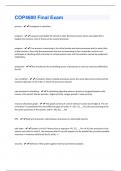
process - A program in execution program - A passive executable file stored on disk. Becomes process when executable file is loaded into memory. One of these can be several processes progress - If no process is executing in its critical section and some processes wish to enter their critical sections, then only those processes that are not executing in their remainder sections can participate in deciding which will enter its critical section next, and this selection cannot be postponed indefinitely. protection - Any mechanism for controlling access of processes or users to resources defined by the OS race condition - A situation where multiple processes access the same data concurrently and the outcome depends on the order in which the processes execute rate monotonic scheduling - A scheduling algorithm where a priority is assigned based on the inverse of its period. Shorter periods = higher priority. Longer periods = lower priority. resource allocation graph - This graph consists of a set of vertices V and a set of edges E. The set of vertices V is partitioned into two different types of nodes: P = {P1, P2, ..., Pn}, the set consisting of all the active processes in the system, and R = {R1, R2, ..., Rm RPC - Abstracts procedure calls between processes on networked systems safe state - System is in this if there exists a sequence <P1, P2, ..., Pn> of ALL the processes in the system such that for each Pi, the resources that Pi can still request can be satisfied by currently available resources + resources held by all the Pj, with j < i security - Defense of the system against internal and external attackssegmentation - Supports this view by providing addresses with a segment number ( mapped to a segment base address ) and an offset from the beginning of that segment. sequential access - Uses a small master index that points to disk blocks of a secondary index. The secondary index blocks point to the actual file blocks. The file is kept sorted on a defined key. To find a particular item, we first make a binary search of the master index, which provides the block number of the secondary index. This block is read in, and again a binary search is used to find the block containing the desired record. Finally, this block is searched sequentially. In this way, any record can be located from its key by at most two direct-access reads short term scheduler - Selects which process should be executed next and allocates CPU. Sometimes the only scheduler in a system. Is invoked frequently (milliseconds) (must be fast) socket - An endpoint for communication. A pair of processes communicating over a network employ a pair of sockets — one for each process. Identified by an IP address concatenated with a port number. In general, it uses a client - server architecture. starvation - Indefinite blocking. A process may never be removed from the semaphore queue in which it is suspended static linking - Library modules get fully included in executable modules. Wastes both disk space and main memory usage. Every program that included a certain routine from the library would have to have their own copy of that routine linked into their executable code. dynamic linking - Only a stub is linked into the executable module, containing references to the actual library module linked in at run time. swapping - A process can be swapped temporarily out of memory to a backing store and then brought back into memory for continued execution symmetric clustering - Has multiple nodes running applications, monitoring each othersymmetric multiprocessing - Each processor performs all tasks system call - Programming interface to the services provided by the OS thrashing - a process is busy swapping pages in and out throughput - # of processes that complete their execution per time unit time sharing - Logical extension in which CPU switches jobs so frequently that users can interact with each job while it is running, creating interactive computing
Written for
- Institution
- COP4600
- Course
- COP4600
Document information
- Uploaded on
- December 21, 2023
- Number of pages
- 4
- Written in
- 2023/2024
- Type
- Exam (elaborations)
- Contains
- Questions & answers
Subjects

Document also available in package deal