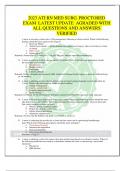
ATI RN MEDICAL SURGICAL
PROCTORED EXAMS WITH 25
LATEST MULTIPLE VERSIONS
EXAMS 2020 | 2021 | 2022/2023
GRADE A+
Real exam 2023 /2024 update
, Medical Surgical ATI
Lyme Disease
A nurse is providing teaching to a client who has a severe form of stage II
Lyme disease. Understanding of the patient teaching. ANS: My joints ache
because I have Lyme disease. Chronic complications memory problem
and fatigue
Musculoskeletal: Osteoporosis/Osteomyelitis
A nurse is assessing for compartment syndrome in a client who has a
short leg cast. Which of the following findings is a manifestation of this
condition? ANS: Pain that increases with passive movement. Other s/s
diminished pulse or pulselessness and capillary refill greater than 2 seconds
in the affected extremity. Warmth indicates infection.
A nurse is providing postoperative teaching for a client who had a total
knee arthroplasty. Which of the following instructions should the nurse
include? Flex the foot every hour when awake. Avoid placing pillows under
the knee. Elevate the leg when sitting in a chair to reduce edema and pain.
Keep the operative leg in a neutral position when resting in bed
Teaching external fixation device for fracture of lower extremity: use
crutches with rubber tip. Casts/splints/boots applied. Continuous use for 4-6
weeks. Teach wound and pin care. Only provider can adjust.
Post-op open reduction internal fixation of the ankle. What assessment
report: extremity cool on palpation. Other findings to report: pallor, cool
temp, paresthesia
A nurse is assessing a client who has a diagnosis of rheumatoid arthritis.
Which of the following nonpharmacological interventions should the
nurse suggest to the client to reduce pain? Alternate application of heat and
cold to the affected joints. Diet high in nutrients, such as protein, vitamins,
and iron, to promote tissue repair. Elevation of the affected extremities does
not relieve the painful inflammation caused by rheumatoid arthritis.
,
, Stuvia.com - The Marketplace to Buy and Sell your Study Material
Elevation of the extremities can assist with managing the pain of a client
who has peripheral vascular disease. Regular exercise is important to
prevent stiffness.
Caring for a client with hx of a compound fracture, 3 wks ago.
Unexpected finding showing osteomyelitis? ANS: Sedimentation rate. An
increased sedimentation rate occurs when a client has any type of
inflammatory process, such as osteomyelitis.
A nurse is teaching a client about osteoporosis prevention. The nurse
should instruct the client which of the following medications can increase
their risk of developing osteoporosis? ANS: Prednisone. The nurse
should instruct the client that prednisone can increase the risk for
developing osteoporosis due to suppression of bone formation, and an
increase in bone resorption by osteoclasts. Prednisone can also reduce
intestinal absorption of calcium. Conjugated estrogen reduces risk.
Colchicine can cause aplastic anemia.
A nurse is providing education to a client who is at risk for osteoporosis.
Which of the following instructions should the nurse include? Walk for 30
mins four times per week. Other teaching: Glucosamine for pain, avoid
exercises that cause jarring motions, such as jogging, take over-the-counter
calcium supplements.
Procedures
Suctioning client tracheostomy tube. Signs of hypoxia: The client’s
heart rate increases. Coughing is expected. Late signs are diaphoresis and
a decrease in blood pressure and will not be seen now. An increase in blood
pressure is an early sign.
A nurse is caring for a client who has an arterial line. Nursing action to
take? ANS: Place a pressure bag around the flush solution. Arterial line used
for ABG samples and hemodynamic monitoring. Supine, HOB 60 degrees.
PROCTORED EXAMS WITH 25
LATEST MULTIPLE VERSIONS
EXAMS 2020 | 2021 | 2022/2023
GRADE A+
Real exam 2023 /2024 update
, Medical Surgical ATI
Lyme Disease
A nurse is providing teaching to a client who has a severe form of stage II
Lyme disease. Understanding of the patient teaching. ANS: My joints ache
because I have Lyme disease. Chronic complications memory problem
and fatigue
Musculoskeletal: Osteoporosis/Osteomyelitis
A nurse is assessing for compartment syndrome in a client who has a
short leg cast. Which of the following findings is a manifestation of this
condition? ANS: Pain that increases with passive movement. Other s/s
diminished pulse or pulselessness and capillary refill greater than 2 seconds
in the affected extremity. Warmth indicates infection.
A nurse is providing postoperative teaching for a client who had a total
knee arthroplasty. Which of the following instructions should the nurse
include? Flex the foot every hour when awake. Avoid placing pillows under
the knee. Elevate the leg when sitting in a chair to reduce edema and pain.
Keep the operative leg in a neutral position when resting in bed
Teaching external fixation device for fracture of lower extremity: use
crutches with rubber tip. Casts/splints/boots applied. Continuous use for 4-6
weeks. Teach wound and pin care. Only provider can adjust.
Post-op open reduction internal fixation of the ankle. What assessment
report: extremity cool on palpation. Other findings to report: pallor, cool
temp, paresthesia
A nurse is assessing a client who has a diagnosis of rheumatoid arthritis.
Which of the following nonpharmacological interventions should the
nurse suggest to the client to reduce pain? Alternate application of heat and
cold to the affected joints. Diet high in nutrients, such as protein, vitamins,
and iron, to promote tissue repair. Elevation of the affected extremities does
not relieve the painful inflammation caused by rheumatoid arthritis.
,
, Stuvia.com - The Marketplace to Buy and Sell your Study Material
Elevation of the extremities can assist with managing the pain of a client
who has peripheral vascular disease. Regular exercise is important to
prevent stiffness.
Caring for a client with hx of a compound fracture, 3 wks ago.
Unexpected finding showing osteomyelitis? ANS: Sedimentation rate. An
increased sedimentation rate occurs when a client has any type of
inflammatory process, such as osteomyelitis.
A nurse is teaching a client about osteoporosis prevention. The nurse
should instruct the client which of the following medications can increase
their risk of developing osteoporosis? ANS: Prednisone. The nurse
should instruct the client that prednisone can increase the risk for
developing osteoporosis due to suppression of bone formation, and an
increase in bone resorption by osteoclasts. Prednisone can also reduce
intestinal absorption of calcium. Conjugated estrogen reduces risk.
Colchicine can cause aplastic anemia.
A nurse is providing education to a client who is at risk for osteoporosis.
Which of the following instructions should the nurse include? Walk for 30
mins four times per week. Other teaching: Glucosamine for pain, avoid
exercises that cause jarring motions, such as jogging, take over-the-counter
calcium supplements.
Procedures
Suctioning client tracheostomy tube. Signs of hypoxia: The client’s
heart rate increases. Coughing is expected. Late signs are diaphoresis and
a decrease in blood pressure and will not be seen now. An increase in blood
pressure is an early sign.
A nurse is caring for a client who has an arterial line. Nursing action to
take? ANS: Place a pressure bag around the flush solution. Arterial line used
for ABG samples and hemodynamic monitoring. Supine, HOB 60 degrees.