

100% satisfaction guarantee Immediately available after payment Both online and in PDF No strings attached 4.2 TrustPilot
logo-home
Exam (elaborations)

Quiz 5 - Pulmonary Function Questions & Answers

Rating
-
Sold
-
Pages
14
Grade
A+
Uploaded on
20-12-2023
Written in
2023/2024

Quiz 5 - Pulmonary Function Questions & Answers 1. A patient has a history of emphysema and has hyperinflated lungs. Which of the following would be true regarding this patient? A. Increased lung compliance B. Decreased alveolar surfactant C. Increased lung elastic recoil D. Increased airway resistance ****** it does cause this but primary is compliance 2. The compliance within the apex of the lung of a standing person would be than the base of the lung. A. Greater Than B. Lesser Than ← The key had this answer as correct, but I selected it on my quiz and missed it. 8/10/19 C. Equal 3. The space between the lungs that include the heart, esophagus, and the great vessels is termed A. Nasopharynx B. Carina C. Hilum D. Mediastinum 4. Which of the following is true regarding Acute Respiratory Syndrome (ARDS) A. It is caused by injury to the bronchioles B. It can cause severe pulmonary edema C. It is most commonly caused by exposure to inhaled irritants D. Macrophage and neutrophils are not involved in the response 5. Pulmonary fibrosis is most likely to result in all of the following except A. thickening of the alveolocapillary membrane B. Decreased diffusing capacity in the lungs C. Hypoxemia D. Oxygen toxicity 6. Emphysema results from A. A ruptured bleb B. An infected pleural effusion C. Persistent abnormal dilation of bronchi D. An excessive amount of fibrous or connective tissue in the lung 7. A reduced oxygenation of the blood is termed A. Hypoxemia B. Hypoxia C. Pneumoconiosis D. Asthma 8. Along with respiratory bronchioles, the is a thin walled balloon-liked structure that acts as the primary unit of gas exchange A. Alveolus B. Pore of Kohn C. Clara cell D. Bronchus 9. The most common feature as a result of hyperventilation is A. Acidosis B. Hypocapnia C. Hypercapnia D. Clubbing of the fingers 10. The pores of Kohn play a role in: a. Allowing plasma to leak from the capillary to the interstitium b. Connecting the right lung to the left lung c. Allowing blood flow to be evenly spread throughout the lungs d. Allowing air to pass from one alveoli to another, allowing equal distribution of air 11. What effect would acidemia at the alveolar level have on the pulmonary artery? a. Increased blood flow to that area (vasodilation) b. Decreased blood flow (vasoconstriction) to that area c. No effect of blood flow d. Vasodilation combined with decreased ventilation to the area **12. While most alveolar perfusion is under control of local humoral conditions, widespread decrease in PaO2 (alveolar O2) is likely to result in: a. Bronchoconstriction b. Pulmonary artery constriction (pulmonary hypertension) c. Increased blood flow to the lungs d. All of the above **13. A pulmonary embolus creating alveolar dead space will likely have which of the following effects? a. Shunt with very low V/Q ratio – WRONG b. Increased pulmonary compliance? c. High V/Q ratio d. Pulsus paradoxus 14. Severe bronchospasm not responsive to the normal measures (beta agonist bronchodilators) is best described as: a. Pulmonary fibrosis b. Pulsus paradoxus c. Air trapping d. Status asthmaticus 15. All of the following are findings consistent with pulmonary fibrosis EXCEPT: a. Increased lung compliance b. Chronic inflammation of the lung c. Decreased vital capacity? d. ? 16. Which of the following does NOT increase airway resistance (increase the work of breathing)? a. Bronchoconstriction b. Activation of the sympathetic nervous system effects on the airways c. … of the bronchial mucous d. Mucus collecting in the …. **17. The effect of H+ on oxygen binding to hemoglobin is termed the effect. 1. Haldane 2. Bohr 3. Bohrophil 4. Root 18. What happens to the functional residual capacity in COPD? A. It increases, resetting the TV to a higher volume B. It decreases, lowering the tidal volume level C. It is unchanged D. It increases in inspiration but decreases in expiration 19. Acidosis will the affinity of oxygen to hemoglobin and thus would be considered a shift in the oxyhemoglobin dissociation curve. A. Increase, right B. Increase, left C. Decrease, right D. Decrease, left 20. Which of the following is NOT part of Virchow’s triad in the development of thrombi and emboli? A. Hypercoagulability of blood

Show more Read less
Institution
Course


Whoops! We can’t load your doc right now. Try again or contact support.

Written for

Course

Document information

Uploaded on
December 20, 2023
Number of pages
14
Written in
2023/2024
Type
Exam (elaborations)
Contains
Questions & answers

Subjects

Content preview

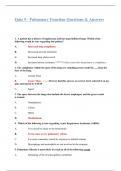
Quiz 5 - Pulmonary Function Questions & Answers


1. A patient has a history of emphysema and has hyperinflated lungs. Which of the
following would be true regarding this patient?

A. Increased lung compliance

B. Decreased alveolar surfactant

C. Increased lung elastic recoil

D. Increased airway resistance ****** it does cause this but primary is compliance

2. The compliance within the apex of the lung of a standing person would be than the
base of the lung.

A. Greater Than

B. Lesser Than ←----The key had this answer as correct, but I selected it on my
quiz and missed it. 8/10/19

C. Equal

3. The space between the lungs that include the heart, esophagus, and the great vessels
is termed

A. Nasopharynx

B. Carina

C. Hilum

D. Mediastinum

4. Which of the following is true regarding Acute Respiratory Syndrome (ARDS)

A. It is caused by injury to the bronchioles

B. It can cause severe pulmonary edema

C. It is most commonly caused by exposure to inhaled irritants

D. Macrophage and neutrophils are not involved in the response

5. Pulmonary fibrosis is most likely to result in all of the following except

A. thickening of the alveolocapillary membrane

, B. Decreased diffusing capacity in the lungs

C. Hypoxemia

D. Oxygen toxicity


6. Emphysema results from

A. A ruptured bleb

B. An infected pleural effusion

C. Persistent abnormal dilation of bronchi

D. An excessive amount of fibrous or connective tissue in the lung

7. A reduced oxygenation of the blood is termed

A. Hypoxemia

B. Hypoxia

C. Pneumoconiosis

D. Asthma

8. Along with respiratory bronchioles, the-----is a thin walled balloon-liked structure that
acts as the primary unit of gas exchange

A. Alveolus

B. Pore of Kohn

C. Clara cell

D. Bronchus

9. The most common feature as a result of hyperventilation is

A. Acidosis

B. Hypocapnia

C. Hypercapnia

D. Clubbing of the fingers

10. The pores of Kohn play a role in:
$14.99
Get access to the full document:

100% satisfaction guarantee
Immediately available after payment
Both online and in PDF
No strings attached


Also available in package deal

Get to know the seller

Seller avatar
Reputation scores are based on the amount of documents a seller has sold for a fee and the reviews they have received for those documents. There are three levels: Bronze, Silver and Gold. The better the reputation, the more your can rely on the quality of the sellers work.
Cowell Chamberlain College Of Nursng
Follow You need to be logged in order to follow users or courses
Sold
512
Member since
5 year
Number of followers
483
Documents
853
Last sold
3 weeks ago
EXAMS GURU

SCORE As

4.0

91 reviews

5
46
4
15
3
18
2
4
1
8

Recently viewed by you

Why students choose Stuvia

Created by fellow students, verified by reviews

Quality you can trust: written by students who passed their tests and reviewed by others who've used these notes.

Didn't get what you expected? Choose another document

No worries! You can instantly pick a different document that better fits what you're looking for.

Pay as you like, start learning right away

No subscription, no commitments. Pay the way you're used to via credit card and download your PDF document instantly.

Student with book image

“Bought, downloaded, and aced it. It really can be that simple.”

Alisha Student

Frequently asked questions

