

ETC 3301 Final Exam Questions With 100% Correct Answers.
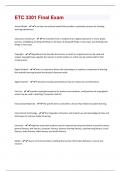
Assure Model - a six step instructional model that provides a systematic process for creating learning experiences. Classroom Continuum - the transition from a traditional to a digital classroom in a four-phase process: 1) dabbling, 2) doing old things in old ways, 3) doing old things in new ways, and 4) doing new things in new ways Copyright - Regulations that describe the manner in which an original work can be used and copied. Copyright laws regulate the manner in which authors or artists can be reimbursed for their creative work. Digital Student - learn in classrooms where the technology is a seamless component of learning that extends learning beyond the physical classroom walls. Digital Teacher - instruction includes presentations that are media rich and interactive. Fair Use - provides copyright exception for teachers and students, small portions of copyrighted works may be used in teaching, if properly cited etc. Instructional Materials - the specific items used within a lesson that influence student learning. Instructional Technology - the integration of teacher and student use and knowledge of tools and techniques to improve student learning. Literacies - eight key areas that students need to improve learning and achieve successful careers; general literacy, text literacy, computer literacy, distance learning literacy, cyberlearning literacy, visual literacy, audio literacy, video literacy, and media literacy. Media - means of communication; anything that carries information between a source and receiver.Media Formats - the physical forms in which message are incorporated and displayed (slides, DVD, CD, etc.). NETS-S - National Education Technology Standards for Students; six critical skills students need to achieve success in school and in future careers. NETS-T - National Education Technology Standards for Teachers; provide five basic guidelines for becoming a digital teacher. Technology Gap - the gap between people with access to digital and information technology and individuals with limited or no access. Also known as the Digital Divide. Behaviorism - a theory that equates learning with changes in observable behavior; with this theory, there is no speculating about mental events that may mediate learning. Cognitivism - a theory according to which mental processes mediate learning and learning entails the construction or reshaping of mental schemata. Constructivism - a theory that considers the engagement of students in meaningful experiences as the essence of learning
Document information
- Uploaded on
- December 19, 2023
- Number of pages
- 15
- Written in
- 2023/2024
- Type
- Exam (elaborations)
- Contains
- Questions & answers


