Fisdap Trauma Block Exam Questions With Verified Answers
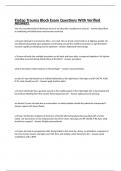
why are circumferential full thickness burns of an extremity considered so serious? - Answer blood flow to underlying and distal tissue may become restricted a 25-year-old male is unconscious after a car crash. His car struck a tree head-on at highway speeds. He has abdominal guarding upon palpation and bruising around the umbilicus bruising is a sign that there has been significant bleeding into the abdomen - Answer abdominal hemorrhage a 34-year-old male has multiple lacerations on his back and torso after a suspected explosion. His injuries most likely occurred during which phase of the blast? - Answer secondary what is the body's initial response to hemorrhage? - Answer vasoconstriction an alert 19 year old female has a midshaft deformity to her right femur. Vital signs are BP 130/78, P108, R 18. what should you do? - Answer apply traction splint a 25-year-old female has a gunshot wound to the medial aspect of her right thigh. She is disoriented and has profuse bleeding from the wound. What should you do? - Answer apply pressure dressing an altered 24 year old male has an evisceration. In which position should the patient be transported? - Answer supine with knees flexed a 20 year old female complains of shortness of breath after being physically assaulted with a tennis racket. she has bruises on the midclavicular line of her chest. vital signs are BP 120/80, P 80, R22. what should you suspect? - Answer Simple pneumothorax a 43 year old male is unresponsive after being kicked in the chest by a horse. on inhalation a segment of his chest moves inward. vital signs are P130, R24, and shallow. what should you do? - Answer assist ventilations with a BVM a 16 year old male complains of severe pain in his upper left quadrant after being hit in the stomach while playing football. what should you suspect? - Answer ruptured spleen an 18 year old male opens his eyes when you talk to him, moans, and reaches for your hand when you pinch his shoulder. what is his GCS score? - Answer 10 a 45 year old female was stabbed in the upper right chest. her breath sounds are diminished on the right side. vital signs are BP 70/48, P 150, R 32 and shallow. what should you do? - Answer perform a needle decompression what chemical do muscle cells release after being damaged? - Answer potassium a 22 year old male has suffered blunt trauma to the sternum. he is awake and complains of severe chest pain. his ecg reveals a sinus rhythm with frequent multifocal pvcs and ST elevation. vital signs are BP 100/60, P72, R24. what is most likely the cause? - Answer myocardial contusion a 46 year old male is unresponsive to verbal stimuli after being stabbed. he has an open, bubbling chest wound. what should you do? - Answer cover the wound with a gloved hand a 39 year old female was stabbed with a broken bottle in her left lower quadrant. her bowels are protruding from the wound. what should you do? - Answer apply a moist sterile dressing a 29 year old male has a traumatic amputation of the left arm. vital signs are BP 66/22, P128, R18. at what rate should you administer IV fluids? - Answer 20cc/kg a 51 year old female has a 4inch lac to her right leg. bright red blood is rapidly soaking through the initial dressings. what should you do? - Answer apply a tourniquet a 20year old male was involved in a fight. bystanders report he was struck in the head and went unconscious, during the primary survey he was awake and complained of head pain. he loses consciousness while you obtain vital signs. what should you suspect? - Answer epidural hematoma an unresponsive 31 year old female was found at the bottom of the satirs. she has blood draining down from ears and nose and dry vomit on her face. emergency medical responders are unsure how long she has been there. vital signs are BP 202/122, P54, R10 and irregular, SpO2 and reduce brain swelling - Answer assist ventilations with a bag valve mask an 18 year old male screams in pain and has a large volume of bright blood spurting from his right wrist. what should you do? - Answer apply direct pressure a confused 76 year old female complains of upper leg pain after falling on the sidewalk. she has a mid-shaft femur deformity and crepitus of the pelvis. she has a history of osteoporosis and kyphosis. what should you do? - Answer stabilize her c-spine and secure her to a long board a 21 year old male has a LeFort III fracture. what should you be most concerned about - Answer patency of the upper airway a 22 year old female was thrown from a horse. she complains of back pain and dizziness. her skin is warm and dry. vital signs are BP 74/50, P84, R20. what should you suspect? - Answer Neurogenic shock a 31 year old male was in a car crash at highway speeds. he has a contusion above his left breast and left lateral torso. vital signs are BP 90/76, P118, with diminished heart tones, R24. what should you suspect? - Answer cardiac tamponade Isolated musculoskeletal injuries: - Answer often result in short- or long-term disability A function of the musculoskeletal system is hematopoiesis, which is defined as the process of: - Answer generating blood cells. Which of the following structures is NOT part of the axial skeleton? - Answer Femoral shaft The appendicular skeleton is composed of the: - Answer pectoral girdle, pelvic girdle, and bones of the extremities Which of the following bones is MOST vulnerable to injury? - Answer Clavicle The upper extremity joins the shoulder girdle at the - Answer glenohumeral joint The carpals, especially the scaphoid, are MOST vulnerable to fracture when a person: - Answer falls on an outstretched hand. The ischium, ilium, and pubis are fused together to form the: - Answer acetabulum Hip fractures are actually fractures of the - Answer femoral neck The fibula - Answer is not a component of the knee joint When a person jumps from a height and lands on his or her feet, direct trauma occurs to the - Answer calcaneus ___________ is a dense, fibrous membrane that is important for bone repair and maintenance. - Answer Periosteum After 35 years of age, age-related decrease in bone density is accelerated in females because: - Answer of decreased estrogen levels secondary to menopause Osteoporosis is MOST accurately defined as a(n) - Answer significant decrease in bone density The joints that connect the ribs to the sternum are examples of - Answer cartilaginous joints Diarthroses - Answer are the most mobile joints of the body. A ____________ is a padlike sac or cavity located within the connective tissue, usually in proximity to a joint - Answer bursa What structure helps maintain the stability of a joint and determines the degree of joint motion? - Answer Ligament By maintaining a state of partial contraction, __________ muscle allows the body to maintain its posture. - Answer skeletal Skeletal muscles that are not used or exercised tend to: - Answer atrophy The energy for muscular contraction is derived from the metabolism of _______ and results in the production of _______. - Answer glucose, lactic acid Skeletal muscle is innervated by: - Answer somatic motor neurons The upper extremity's blood supply originates from the - Answer subclavian artery. The anterior and posterior tibial arteries are direct subdivisions of the - Answer popliteal artery. A pathologic fracture occurs when - Answer an occult medical condition causes abnormal bone weakness Which of the following is the BEST example of an indirect injury? - Answer Shoulder dislocation secondary to falling on an outstretched hand Which of the following musculoskeletal injuries would MOST likely occur together? - Answer Knee dislocation and tibial fracture What type of fracture occurs at an angle across the bone and is typically caused by direct or twisting force? - Answer Oblique A stress fracture would MOST likely occur when - Answer the muscle develops faster than the bone and places exaggerated stress on the bone The MOST significant immediate risk associated with an open fracture is: - Answer hemorrhage In a closed femur fracture, blood loss may exceed _______ before enough pressure develops to tamponade the bleeding. - Answer 1,000 mL The MOST reliable sign of a fracture is: - Answer deformity Which of the following statements regarding a nondisplaced fracture is correct? - Answer Nondisplaced fractures are generally caused by low-energy trauma and are typically not associated with deformity A patient standing with his or her head cocked toward a knocked-down left shoulder MOST likely has a fracture of the: - Answer left clavicle Eliciting for crepitus during your exam of a deformed extremity: - Answer may cause further injury to the bone and surrounding soft tissues The BEST way to detect deformity or any other abnormality in an injured extremity is to - Answer compare it to the extremity on the opposite side A subluxation occurs when - Answer a joint is partially dislocated A dislocation is considered an urgent injury because of its potential to cause: - Answer neurovascular compromise. The sudden twisting of a joint beyond its normal range of motion, causing a temporary subluxation, is called a: - Answer sprain. Immediate pain from the heel to the calf and a sudden inability for plantar flexion of the foot is MOST indicative of: - Answer Achilles tendon rupture. Signs of bursitis include all of the following, EXCEPT - Answer deformity In contrast to osteoarthritis, rheumatoid arthritis: - Answer is a systemic inflammatory disease that affects joints and other body systems. When assessing a multisystems trauma patient, it is MOST important to: - Answer avoid being distracted by visually impressive injuries. Closed bilaterally fractured femurs can result in internal blood loss of up to: - Answer 3,000 mL After ensuring your own safety, your next priority when caring for a patient with an extremity injury is to: - Answer prevent further injury. Which of the following is NOT one of the 6 Ps of musculoskeletal injury assessment? - Answer Passive extension When assessing distal pulses in a patient with a lower extremity injury, it is MOST important to: - Answer compare the strength of the pulses in both lower extremities. Which of the following medical conditions would MOST likely cause changes in sensation in a patient with an extremity injury? - Answer Diabetes The goal of prehospital pain control in a patient with a musculoskeletal injury should be to: - Answer diminish the patient's pain to a tolerable level Swelling and inflammation associated with musculoskeletal injuries are reduced: - Answer if cold packs are applied during the acute stage of the injury Correctly splinting an injured extremity: - Answer helps to control internal bleeding by allowing clots to form where vessels are damaged. The FIRST step in splinting a musculoskeletal injury involves: - Answer exposing and assessing the injury site The MOST practical method of splinting multiple fractures in a critically injured patient is to: - Answer splint the axial skeleton using a long backboard You should NOT apply a pneumatic splint on a patient if he or she: - Answer has an open fracture in which bone ends are exposed The likelihood of experiencing systemic complications from a musculoskeletal injury is related to all of the following factors, EXCEPT the: - Answer splinting method used in the field Which of the following is NOT an intervention the paramedic can perform to help reduce the risk of long-term disability following a musculoskeletal injury? - Answer Prehospital fracture reduction Compartment syndrome occurs when: - Answer pressure in the fascial compartment leads to impaired circulation, sensory changes, and progressive muscle death. The return of myoglobin to the systemic circulation following a crush injury would result in all of the following conditions, EXCEPT: - Answer metabolic alkalosis. The risk of a pulmonary embolism following musculoskeletal trauma is HIGHEST in patients with: - Answer pelvic and lower extremity injuries that lead to prolonged immobilization. Common signs and symptoms of an acute pulmonary embolism include all of the following, EXCEPT: - Answer pulmonary edema. You arrive at the scene of a motorcycle crash and find the rider lying supine approximately 20 feet from his bike; he is still wearing his helmet. As you approach him, you note that he has bilaterally deformed femurs. You should: - Answer manually stabilize his head and assess his airway. A 40-year-old woman has an unstable pelvis following a motor vehicle crash. She is conscious but confused. Her blood pressure is 80/50 mm Hg, pulse is 120 beats/min and weak at the radial arteries, and respirations are 24 breaths/min and shallow. After starting at least one large-bore IV line, you should: - Answer give enough isotonic crystalloid fluids to improve her mental status and radial pulse quality A 60-year-old woman slipped and fell on an icy sidewalk and landed on her outstretched hand. Your assessment reveals that she has an obvious Colles fracture. The patient denies any other injuries and is conscious and alert. Her vital signs are stable and she describes her pain as a 2 on a scale of 0 to 10. Given this patient's current status, the MOST appropriate way to treat her injury involves: - Answer administering analgesia and then properly splinting her injury A young man has an isolated injury to his left lower leg. Your assessment reveals obvious deformity and ecchymosis. Distal circulation as well as motor and sensory functions are grossly intact, and the patient is hemodynamically stable. In addition to stabilizing the suspected fracture site, you should: - Answer immobilize the knee and the ankle A 19-year-old man experienced direct trauma to his left elbow. Your assessment reveals gross deformity and ecchymosis. His arm is pink and warm, and he has a strong radial pulse. Your transport time to the hospital will be delayed. You should: - Answer splint the elbow in the position found and reassess distal circulation You have applied board splints to a suspected lower leg fracture in a young woman and have given her fentanyl for pain. En route to the hospital, the patient states that the pain is excruciating. Further narcotics fail to relieve the pain. Reassessment of the injured area reveals that the overlying skin is taut and the pedal pulse is weak. You should: - Answer loosen the splint, elevate the leg, apply ice, and notify the hospital A 45-year-old man was cutting down a large tree when it collapsed, pinning him at the thighs. The patient's wife found him approximately 4 hours after the incident. The patient is conscious and in severe pain. His blood pressure is 128/68 mm Hg, pulse is 120 beats/min and regular, and respirations are 22 breaths/min with adequate depth. In addition to supplemental oxygen and cardiac monitoring, which of the following treatments should you provide BEFORE the tree is removed from his legs? - Answer IV therapy with a crystalloid fluid bolus and albuterol via nebulizer or mucosal atomizer device A 68-year-old woman presents with an acute onset of dyspnea and sharp chest pain. Her medical history is significant for a hip replacement 2 weeks ago. The patient is conscious and alert, with a blood pressure of 112/58 mm Hg, pulse rate of 90 beats/min and irregular, and respirations of 22 breaths/min and labored. Which of the following treatment interventions is MOST appropriate for this patient? - Answer Oxygenation and ventilation support and rapid transport A 71-year-old man slipped on wet grass and landed on his left side. He denies losing consciousness before or after the fall and is presently conscious and alert. He complains of pain to his left hip and in his neck. Your assessment reveals a hematoma to the left side of his head and an external rotation and shortening of his left leg. His vital signs are stable. The MOST appropriate treatment for this patient includes: - Answer supplemental oxygen, spinal motion restriction precautions, an IV line of normal saline, stabilization of his hip with pillows, fentanyl if needed, and transport. A 17-year-old man jumped from a second-story balcony and landed on his feet. He complains of pain to both of his heels and knees. Your assessment reveals swelling and ecchymosis to both of his feet. His vital signs are stable and he is breathing without difficulty. In addition to caring for his lower-extremity injuries, it is MOST important that you: - Answer apply spinal motion restriction precautions. A person blowing on hot food in an attempt to cool it is an example of: - Answer convection Which of the following locations would provide the BEST protection from a lightning strike? - Answer A car with the windows rolled up
Written for
- Institution
- Fisdap Trauma
- Course
- Fisdap Trauma
Document information
- Uploaded on
- December 19, 2023
- Number of pages
- 42
- Written in
- 2023/2024
- Type
- Exam (elaborations)
- Contains
- Questions & answers
Subjects
- fisdap trauma
-
fisdap trauma block exam questions with verified a
-
why are circumferential full thickness burns of an
-
a 25 year old male is unconscious after a car cras

Also available in package deal