A-Level Pure Mathematics Formulas – WJEC Questions and Answers 2023
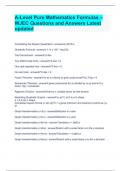
A-Level Pure Mathematics Formulas – WJEC Questions and Answers 2023 Completing the Square (Quadratic) a(x+B)^2+c Quadratic Formula x = -b ± √(b² - 4ac)/2a The Discriminant b^2-4ac Two distinct real roots b^2-4ac > 0 One real repeated root b^2-4ac = 0 No real roots b^2-4ac < 0 Factor Theorem If (x-a) is a factor of given polynomial P(x), P(a) = 0 Remainder Theorem If given polynomial f(x) is divided by (x-a) and isn't a factor, f(a) = remainder Algebraic Division Divide by x, multiply factor by that answer Sketching Quadratic Graphs For ax^2, a>0 is a U shape a < 0 is an n shape Completed square format y= a(x+p)^2 + q gives minimum and maximum points as (-p, q) Graph transformation y=-f(x) Reflection in x-axis Graph transformation y=f(-x) Reflection in y-axis Graph transformation y=f(x+a) Translation <- (left) a Graph transformation y=af(x) Stretch with a scale factor a in the y direction Graph transformation y=f(x-a) Translation -> (right) a Graph transformation y=f(x/a) Stretch with a scale factor a in the x direction Graph transformation y=f(ax) a>1 Horizontal compression Graph transformation y=f(x)+a Translation ^ (up) a Graph transformation y=f(ax) 0<a<1 Horizontal stretch Graph transformation y=f(x)-a Translation down a Gradient of a line y2-y1/x2-x1 Length of a straight line √(x2-x1)^2+(y2-y1)^2 Midpoint of a line (x1+x2/2, y1+y2/2) Equation of a line y-y1=m(x-x1) Gradients of parallel lines m1=m2 Gradients of perpendicular lines m1m2=-1 Perpendicular lines Tangents are perpendicular to normals Radius is perpendicular to tangent Equation of a circle (x-a)^2 + (y-b)^2 = r^2 (a,b) is the centre, r is the radius Circle and line intersecting Once-tangent Twice-solve simultaneously Using the discriminant with circle intersection b^2-4ac > 0: 2 intersections b^2-4ac = 0: 1 intersection b^2-4ac < 0: no intersections Circles intersecting Externally once: diameter=r1+r2 Internally once: diameter=r1-r2 x-axis asymptote y=a^x y-axis asymptote y=lnx First Law of Logarithms log_a(x) + log_a(y)=log_a(xy) Second Law of Logarithms log_a(x)-log_a(y)=log_a(x/y) Third Law of Logarithms log_a(x)^k=klog_a(x) Binomial Expansion (a+b)^n = a^n + (n 1)a^(n-1)b + (n 2)a^(n-2)b^2 + ... + (n r)a^(n-r)b^r + ... + b^n Differentiation y=kx^n, dy/dx=nkx^(n-1) Second Order Differentiation y=kx^n, d^2y/dx^2=(n-1)(n)kx^(n-2) Stationary points dy/dx=0 Maximum point d^2y/dx^2<0 Minimum point d^2y/dx^2>0 Increasing gradient dy/dx>0 Decreasing gradient dy/dx<0 Point of inflection Gradient will always be positive or negative
Written for
- Institution
- WJEC
- Course
- WJEC
Document information
- Uploaded on
- December 17, 2023
- Number of pages
- 6
- Written in
- 2023/2024
- Type
- Exam (elaborations)
- Contains
- Questions & answers
Subjects
-
a level pure mathematics formulas wjec questions
-
completing the square quadratic axb2c
-
factor theorem if x a is a factor of given polyn
-
equation of a circle x a2 y b2 r2 ab

Also available in package deal