Food Manager Certification Exam Study Guide
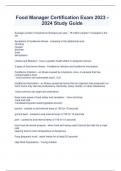
Average number of food borne illnesses per year - 76 million people (1/4 people in the us) Symptoms of foodborne illness - cramping in the abdominal area vomiting nausea diarrhea fever dehydration Listeria and Botulism - have a greater health effect on pregnant women 2 types of food borne illness - Foodborne infection and foodborne intoxication Foodborne Infection - an illness caused by a bacteria, virus, or parasite that has contaminated a food - most common are salmonella and E. Coli. foodborne intoxication - an illness caused by toxins that an organism has produced in a food; toxins may also be produced by chemicals, heavy metals, or other substances -most common are staph and clostridium three main areas of food safety and sanitation - -time and temp -heat and cold -handwashing/ware-washing(plates and etc) poultry - cooked to and internal temp of 165 for 15 seconds ground beef - cooked to and internal temp of 155 for 15 seconds pork - cooked to and internal temp of 145 for 15 seconds food must be stored properly - when food isn't being used it should be held hot or kept cold keeping food at room temperature is dangerous Food preparers must - wash hands for at least 20 seconds High Risk Populations - Young children the elderly people with compromised immune systems Sources of contamination - food handlers food contact surfaces packaging materials soil contaminated water air ingredients pests food handlers - should follow proper personal hygiene - a speck of dirt can contain over a million bacteria food-contact surfaces - should be cleaned every 4 hours -old food on surfaces can attract pests such as roaches, mice and rats packaging materials - should be kept 6 inches off the ground dirty soil - all produce must be washed well -crops that grow low in the soil have a higher likelihood of contamination water - must be drinkable as bacteria and parasites can live in water -dirty water can have microorganisms such as E. Coli, salmonella, vibrio, shigella, and giardia food contaminants - biological physical chemical cross contamination biological hazards - bacteria, viruses, parasites, fungi bacteria - food must be out of danger zone (41°-135°) -cannot be in danger zone for more than 4 hours accounts for more than 90% of foodborne illnesses doubles every 20 minutes toxins - cannot be killed with heat or cold as bacteria multiplies, they produce waste products -waste products may look and feel like slime spores - forms when bacteria changes forms that are very resistant to heat and dry conditions
Written for
- Institution
- Food Manager Certification,
- Course
- Food Manager Certification,
Document information
- Uploaded on
- December 17, 2023
- Number of pages
- 10
- Written in
- 2023/2024
- Type
- Exam (elaborations)
- Contains
- Questions & answers
Subjects
-
food manager certification exam
-
food manager certification

Also available in package deal