Financial Markets and Institutions
Introduction
Macro economics:
- Income (gdp) related to consumption, investment, Y= C + I + G + (X – M)
government purchases and net-export Y- T= C + I + G – T + (X – M)
- An identity Y- T – C = I + (G – T) + (X – M)
- Used for forecasting, predictions, … • S = I + (G – T) + (X – M)
What is staying left?
- Savings (S)
o = investments – budget deficit – what lost from trade
Why important?
- Savings = surplus
- Investments = shortage
- What is left must equal what you need (shortage)
o Financial system → S = Y
o Equilibrium
How to get the surplus (savings) to where it is needed (debt in all its forms + equity)
➔ Financial plumbing of the economy
Endogenous system: (= created, looks like it looks)
- time dependent
- geography dependent
o (There is no unified system in the EU!)
o EU is not UK, China, US
o All different
The Belgian Financial system
Europe on average:
- Different financial markets for EU countries → Reasons:
o Language barriers, law, consumer habits, …
Starting point: 2 countries: A & B
- Money → in the hands of economic agents
(consumers, corporations, governments,
institutional players).
- Money = used to transact (buying or selling).
o Financial intermediaries and/or
auctions (exchanges/capital markets)
are necessary just as payment
systems.
- Payment systems going through important
change as result fin. and tech. innovations
Financial intermediaries → 2 subclasses:
- Commercial banks
- Shadow banks
,System has to be regulated
- Banking union of the EU, ECB, NCB, prime regulators
- Belgium: NBB/FSMA
Transactions also happen between countries (or between banks within a given country).
- This happens mostly in the (international) capital markets.
- Physical places or decentralised between banks
- Supranational authorities:
o Bank for International Settlements (BIS)
o Self-regulation (ISDA/ESMA)
Derivatives require the intervention of Central Clearing Parties (CPP)
Banking system much more important in BE, FR, GER,
… (EU)
• We are a banking system
Typecasting the Belgian Financial System • Not a capital banking system (US, UK)
➔ Not specific for Belgium market
o In essence: European financial market
Capital markets marginal, not important?
• No
• Banks use capital markets
o Make transactions and make it secure and reduce risk
o Will use interest rates
,Money & creation of money
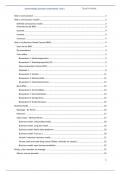
Contents
1.1 Origin and Characteristics
a) Definition
b) Function
c) Characteristics
d) Evolution
e) Forms
1.2 Supply of money
a) Definitions
b) Money supply: base money
c) Money supply: multiplier
d) Some numbers
1.1 Origin & characteristics
a) Definition
Product generally accepted in exchange for goods and services
o Mean of exchange
o Ex. Car, bread, …
Based on convention
- Based on trust
- 2 types:
o Implicit agreement
▪ Whatever the economic agents agree to use as mean of exchange
o Explicit agreement
▪ By law
If public lacking trust → even legal obligations cannot enforce the use of the legal tender outside officially
controlled circuit
- Ex. Argentina
Money coins all legal tender issues by CB
Euro = legal tender in EU:
- Regulated by law
- Used to make payments
- Sufficient?
o Most of the time → Yes
o But: not always
▪ Ex. Argentina → Pesos
• Pesos as legal tender
• But will prefer to accept dollar over pesos
• There is not a lot of trust in pesos
• Even if it is the legal tender
➔ It is what people decide to use
o A convention based on trust
o Never a given
, o What CB does, can influence the fate in euros
Ex. bitcoin invented
- Did not believe in stabillity of euro
- Wanted to make own system
b) Function
Function:
- Means of exchange
- Investment
- Unit of account
- Standard for future payments
Means of exchange:
- Use money to make purchases
- Stable purchasing power
- Ex. Buying a loaf of bread
Investment:
- Keep valuables in money
- Ex. Hyperinflation Germany:
o People don’t want money in value, but preferred cigarettes
Unit of account of purchasing power:
- Relative value of goods is not directly determined
- But it is presented in terms of money
- Comparison of value do happen in money terms
- Ex. Car costs €30,000 or €50,000
Standard for future payments:
- Transactions spread over time
- Existing of interest rates
c) Characteristics
Characteristics of money:
• Valuable in comparison to its weight.
• Durable.
• Divisible.
• Standardised quality.
• Easily recognisable.
• Stable Purchasing power.
➔ 6 characteristics why use 5€ bill as money
Valuable in comparison to it weights:
- Ex. 5€ bank note compared to gold
o Gold heavy, can't make transactions with it
o Small bill is more practicle
Durable:
- Not perishable in time
- Ex. banana as money:
o Will perish in couple days
Introduction
Macro economics:
- Income (gdp) related to consumption, investment, Y= C + I + G + (X – M)
government purchases and net-export Y- T= C + I + G – T + (X – M)
- An identity Y- T – C = I + (G – T) + (X – M)
- Used for forecasting, predictions, … • S = I + (G – T) + (X – M)
What is staying left?
- Savings (S)
o = investments – budget deficit – what lost from trade
Why important?
- Savings = surplus
- Investments = shortage
- What is left must equal what you need (shortage)
o Financial system → S = Y
o Equilibrium
How to get the surplus (savings) to where it is needed (debt in all its forms + equity)
➔ Financial plumbing of the economy
Endogenous system: (= created, looks like it looks)
- time dependent
- geography dependent
o (There is no unified system in the EU!)
o EU is not UK, China, US
o All different
The Belgian Financial system
Europe on average:
- Different financial markets for EU countries → Reasons:
o Language barriers, law, consumer habits, …
Starting point: 2 countries: A & B
- Money → in the hands of economic agents
(consumers, corporations, governments,
institutional players).
- Money = used to transact (buying or selling).
o Financial intermediaries and/or
auctions (exchanges/capital markets)
are necessary just as payment
systems.
- Payment systems going through important
change as result fin. and tech. innovations
Financial intermediaries → 2 subclasses:
- Commercial banks
- Shadow banks
,System has to be regulated
- Banking union of the EU, ECB, NCB, prime regulators
- Belgium: NBB/FSMA
Transactions also happen between countries (or between banks within a given country).
- This happens mostly in the (international) capital markets.
- Physical places or decentralised between banks
- Supranational authorities:
o Bank for International Settlements (BIS)
o Self-regulation (ISDA/ESMA)
Derivatives require the intervention of Central Clearing Parties (CPP)
Banking system much more important in BE, FR, GER,
… (EU)
• We are a banking system
Typecasting the Belgian Financial System • Not a capital banking system (US, UK)
➔ Not specific for Belgium market
o In essence: European financial market
Capital markets marginal, not important?
• No
• Banks use capital markets
o Make transactions and make it secure and reduce risk
o Will use interest rates
,Money & creation of money
Contents
1.1 Origin and Characteristics
a) Definition
b) Function
c) Characteristics
d) Evolution
e) Forms
1.2 Supply of money
a) Definitions
b) Money supply: base money
c) Money supply: multiplier
d) Some numbers
1.1 Origin & characteristics
a) Definition
Product generally accepted in exchange for goods and services
o Mean of exchange
o Ex. Car, bread, …
Based on convention
- Based on trust
- 2 types:
o Implicit agreement
▪ Whatever the economic agents agree to use as mean of exchange
o Explicit agreement
▪ By law
If public lacking trust → even legal obligations cannot enforce the use of the legal tender outside officially
controlled circuit
- Ex. Argentina
Money coins all legal tender issues by CB
Euro = legal tender in EU:
- Regulated by law
- Used to make payments
- Sufficient?
o Most of the time → Yes
o But: not always
▪ Ex. Argentina → Pesos
• Pesos as legal tender
• But will prefer to accept dollar over pesos
• There is not a lot of trust in pesos
• Even if it is the legal tender
➔ It is what people decide to use
o A convention based on trust
o Never a given
, o What CB does, can influence the fate in euros
Ex. bitcoin invented
- Did not believe in stabillity of euro
- Wanted to make own system
b) Function
Function:
- Means of exchange
- Investment
- Unit of account
- Standard for future payments
Means of exchange:
- Use money to make purchases
- Stable purchasing power
- Ex. Buying a loaf of bread
Investment:
- Keep valuables in money
- Ex. Hyperinflation Germany:
o People don’t want money in value, but preferred cigarettes
Unit of account of purchasing power:
- Relative value of goods is not directly determined
- But it is presented in terms of money
- Comparison of value do happen in money terms
- Ex. Car costs €30,000 or €50,000
Standard for future payments:
- Transactions spread over time
- Existing of interest rates
c) Characteristics
Characteristics of money:
• Valuable in comparison to its weight.
• Durable.
• Divisible.
• Standardised quality.
• Easily recognisable.
• Stable Purchasing power.
➔ 6 characteristics why use 5€ bill as money
Valuable in comparison to it weights:
- Ex. 5€ bank note compared to gold
o Gold heavy, can't make transactions with it
o Small bill is more practicle
Durable:
- Not perishable in time
- Ex. banana as money:
o Will perish in couple days