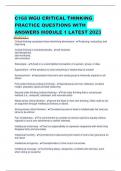
C168 WGU CRITICAL THINKING PRACTICE QUESTIONS WITH ANSWERS MODULE 1 LATEST 2023
C168 WGU CRITICAL THINKING PRACTICE QUESTIONS WITH ANSWERS MODULE 1 LATEST 2023 MODULE 1 Critical thinking comprises three interlinking dimensions - Analyzing, evaluating, and improving Critical thinking is characteristically - self-directed, self-disciplined, self-monitored, self-corrective Stereotype - A fixed or a oversimplified conception of a person, group, or idea Egocentrism - the tendency to view everything in relationship to oneself Sociocentrism - assumption that one's own social group is inherently superior to all others First-order thinking (ordinary thinking) - Spontaneous and non-reflective, contains insight, prejudice, good and bad reasoning Second-order thinking (critical thinking) - First-order thinking that is consciously realized (i.e., analyzed, assessed, and reconstructed) Weak sense critical thinkers - Ignore the flaws in their own thinking, Often seek to win an argument through intellectual trickery or deceit. Strong sense critical thinkers - Consistent pursuit of what is intellectually fair and just, strive to be ethical Fair mindedness - The commitment to consider al relevant opinions equally without regards to one's own sentiments or selfish interests. Intellectual unfairness - Feel no responsibility to represent viewpoints with which they disagree fairly and accurately Intelectual humility - Commitment to discovering the extent of one's own ignorance on any issue Intellectual arrogance - Overestimation of how much one knows Intellectual Courage - Confronting ideas, viewpoints, or beliefs with fairness, even when doing so is painful Intellectual cowardice - Fear of ideas that do not conform to one's own Intellectual Empathy - Inhabiting the perspectives of others in order to genuinely understand them Intellectual self-centeredness - Thinking centered on self Intellectual Integrity - Holding oneself to the same rigorous intellectual standards that one expects others to meet Intellectual dishonesty - Marked by contradictions and inconsistencies of which the perpetrator is unconscious Intellectual Perseverance - Working one's way through intellectual complexities despite frustrations inherent in doing so, Not giving up when confronted by complicated problems that don't lend themselves to easy solutions Intellectual laziness - Giving up quickly when confronted with a tough intellectual challenge Confidence in Reason - Proceeds from the belief that both the individual's and society's higher interests are best served by unfettered reason Intellectual distrust of reason - Lack of confidence in reason, Inclines us to assert the truth of our own beliefs, flawed though they might be Intellectual Autonomy - Thinking for oneself while adhering to standards of rationality Intellectual conformity - Intellectual dependence, Society rewards conformity of thought, which perpetuates the status quo (political, economic, or intellectual), while providing scant incentive for true intellectual autonomy Tactics for the beginning critical thinker - Use "wasted" time, Handle one problem per day, Internalize intellectual standards, Keep an intellectual journal, Practice intellectual strategies, Reshape your character, Deal with your ego, Redefine the way you see things, Get in touch with your emotions, Analyze group influences on your life. Three Functions of the Mind - Thinking, Feeling, and Wanting
Written for
- Institution
- C168 WGU CRITICAL THINKING PRACTICE
- Course
- C168 WGU CRITICAL THINKING PRACTICE
Document information
- Uploaded on
- December 16, 2023
- Number of pages
- 15
- Written in
- 2023/2024
- Type
- Exam (elaborations)
- Contains
- Questions & answers
Subjects
-
c168 wgu critical thinking practice questions
-
c168 wgu critical thinking practice quiz ans
-
c168 wgu critical thinking practice quiz ans2023

Also available in package deal