
Psychology of language
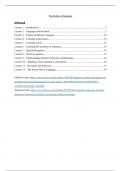
Inhoud
Lecture 1 – Introduction..............................................................................................................2
Lecture 2 – Language and the brain............................................................................................5
Lecture 3 – Origins of Human Language..................................................................................14
Lecture 4 – Learning sound patters...........................................................................................18
Lecture 5 – Learning words......................................................................................................22
Lecture 6 – Learning the structures of sentences......................................................................25
Lecture 7 – Speech Perception..................................................................................................30
Lecture 8 – Word recognition...................................................................................................37
Lecture 9 – Understanding Sentence Structure and Meaning...................................................45
Lecture 10 – Speaking: From planning to articulation..............................................................50
Lecture 11 – Discourse and inference.......................................................................................55
Lecture 12 – The Social Side of Language...............................................................................59
Midterm exam: https://www.stuvia.com/nl-nl/doc/2396390/language-in-mind-2nd-edition-an-
introduction-to-psycholinguistics-by-julie-sedivy.-isbn-9781605358369-1605358363.-
complete-download.-test-bank
Summary book: https://www.stuvia.com/nl-nl/doc/987745/full-summary-language-in-mind-
plus-notes-lectures-psychology-in-language-tilburg-university
,Lecture 1 – Introduction
Around 7000 languages that are spoken in the world, but not all have a lot of native speakers
Why look at language?
- It is all around us, everyone uses language
- Language is pretty complex
- Language use happens quickly, without too much effort or errors
- Often, we don’t realize what we do when we use language
- Language is interesting, funny, beautiful, evocative…
What is language?
- Always a good starting point when you do research
o What is the object of study?
o What is (and what isn’t) part of it?
o What does it look like?
o What is it used for?
- Try to define language
o What are its characteristics?
o What sets it apart from other aspects of human behavior?
Defining language
A system of form-meaning pairings that can be used to intentionally communicate meaning
- System: there is structure to the madness
- Form-meaning pairings: of different sizes, at various levels of specificity
- Use: different modalities, production, and perception
- Intentionally: producer wants to achieve something
- Communicate meaning: almost anything can be expressed
Language as a system
Usually thought of as ‘rules’, but (psycho)linguists are generally not prescriptivists.
- Meaning most researchers do not consider it their job to establish or guard the rules of
preferred language use (such as the use of ‘proper’ grammar, style, spelling, etc.)
- As teachers, however, we must make an exception…
,Rather we describe and try to understand and perhaps predict systematicities at different
levels: sounds, words, phrases, clauses, sentences, discourse.
Form-meaning pairings
- The most intuitive form-meaning unit is a word, but we will see that there are units of
different sizes:
o Un- in unpleasant
o The X- er the Y-er (the sooner the better; the more you pay attention, the more
you’ll remember)
Language use
- Language is spoken and heard, signed and seen, and written and read
- Language is acquired, learned, and sometimes forgotten or lost
o If you acquire a language, it is spontaneous (as a child)
o Learning are the languages you learn at school
- We know that we can use language
- We don’t necessarily know how we do it: there is much about which we are unaware
(how do you move your tongue when you speak?)
Intentional communication
- We use language to exchange information, to express emotions, to get others to do
something, etc.
- This makes language very relevant for students of communication sciences
Communicating meaning
- We can communicate almost anything, including
o Deceiving and saying things that are not true (prevarication)
o Talking about things that are not physically present or do not exist
(displacement)
These are two of Hockett’s ‘design features’, more about these in week 3
Linguistics – the study of language
, Language can be studied in a number of different ways, at different levels
and with different foci
• Phonetics (the study of raw sounds)
• Phonology (the study of how sounds are used within a language)
• Morphology (the study of words and word formation)
• Semantics (the study of meaning)
• Syntax (the study of word order)
• Pragmatics (the study of language use)
• Discourse studies (the study of language in interaction)
... and this is not an exhaustive list
Psychology of language
- The study of language in mind and brain
- Focus on acquiring and processing language
- Often from a cognitive point of view (memory, attention, etc.)
- Approaching language from a functional perspective
Evidence
If this is the field of study, what types of evidence would we need and value when we
research it?
- Actual language use (production and perception)
- Language processing data: eye tracking, brain activity
- Behavior as influenced by language
- Attitudinal measures
- Errors, problems in language use
If this is the field of study, what types of evidence would we need and value when we
research it?
Lots of experimental data (e.g., reaction times in lexical decision tasks)
- Tightly controlled for many factors, but...
- Not very realistic / close to what people do in real life
So be critical! Keep asking yourself (and us): what does this experimental result imply for
how we store and use language?
Inhoud
Lecture 1 – Introduction..............................................................................................................2
Lecture 2 – Language and the brain............................................................................................5
Lecture 3 – Origins of Human Language..................................................................................14
Lecture 4 – Learning sound patters...........................................................................................18
Lecture 5 – Learning words......................................................................................................22
Lecture 6 – Learning the structures of sentences......................................................................25
Lecture 7 – Speech Perception..................................................................................................30
Lecture 8 – Word recognition...................................................................................................37
Lecture 9 – Understanding Sentence Structure and Meaning...................................................45
Lecture 10 – Speaking: From planning to articulation..............................................................50
Lecture 11 – Discourse and inference.......................................................................................55
Lecture 12 – The Social Side of Language...............................................................................59
Midterm exam: https://www.stuvia.com/nl-nl/doc/2396390/language-in-mind-2nd-edition-an-
introduction-to-psycholinguistics-by-julie-sedivy.-isbn-9781605358369-1605358363.-
complete-download.-test-bank
Summary book: https://www.stuvia.com/nl-nl/doc/987745/full-summary-language-in-mind-
plus-notes-lectures-psychology-in-language-tilburg-university
,Lecture 1 – Introduction
Around 7000 languages that are spoken in the world, but not all have a lot of native speakers
Why look at language?
- It is all around us, everyone uses language
- Language is pretty complex
- Language use happens quickly, without too much effort or errors
- Often, we don’t realize what we do when we use language
- Language is interesting, funny, beautiful, evocative…
What is language?
- Always a good starting point when you do research
o What is the object of study?
o What is (and what isn’t) part of it?
o What does it look like?
o What is it used for?
- Try to define language
o What are its characteristics?
o What sets it apart from other aspects of human behavior?
Defining language
A system of form-meaning pairings that can be used to intentionally communicate meaning
- System: there is structure to the madness
- Form-meaning pairings: of different sizes, at various levels of specificity
- Use: different modalities, production, and perception
- Intentionally: producer wants to achieve something
- Communicate meaning: almost anything can be expressed
Language as a system
Usually thought of as ‘rules’, but (psycho)linguists are generally not prescriptivists.
- Meaning most researchers do not consider it their job to establish or guard the rules of
preferred language use (such as the use of ‘proper’ grammar, style, spelling, etc.)
- As teachers, however, we must make an exception…
,Rather we describe and try to understand and perhaps predict systematicities at different
levels: sounds, words, phrases, clauses, sentences, discourse.
Form-meaning pairings
- The most intuitive form-meaning unit is a word, but we will see that there are units of
different sizes:
o Un- in unpleasant
o The X- er the Y-er (the sooner the better; the more you pay attention, the more
you’ll remember)
Language use
- Language is spoken and heard, signed and seen, and written and read
- Language is acquired, learned, and sometimes forgotten or lost
o If you acquire a language, it is spontaneous (as a child)
o Learning are the languages you learn at school
- We know that we can use language
- We don’t necessarily know how we do it: there is much about which we are unaware
(how do you move your tongue when you speak?)
Intentional communication
- We use language to exchange information, to express emotions, to get others to do
something, etc.
- This makes language very relevant for students of communication sciences
Communicating meaning
- We can communicate almost anything, including
o Deceiving and saying things that are not true (prevarication)
o Talking about things that are not physically present or do not exist
(displacement)
These are two of Hockett’s ‘design features’, more about these in week 3
Linguistics – the study of language
, Language can be studied in a number of different ways, at different levels
and with different foci
• Phonetics (the study of raw sounds)
• Phonology (the study of how sounds are used within a language)
• Morphology (the study of words and word formation)
• Semantics (the study of meaning)
• Syntax (the study of word order)
• Pragmatics (the study of language use)
• Discourse studies (the study of language in interaction)
... and this is not an exhaustive list
Psychology of language
- The study of language in mind and brain
- Focus on acquiring and processing language
- Often from a cognitive point of view (memory, attention, etc.)
- Approaching language from a functional perspective
Evidence
If this is the field of study, what types of evidence would we need and value when we
research it?
- Actual language use (production and perception)
- Language processing data: eye tracking, brain activity
- Behavior as influenced by language
- Attitudinal measures
- Errors, problems in language use
If this is the field of study, what types of evidence would we need and value when we
research it?
Lots of experimental data (e.g., reaction times in lexical decision tasks)
- Tightly controlled for many factors, but...
- Not very realistic / close to what people do in real life
So be critical! Keep asking yourself (and us): what does this experimental result imply for
how we store and use language?


