LE 2 – Pathology
November 10th, 2023
Chapter 5: Neoplasia (Rubin’s Pathology). The Pathology of Neoplasia + The Biology and Molecular
Pathogenesis of Cancer (excluding Epigenetics Mechanisms, Cancer Cell Metabolism, Cancer Stem Cells
and Tumor Heterogeneity, The Immune System and Cancer).
Pathology
‘’The study of suffering’’
• Cause and mechanism of disease processes
• Structural and functional changes in cells, tissues and organs
• Consequences of the changes
Cause = etiology
Mechanism = pathogenesis
Structural changes = morphology
Consequences = clinical significance (symptoms, course and outcome)
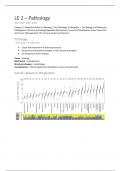
Cancer: disease of the genome
,From DNA to (aberrant) cellular function
10 hallmarks (or attributes) of cancer
Errors during DNA replication
The more cell divisions, the higher risk of introduced genetic aberrations, the higher risk for cancer
development.
, DNA damage induced by physical and chemical agents
Mutational signature associated with tobacco smoking
The profile is similar to the mutational spectrum observed in the experimental systems exposed to
tobacco carcinogens. This signature is, therefore, likely due to direct DNA damage by tobacco smoke
mutagens.
Drivers and passengers
• Driver mutations confer a selective advantage on the cell.
• Driver mutations can be linked to cancer phenotypes; the hallmarks.
Frequently mutated genes in CRC (Colorectal Cancer)
Oncogenes (activation)
• Regulators of cell growth and differentiation (e.g., KRAS)
Tumor suppressor genes (inactivation)
• Gatekeepers (e.g., TP53 → apoptosis)
• Caretakers (e.g., mismatch repair genes → genome stability
November 10th, 2023
Chapter 5: Neoplasia (Rubin’s Pathology). The Pathology of Neoplasia + The Biology and Molecular
Pathogenesis of Cancer (excluding Epigenetics Mechanisms, Cancer Cell Metabolism, Cancer Stem Cells
and Tumor Heterogeneity, The Immune System and Cancer).
Pathology
‘’The study of suffering’’
• Cause and mechanism of disease processes
• Structural and functional changes in cells, tissues and organs
• Consequences of the changes
Cause = etiology
Mechanism = pathogenesis
Structural changes = morphology
Consequences = clinical significance (symptoms, course and outcome)
Cancer: disease of the genome
,From DNA to (aberrant) cellular function
10 hallmarks (or attributes) of cancer
Errors during DNA replication
The more cell divisions, the higher risk of introduced genetic aberrations, the higher risk for cancer
development.
, DNA damage induced by physical and chemical agents
Mutational signature associated with tobacco smoking
The profile is similar to the mutational spectrum observed in the experimental systems exposed to
tobacco carcinogens. This signature is, therefore, likely due to direct DNA damage by tobacco smoke
mutagens.
Drivers and passengers
• Driver mutations confer a selective advantage on the cell.
• Driver mutations can be linked to cancer phenotypes; the hallmarks.
Frequently mutated genes in CRC (Colorectal Cancer)
Oncogenes (activation)
• Regulators of cell growth and differentiation (e.g., KRAS)
Tumor suppressor genes (inactivation)
• Gatekeepers (e.g., TP53 → apoptosis)
• Caretakers (e.g., mismatch repair genes → genome stability