LE 1 – Epidemiological aspects of
tumors
November 10th, 2023
Life-time risk
Females 1 in 3
Males 1 in 2
Key epidemiolocal concepts
Prevalence
Incidence
Mortality
Relative survival
Prevalence = nr. of people with cancer / population at risk (at a certain time).
Incidence = nr of newly diagnosed cases of cancer / population at risk (at a certain time).
Incidence
Number: absolute number of new cases in a certain period.
CR (crude rate): nr of new cases per 100,000 persons per year.
ESR (European standardized rate): nr of new cases per 100,00 persons per year, standardized
to the population of Europe.
WSR (World standardized rate): nr of new cases per 100,000 persons per year, standardized
to the population of the entire world.
Mortality = nr of cases that died from cancer / population at risk (at a certain time).
Relative survival = % of cancer cases alive / % of people of same age and sex expected to be alive in
the general population.
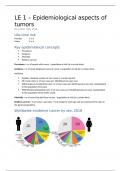
Worldwide incidence cancer by sex, 2018
, Worldwide differences in stomach cancer incidence
Higher incidence in Russia and Asia.
Helicobacter pylori
Food conservation
Worldwide differences in liver cancer incidence
Higher incidence in Asia.
Hepatitis B
Aflatoxin
Worldwide difference sin cervical cancer
Higher incidence in Africa.
Human Papillomavirus
Age is the most important risk factor for cancer in
general.
Time needed for accumulation of damage to daughter cells. Mutation in regulatory genes are
spontaneous or can be caused by chemical substances, radiation, or viruses.
Protective tools
DNA repair
Apoptosis
Mitosis stops (senescence)
Cancer at older age due to accumulation of damage, mutations in regulatory genes or other damage
to repair tools, making them less effective. This results to less control by micro-environment.
Grey pressure
Enormous public health problem
Double aging phenomenon
Better survival because of early detection and/or improved treatment.
More expensive health care due to late stage diagnosis and treatment options.
Focus on prevention.
How do you identify causes of cancer
1. Accidental finding / keep alert
2. Systematic counting / trends
3. Focused research: human observational studies, experimental studies
4. Exploration
tumors
November 10th, 2023
Life-time risk
Females 1 in 3
Males 1 in 2
Key epidemiolocal concepts
Prevalence
Incidence
Mortality
Relative survival
Prevalence = nr. of people with cancer / population at risk (at a certain time).
Incidence = nr of newly diagnosed cases of cancer / population at risk (at a certain time).
Incidence
Number: absolute number of new cases in a certain period.
CR (crude rate): nr of new cases per 100,000 persons per year.
ESR (European standardized rate): nr of new cases per 100,00 persons per year, standardized
to the population of Europe.
WSR (World standardized rate): nr of new cases per 100,000 persons per year, standardized
to the population of the entire world.
Mortality = nr of cases that died from cancer / population at risk (at a certain time).
Relative survival = % of cancer cases alive / % of people of same age and sex expected to be alive in
the general population.
Worldwide incidence cancer by sex, 2018
, Worldwide differences in stomach cancer incidence
Higher incidence in Russia and Asia.
Helicobacter pylori
Food conservation
Worldwide differences in liver cancer incidence
Higher incidence in Asia.
Hepatitis B
Aflatoxin
Worldwide difference sin cervical cancer
Higher incidence in Africa.
Human Papillomavirus
Age is the most important risk factor for cancer in
general.
Time needed for accumulation of damage to daughter cells. Mutation in regulatory genes are
spontaneous or can be caused by chemical substances, radiation, or viruses.
Protective tools
DNA repair
Apoptosis
Mitosis stops (senescence)
Cancer at older age due to accumulation of damage, mutations in regulatory genes or other damage
to repair tools, making them less effective. This results to less control by micro-environment.
Grey pressure
Enormous public health problem
Double aging phenomenon
Better survival because of early detection and/or improved treatment.
More expensive health care due to late stage diagnosis and treatment options.
Focus on prevention.
How do you identify causes of cancer
1. Accidental finding / keep alert
2. Systematic counting / trends
3. Focused research: human observational studies, experimental studies
4. Exploration