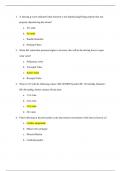
1.A missing p-wave indicated what structure is not depolarizing/firing properly thus not properly depolarizing the atrium?
a.AV node
b.SA node
c.Bundle Branches
d.Perkinje Fibers
2.When left ventricular pressure begins to increase, this will be the driving force to open what valve?
a.Pulmonary valve
b.Tricuspid Valve
c.Aortic Valve
d.Bicuspid Valve
3.What is CO with the following values: HR: 60 BPM Systolic BP: 120 mmHg, Diastolic:
BP: 80 mmHg, Stroke volume: 60 mL/beat
a.1.5 L/min
b.2.0 L/min
c.3.6 L/min
d.36 L/min
4.Fluid collecting in the pericardial cavity that restricts movement of the heart is known as?
a.Cardiac tamponade
b.Mitral valve prolapse
c.Pleural affusion
d.Cardiomyopathy 5.Structure that permits blood flow from right atrium to the left atrium in fetal circulation?
a.Foramen ovale
b.Interatrial septum
c.Coronary sinus
d.Fossa ovalis
6.Blood leaves the right ventricle by passing through which of the following valves? Exam
question
a.Aortic Valve
b.Pulmonary Valve
c.Mitral Valve
d.Tricuspid Valve
7.The cusps (leaflets) of atrioventricular valves attach directly to the ?
a.Papillary muscle
b.Trabeculae carneae
c.Chordae tendineae
d.Coronary sulci
8.Contraction of papillary muscles:
a.Close the atrioventricular valves
b.Close the semilunar valves
c.Eject blood from the ventricles
d.Prevents the atrioventricular valve eversion
9.The visceral pericardium is the same as the:
a.Mediastinum
a.AV node
b.SA node
c.Bundle Branches
d.Perkinje Fibers
2.When left ventricular pressure begins to increase, this will be the driving force to open what valve?
a.Pulmonary valve
b.Tricuspid Valve
c.Aortic Valve
d.Bicuspid Valve
3.What is CO with the following values: HR: 60 BPM Systolic BP: 120 mmHg, Diastolic:
BP: 80 mmHg, Stroke volume: 60 mL/beat
a.1.5 L/min
b.2.0 L/min
c.3.6 L/min
d.36 L/min
4.Fluid collecting in the pericardial cavity that restricts movement of the heart is known as?
a.Cardiac tamponade
b.Mitral valve prolapse
c.Pleural affusion
d.Cardiomyopathy 5.Structure that permits blood flow from right atrium to the left atrium in fetal circulation?
a.Foramen ovale
b.Interatrial septum
c.Coronary sinus
d.Fossa ovalis
6.Blood leaves the right ventricle by passing through which of the following valves? Exam
question
a.Aortic Valve
b.Pulmonary Valve
c.Mitral Valve
d.Tricuspid Valve
7.The cusps (leaflets) of atrioventricular valves attach directly to the ?
a.Papillary muscle
b.Trabeculae carneae
c.Chordae tendineae
d.Coronary sulci
8.Contraction of papillary muscles:
a.Close the atrioventricular valves
b.Close the semilunar valves
c.Eject blood from the ventricles
d.Prevents the atrioventricular valve eversion
9.The visceral pericardium is the same as the:
a.Mediastinum