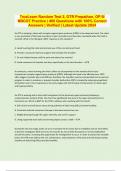
TrueLearn Random Test 2, OTR Prepathon, OP III NBCOT Practice | 460 Questions with 100% Correct Answers | Verified | Latest Update 2024 | 143 Pages
An OTR is treating a client with complex regional pain syndrome (CRPS) in the dominant hand. The client is very protective of the hand secondary to pain and edema and becomes nauseated when the hand is touched. What is the therapist's BEST response to this situation? A. Avoid touching the hand and promote use of the non-dominant hand B. Provide a structured exercise program that includes the shoulder C. Do not initiate therapy until the pain and edema has resolved D. Avoid movement of shoulder and focus specifically on the hand function - B A continuous, severe burning pain that is often out of proportion to the severity of the injury characterizes complex regional pain syndrome (CRPS). Although the hand is the affected area, CRPS often triggers shoulder pain and stiffness; therefore, the shoulder must be incorporated into an exercise program in order to maintain or prevent shoulder dysfunction.CRPS is treated by reducing sympathetic stimulation and is most responsive in the early stages with the first goal of intervention to reduce pain and hypersensitivity. An OTR is working with a client with hemiparesis of the dominant upper extremity following a cerebrovascular accident (CVA). The client has significantly low tone in the upper extremity and no functional use. Which is BEST for the OTR to address when working with this client? A. Risk of joint and soft tissue injury during activities of daily living (ADLs) and bed mobility B. Constraint-induced movement therapy to decrease learned non-use C. Weight-bearing through the upper extremity and use for support D. Using supported reach tasks and moving objects across a table - A During the low tone stage, joints are at an increased risk for injury due to instability and are more likely to become misaligned. With low tone, the muscles do not provide the typical or normal stabilization around the joints, increasing the opportunity for misalignment to occur. In order to protect the unstable joints, the OTR must address the risk, maintenance, and protection of the joints and soft tissues during activities of daily living (ADLs) and bed mobility.
Written for
- Institution
- TrueLearn
- Course
- TrueLearn
Document information
- Uploaded on
- December 13, 2023
- Number of pages
- 143
- Written in
- 2023/2024
- Type
- Exam (elaborations)
- Contains
- Questions & answers
Subjects
-
truelearn random test 2 otr prepathon op iii nbc

Also available in package deal