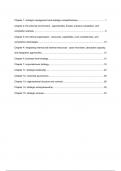
Chapter 1: strategic management and strategic competitiveness............................................ 1
Chapter 2: the external environment - opportunities, threats, industry competition, and
competitor analysis................................................................................................................... 6
Chapter 3: the internal organisation - resources, capabilities, core competencies, and
competitive advantages.......................................................................................................... 10
Chapter 4: integrating internal and external resources - open innovation, absorptive capacity,
and integration approaches.................................................................................................... 12
Chapter 5: business-level strategy..........................................................................................15
Chapter 7: corporate-level strategy.........................................................................................18
Chapter 11: strategic leadership............................................................................................. 23
Chapter 12: corporate governance......................................................................................... 26
Chapter 13: organisational structure and controls.................................................................. 28
Chapter 14: strategic entrepreneurship.................................................................................. 30
Chapter 15: strategic renewal................................................................................................. 33
,Chapter 1: strategic management and strategic competitiveness
The strategic management process
Part 1: Inputs
1. Strategic management and strategic competitiveness
2. The external environment
3. The internal organisation
4. Integrating internal and external resources
Part 2: Formulation
5. Business-level strategy
6. Competitive rivalry and competitive dynamics
7. Corporate-level strategy
8. Strategic acquisition and restructuring
9. International strategy
10. Cooperative strategy
Part 3: Implementation
11. Strategic leadership
12. Corporate governance
13. Organisational structure and controls
14. Strategic entrepreneurship
15. Strategic renewal
1
,Strategic competitiveness: when a firm successfully formulates and implements a
value-creating strategy
Strategy: an integrated and coordinated set of commitments and actions designed to develop
and exploit core competencies and gain a competitive advantage
- Firms make choices among competing alternatives as the pathway for deciding how
they will pursue strategic competitiveness
Competitive advantage: when a firm implements a strategy competitors are unable to
duplicate of ding too costly to try to imitate
- Edge a firm has over other firms
- Is not permanent
Strategic management procesS: fill set of commitments, decisions, and actions required for a
firm to achieve strategic competitiveness and earn above-average returns
- Is a dynamic process
- Analyse external environment and internal organisation → to determine resources,
capabilities, and core competencies
- Develop mission and formulate strategy
The competitive landscape
- Nature of competition is evolving due to factors like financial capital scarcity, market
volatility, and technological advances.
- Change in competition leads to blurred industry boundaries and emphasising the →
maintain competitiveness with cross-industry partnerships
- Conventional sources of competitive advantage (ex. economies of scale and
extensive advertising budgets) are becoming less effective
- Traditional managerial mindsets need to be replaced with a new mindset valuing
flexibility, speed, innovation, and integration
- Governments are more involved in regulating markets, especially for firms operating
globally, increasing the complexity of building competitive advantage.
Hypercompetition: describes a rapidly changing competitive landscape characterised by
inherent instability and constant change
- Results from strategic manoeuvring, global competition, price-quality positioning, and
the pursuit of first-mover advantage
- Factors driving hypercompetition include the global economy and rapid technological
change.
The global economy
Global economy: an economy in which goods, services, people, skills, and ideas move freely
across geographic borders
- Significantly expands and complicates a firm’s competitive environment
- Creates a hypercompetitive business environment
2
, The march of globalisation
Globalisation: the increasing economic interdependence among countries and their
organisations as reflected in the flow of goods and services, financial capital, and knowledge
across country borders
- Is a product of a large number of firms competing against one another in an
increasing number of global economies
- Financial capital might be obtained in one market and used in another → globalisation
increased the range of opportunities for competition
- Must make culturally sensitive decisions
- Globalisation leads to higher levels of performance standards → affects domestic
firms as well
- Risk of entering global market → amount of time required to acquire knowledge about
new markets
Technology and technological changes
Technology diffusion and disruptive technologies
- Technology diffusion: speed at which new technologies become available and are
used
- Perpetual innovation: rapid and consistent new information-intensive technologies
replace older ones
- Speed of innovation to gain competitive advantage
- Reduces benefits of patents
- Disruptive technologies: technologies that destroy the value of an existing technology
and create new markets
The information age
- Ability to effectively and efficiently access and use information has become an
important source of competitive advantage
- Information technology gives small firms flexibility to compete with large firms
Increasing knowledge intensity
- Firm survival depends on ability to capture and transform intelligence into knowledge
- Must build routines that facilitate diffusion of knowledge throughout organisation →
need strategic flexibility
- Strategic flexibility: set of capabilities used to respond to various demands and
opportunities existing in a dynamic and uncertain competitive environment
The I/O model of above average returns
- I/O model = explains the external environment’s dominant influence on a firm’s
strategic actions (Industrial organisational model)
- The model specifies that the industry of a company has a stronger influence on
performance than internal choices of managers
3
Chapter 2: the external environment - opportunities, threats, industry competition, and
competitor analysis................................................................................................................... 6
Chapter 3: the internal organisation - resources, capabilities, core competencies, and
competitive advantages.......................................................................................................... 10
Chapter 4: integrating internal and external resources - open innovation, absorptive capacity,
and integration approaches.................................................................................................... 12
Chapter 5: business-level strategy..........................................................................................15
Chapter 7: corporate-level strategy.........................................................................................18
Chapter 11: strategic leadership............................................................................................. 23
Chapter 12: corporate governance......................................................................................... 26
Chapter 13: organisational structure and controls.................................................................. 28
Chapter 14: strategic entrepreneurship.................................................................................. 30
Chapter 15: strategic renewal................................................................................................. 33
,Chapter 1: strategic management and strategic competitiveness
The strategic management process
Part 1: Inputs
1. Strategic management and strategic competitiveness
2. The external environment
3. The internal organisation
4. Integrating internal and external resources
Part 2: Formulation
5. Business-level strategy
6. Competitive rivalry and competitive dynamics
7. Corporate-level strategy
8. Strategic acquisition and restructuring
9. International strategy
10. Cooperative strategy
Part 3: Implementation
11. Strategic leadership
12. Corporate governance
13. Organisational structure and controls
14. Strategic entrepreneurship
15. Strategic renewal
1
,Strategic competitiveness: when a firm successfully formulates and implements a
value-creating strategy
Strategy: an integrated and coordinated set of commitments and actions designed to develop
and exploit core competencies and gain a competitive advantage
- Firms make choices among competing alternatives as the pathway for deciding how
they will pursue strategic competitiveness
Competitive advantage: when a firm implements a strategy competitors are unable to
duplicate of ding too costly to try to imitate
- Edge a firm has over other firms
- Is not permanent
Strategic management procesS: fill set of commitments, decisions, and actions required for a
firm to achieve strategic competitiveness and earn above-average returns
- Is a dynamic process
- Analyse external environment and internal organisation → to determine resources,
capabilities, and core competencies
- Develop mission and formulate strategy
The competitive landscape
- Nature of competition is evolving due to factors like financial capital scarcity, market
volatility, and technological advances.
- Change in competition leads to blurred industry boundaries and emphasising the →
maintain competitiveness with cross-industry partnerships
- Conventional sources of competitive advantage (ex. economies of scale and
extensive advertising budgets) are becoming less effective
- Traditional managerial mindsets need to be replaced with a new mindset valuing
flexibility, speed, innovation, and integration
- Governments are more involved in regulating markets, especially for firms operating
globally, increasing the complexity of building competitive advantage.
Hypercompetition: describes a rapidly changing competitive landscape characterised by
inherent instability and constant change
- Results from strategic manoeuvring, global competition, price-quality positioning, and
the pursuit of first-mover advantage
- Factors driving hypercompetition include the global economy and rapid technological
change.
The global economy
Global economy: an economy in which goods, services, people, skills, and ideas move freely
across geographic borders
- Significantly expands and complicates a firm’s competitive environment
- Creates a hypercompetitive business environment
2
, The march of globalisation
Globalisation: the increasing economic interdependence among countries and their
organisations as reflected in the flow of goods and services, financial capital, and knowledge
across country borders
- Is a product of a large number of firms competing against one another in an
increasing number of global economies
- Financial capital might be obtained in one market and used in another → globalisation
increased the range of opportunities for competition
- Must make culturally sensitive decisions
- Globalisation leads to higher levels of performance standards → affects domestic
firms as well
- Risk of entering global market → amount of time required to acquire knowledge about
new markets
Technology and technological changes
Technology diffusion and disruptive technologies
- Technology diffusion: speed at which new technologies become available and are
used
- Perpetual innovation: rapid and consistent new information-intensive technologies
replace older ones
- Speed of innovation to gain competitive advantage
- Reduces benefits of patents
- Disruptive technologies: technologies that destroy the value of an existing technology
and create new markets
The information age
- Ability to effectively and efficiently access and use information has become an
important source of competitive advantage
- Information technology gives small firms flexibility to compete with large firms
Increasing knowledge intensity
- Firm survival depends on ability to capture and transform intelligence into knowledge
- Must build routines that facilitate diffusion of knowledge throughout organisation →
need strategic flexibility
- Strategic flexibility: set of capabilities used to respond to various demands and
opportunities existing in a dynamic and uncertain competitive environment
The I/O model of above average returns
- I/O model = explains the external environment’s dominant influence on a firm’s
strategic actions (Industrial organisational model)
- The model specifies that the industry of a company has a stronger influence on
performance than internal choices of managers
3