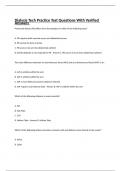
Dialysis Tech Practice Test Questions With Verified Answers
Peritoneal dialysis (PD) differs from hemodialysis in which of the following ways? A. PD requires both vascular access and abdominal access B. PD cannot be done at home C. PD access is by an intra-abdominal catheter D. Sterile dialysate is not required for PD - Answer C. PD access is by an intra-abdominal catheter The main difference between an arteriovenous shunt (AVS) and an arteriovenous fistula (AVF) is an: A. AVS is entirely within the arm B. AVF is entirely within the arm C. AVF is more likely to become clotted or infected D. AVF requires and external tube - Answer B. AVF is entirely within the arm Which of the following dialyzers is used currently? A. Kiil B. Flat Plate C. Coil D. Hollow Tube - Answer D. Hollow Tube Which of the following kidney structures connects with and delivers urine directly to the ureter? A. Pelvis B. Calyx C. Glomerulus D. Cortex - Answer A. Pelvis The glomerular filtration rate is an important index of renal function and in the normal adult is approximately: A. 50mL/min/1.73 m2 B. 75 mL/min/1.73 m2 C. 125 mL/min/1.73 m2 D. 200 mL/min/1.73 m2 - Answer C. 125mL/min/1.73 m2 All of the following substances are produced by the kidney except: A. Rennin B. Aldosterone C. Erythropoietin D. Calcitriol - Answer B. Aldosterone The most likely cause of post-renal failure is: A. Severe Dehydration B. Nephrotoxic Drug C. Glomerulonephritis D. Benign Prostatic Hypertrophy - Answer D. Benign Prostatic Hypertrophy The most common cause of chronic kidney disease in the United States is: A. Diabetes B. Hypertension C. Glomerulonepheritis D. Polycystic Kidney Disease - Answer A. Diabetes Uremia may cause which of the following conditions? A. Itching B. Edema (swelling) of the extremities C. Anemia D. All of the above - Answer D. All of the above All of the following conditions are associated with chronic kidney failure EXCEPT: A. Low Hemoglobin B. Hypoparathyroidism C. Hyperkalemia D. Hyperphosphatemia - Answer B. Hypoparathyroidism What percentage of transplanted kidneys is functional 1 year after transplantation? A. 90% B. 70% C. 50% D. 30% - Answer A. 90% Which hemodialysis schedule is likely to be most efficient? A. In-center hemodialysis, 3-4 hours a session, 3 days a week B. Conventional home hemodialysis C. Short daily home hemodialysis, 2-3 hours a session, 5-7 days a week D. Nocturnal home hemodialysis, 8 hours during sleep, 3 days a week - Answer C. Short daily home hemodialysis, 2-3 hours a session, 5-7 days a week The fluid restriction for most patients undergoing in-center hemodialysis is equal to urine volume/day plus: A. 0 L. B. 0.5 L. C. 1 L. D. 2 L. - Answer C. 1 L. Failure to excrete beta2-microglobulin in patients with kidney failure predisposes to: A. Pericarditis B. Amyloidosis C. Neuropathy D. Seizures - Answer B. Amyloidosis Blood tests for ferritin are performed in hemodialysis patients: A. To check for iron stores B. To check for magnesium levels C. As an alternative to hemoglobin concentration D. To maintain electrolyte balance - Answer A. To check for iron stores Which of the following phosphate binders would best control hyperphosphatemia with the fewest side effects in patients with end stage kidney disease? A. Aluminum hydroxide B. Calcium carbonate C. High dairy product diet D. Lanthanum carbonate - Answer D. Lanthanum carbonate Hemodialysis patients should be taught to: A. Put in their own needles B. Weigh themselves and record it C. Check their dialyzer settings and dialysate D. Do all of the above - Answer D. Do all of the above All of the following statements about vitamins in dialysis patients are true EXCEPT: A. Dialysis does not remove water-soluble vitamins B. Supplemental B-complex vitamins should be given C. Vitamin D should be given to most dialysis patients D. Megadose fat- or water-soluble vitamins should not be given - Answer A. Dialysis does not remove water-soluble vitamins Osmosis is best defined as: A. Diffusion of solute through a semipermeable membrane from a high to low solute concentration B. Diffusion of solvent through a semipermeable membrane from low to high solute concentration C. A version of hydraulic pressure used in dialysis D. Diffusion of solvent through a semipermeable membrane from high to low solute concentration - Answer B. Diffusion of solvent through a semipermeable membrane form low to high solute concentration In hemodialysis, blood and dialysate have which of the following properties? A. They flow in the same direction B. They flow is the opposite direction C. They mix within the dialyzer D. They do not require a semipermeable membrane - Answer B. The flow is in the opposite direction In the dialyzer, water may be removed from: A. The intracellular compartment B. The intravascular compartment C. The interstitial compartment D. All of the above compartments - Answer C. The interstitial compartment Which site in the hemodialysis pathway has the highest positive pressure? A. Arterial blood in the afferent tubing B. Blood entering the dialyzer fibers C. Blood leaving the dialyzer fibers D. Blood in the venous return - Answer B. Blood entering the dialyzer fibers The term "sieving coefficient of a membrane" refers to the: A. Fraction of solute that passes through the membrane by convection B. Amount of water required for solute drag through the membrane C. Concentration of pores in the membrane D. Size of the pores in the membrane - Answer A. Fraction of solute that passes through the membrane by convection Water moves from one body compartment to another by: A. Ultrafiltration B. Active Transport C. Osmotic Forces D. All of the above - Answer C. Osmotic Forces Biocompatibility is best illustrated by: A. Synthetic membranes that do not adsorb blood proteins as well as cellulose membranes B. Independence from protein adsorption of the membrane C. Reprocessed dialyzers that have a lower biocompatibility than new ones D. Reprocessed dialyzers that have better biocompatibility than new ones - Answer D. Reprocessed dialyzers that have a better biocompatibility than new ones The amount of fluid to be taken from the patient during hemodialysis: A. Is independent of the filtration pressure B. Requires the dialysate to have a higher pressure than the blood C. May be calculated by subtracting the patient's estimated dry weight form the pre-dialysis weight and adding any fluid the patient receives during treatment D. May be calculated by adding the patient's pre-dialysis weight and the amount of fluid the patient receives during treatment - Answer C. May be calculated by subtracting the patient's estimated dry weight from the pre-dialysis weight and adding any fluid the patient receives during treatment The ultrafiltration coefficient of a dialyzer refers to the: A. Fluid that passes through the membrane in 1 hour B. Pressure in the blood compartment needed to force fluid through the membrane C. Pressure difference across the membrane D. Fluid that passes through the membrane in 1 minute - Answer A. Fluid that passes through the membrane in 1 hour The molecular weight cutoff of a dialyzer is 12,000 daltons. Which of the following molecules would not pass through the membrane into the dialysate? A. Phosphate B. Urea C. Albumin D. Sodium - Answer C. Albumin Clearance of low-molecular-weight molecules by dialysis is accomplished mostly by: A. Convection B. Diffusion C. Adsorption D. Solvent Drag - Answer B. Diffusion A hollow fiber dialyzer has which of the following properties? A. Very fine fiber tubes held in place polyurethane material B. Fibers about 1 cm in width C. A high membrane compliance D. A high resistance in the fibers, enhancing ultrafiltration pressure - Answer A. Very fine fiber tubes held in place by polyurethane material Synthetic membranes have which of the following properties? A. They are cellulose membranes in which hydroxyl groups are replaced with acetate B. They have thick fiber walls C. They have poor adsorption D. They remove solute by diffusion only - Answer B. They have thick fiber walls If a dialyzer has a urea clearance ret (K) of 200mL/min and a blood flow rate (Qb) of 300 mL/min, what volume of the blood will be cleared of urea in 1 minute: A. 100 mL B. 200 mL C. 300 mL D. 500 mL - Answer B. 200mL To determine the most accurate clearance rate of a particular solute, one should: A. Use water instead of blood B. Use a large-molecular-weight-molecule C. Reduce the manufacturer's state rate by 10% D. Measure the solute concentrations of blood going into and out of the dialyzer - Answer D. Measure the solute concentrations of blood going into and out of the dialyzer All of the following substances are added to the dialysate EXCEPT: A. Bicarbonate B. Chloride C. Sodium D. Phosphate - Answer D. Phosphate Sodium Modeling refers to: A. Changing the concentration of the dialysate sodium during the course of dialysis B. Injecting sodium chloride directly into the patient's vein C. Adjusting the sodium concentrate of the dialysate with normal saline D. None of the above - Answer A. Changing the concentration of the dialysate sodium during the course of dialysis Conductivity is best defined as: A. A method of checking electrolyte levels in the dialysate B. The voltage required to maintain the dialysis pump to achieve a given flow rate C. A monitor and alarm system to measure dialysate flow rate D. Something that is measured once to check the final ionic concentrations of the dialysate - Answer A. A method of checking electrolyte levels in the dialysate Which of the following statements about the proportioning system is correct? A. The concentrates are mixed manually B. It relies on a continuous supply of fresh concentrate and treated water C. The concentrates are heated after mixing D. Fixed-ration mixing is the only method used - Answer B. It relies on a continuous supply of fresh concentrate and treated water An advantage of high-flux dialysis is: A. Small pore size B. Fast removal of fluid C. Retention of beta2-microglobulin in the blood D. Slow blood flow, leading to more efficient removal of toxic substances - Answer B. Fast removal of fluid A disadvantage of high-flux dialysis is: A. Acetate must be used instead bicarbonate buffer B. Membrane biocompatibility is reduced C. Pyrogen reactions are common D. Post-dialysis fatigue is common - Answer C. Pyrogen Reactions are common All of the following statements regarding home dialysis are true EXCEPT: A. A spouse's or other family member's assistance is desirable B. A visiting dialysis nurse may be employed C. The patient and assistant must train for 6-8 weeks D. It cannot be done during sleep - Answer D. It cannot be done during sleep In most dialysate systems, the temperature: A. Is maintained by a thermistor-controlled heater B. Is maintained between 41 degrees Celsius - 43 degrees Celsius C. Of water is raised only after mixing with concentrate D. Is decreased to increase diffusion - Answer A. Is maintained by a thermistor-controlled heater Dialysate flow rate has which of the following properties? A. Lower flow rates improve dialysate efficiency B. It is always preset C. It may vary from 0-2000 mL/min D. Low water pressure may set off an alarm - Answer D. Low water pressure may set off an alarm Which of the following statements about blood leaks in the dialysis system correct? A. They require more than 10 mL of blood to trigger an alarm B. They are detected by use of a light source and photocell C. The blood can be returned to the patient D. They cannot be differentiated from false alarms - Answer B. They are detected by use of a light source and photocell Dialysate pH is kept in which of the following ranges? A. 7.0-7.4 B. 7.35-7.45 C. 6.0-7.0 D. 8.0-9.0 - Answer A. 7.0-7.4 Which of the following statements about fluid removal from the blood is correct? A. It is achieved with a higher dialysate pressure than blood pressure (TMP) B. It depends on the Trans-membrane Pressure (TMP) C. It requires that the TMP must be calculated mathematically by the technician D. The manufacturer's ultrafiltration constant is usually lower than the true value - Answer B. It depends on the trans-membrane Pressure (TMP) Dialysis machines control the rate of fluid removal by: A. Volume Control B. Flow Control C. Both A and B D. Neither A nor B - Answer C. Both A and B Drip chambers in the extracorporeal circulation do all the following EXCEPT: A. Monitor arterial and venous pressure by attached gauges B. Trap air C. Prevent blood clots from reaching the patient D. Pump blood into the dialyzer - Answer D. Pump blood into the dialyzer
Written for
- Institution
- Dialysis Tech
- Module
- Dialysis Tech
Document information
- Uploaded on
- December 11, 2023
- Number of pages
- 41
- Written in
- 2023/2024
- Type
- Exam (elaborations)
- Contains
- Questions & answers
Subjects
- dialysis tech stuvia
-
dialysis tech practice test questions with verifie
-
peritoneal dialysis pd differs from hemodialysis
-
the main difference between an arteriovenous shunt

Also available in package deal