State Exam - Dialysis Technician Exam Questions With Correct Answers
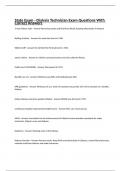
3 main kidney tasks - Answer Removing waste and fluid from blood, keeping electrolytes in balance Belding Scribner - Answer He made the shunt in 1960 Willem Kolff - Answer He did the first HD treatment in 1943 James Cimino - Answer In 1966 he connected artery and vein called AV fistula Public law 92-603 ESRD - Answer Was passed in 1972 Bundles are set - Answer Medicare pays 80% and Medicaid pays 20% RPA guidelines - Answer Minimum of 3x a week of treatment to provide 15% of the function of a healthy kidneys kidney disease outcomes quality initiative - Answer KDOQI was formed in 1999 Continuous Quality Improvement (CQI) Process - Answer Plan, do, check and act AAMI - Answer Association for the Advancement of Medical Instrumentation standards for water treatment, dialyzer reuse and dialyzer Nephrons - Answer Working units of the kidneys Kidneys function - Answer Remove waste, keep fluids and electrolytes in balance, control blood pressure, maintain acid-base balance and make hormones 2 endocrine functions - Answer Erythropoietin and calcitriol Erythropoietin - Answer Triggers bone marrow to make red blood cells Calcitriol - Answer A hormone produced from vitamin D that acts in essentially the same manner as parathyroid hormone. Balance calcium and phosphorus and key to bone metabolism Diabetes - Answer Number 1 cause of chronic kidney disease Hypertension - Answer Is the 2nd cause of CKD Uremia - Answer Build up of waste products in the blood pruritus - Answer itching and high phosphorus Amyloidosis - Answer Waxy proteins deposited in the soft tissues, bones and joints. Beta 2 microglobulin peripheral neuropathy - Answer Nerve damage, pins and needles High biological value protein - Answer Meat, poultry, fish and dairy Low Biological Value Protein - Answer Beans, rice and nuts Albumin levels - Answer < 4.0 g/dL raises risk of death Health Insurance Portability and Accountability Act - Answer Governs security of patients info edema - Answer swelling in feet, hands or face Solvent - Answer A liquid substance capable of dissolving other substances Solute - Answer A substance that is dissolved in a solvent Diffusion - Answer Solute moves from an area of higher concentration to a lower concentration Osmosis - Answer Movement of solvent through semi-permeable membrane from an area of lower solute concentration to an area of higher one Osmolarity - Answer A measure of the total solute concentration per liter of solution Hypertonic - Answer Having a higher concentration of solute than another solution. Solute higher than blood interstitial space - Answer The space in between the cells. 80% outside Filtration ( mechanical, removal of water) - Answer Movement of fluid through filter as the result of hydraulic pressure Ultra-filtration - Answer Water removal from blood during dialysis due to pressure gradient (squeezing out of water) Convection - Answer The transfer of thermal energy by the movement of a fluid (solvent drag) Dialyzer characteristics - Answer Biocompatibility, membrane surface area, molecular weight cutoff, ultrafiltration coefficient, mass transfer coefficient and clearance 3 different types of dialyzers - Answer Cellulose, synthetic cellulose and modified cellulose 3 main ways to remove solutes that affect the dialyzer clearance - Answer Diffusion, convection and adsorption main concentrate in dialysate - Answer Treated water, sodium, calcium, magnesium, chloride, potassium, glucose, acid and bicarbonate Electrolyte causes arrhythmia - Answer Potassium Potassium normal range - Answer 3.5 to 5.5 mEq/L Sodium normal range - Answer 135-145 mEq/L Too much sodium can cause? - Answer Hypernatremia. Increase risk for high blood pressure. Hypertension Ultrafiltration coefficient - Answer (KUF) of Water can occur across the membrane in 1 hour at a given pressure Conductivity - Answer The ability of an object to transfer heat or electricity to another object. Transducer protector - Answer Device inside the machine that converts air pressure into electronic signal. Are barriers between blood in the tubing and the transducer in the machine. air detector alarm: - Answer detects air in the venous line of the extracorporeal circuit for air. (Ultrasonic devices) ultrasonic device - Answer Check for sound wave variance Adsorption - Answer Ability of the membrane material to adsorb protein from the patient blood effect the biocompatibility of the dialyzer Chloride range - Answer 100-124 mEq/L Buffer - Answer compound that prevents sharp, sudden changes in pH hemodialysis delivery system - Answer Mixes and deliver dialysate, pumps blood through the dialyzer and monitors various parameters to ensure safe treatment
Written for
- Institution
- Dialysis technician
- Course
- Dialysis technician
Document information
- Uploaded on
- December 11, 2023
- Number of pages
- 13
- Written in
- 2023/2024
- Type
- Exam (elaborations)
- Contains
- Questions & answers
Subjects
-
dialysis technician stuvia
-
state exam dialysis technician exam questions wi
-
3 main kidney tasks removing waste and fluid from
-
belding scribner he made the shunt in 1960

Also available in package deal