Case 4 Defining Health 02-12-2022
What different models exist to define health and how has our definition of health
changed over time? What are the strengths and limitations of each model?
Health can have medical, social, economic, spiritual and many other components, so it is hard to
define it. The way the politics are managed defines what sort of model the country uses. How we
organise health, influences how health is delivered.
Development over time
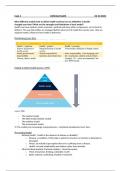
Models to define health (Larson, 1999)
- The medical model
- The WHO model (holistic model)
- The wellness model
- The environment model
The models are increasingly comprehensive + constitute development over time
The medical model
- Defining health: “health is the absence of disease or disability”
o Disease: a condition of the body in which its structure or function is disturbed or
deranged
o Illness: an individual perception that one is suffering from a disease.
o Health: virtually undefinable and relative rather than absolute.
- Mind and body dualism (Cartesian dualism – Rene Descartes):
o Mind: immaterial, thinking, indivisible (=self)
o Body: material, unthinking, divisible (=machine)
, The body is seen as a machine. A disease is a malfunction. When the body is in
health, there is absence of disease or infirmity.
The mind steers the body
- Medical model as a paradigm: medicine = health.
- Explaining health inequalities: access to high-quality health care & use of health service
Impact on the health system:
- Reductionism:
o We see more specialization in disease/work field and more fragmentation in
professions.
- The mechanical approach leads to dehumanization and disempowerment
o Limited attention to doctor and patient beliefs
o Patient health beliefs/ personal circumstances are not considered
Impact on the health system (governance)
o Medical professions are seen as the main actor
o Health is non-political
o The focus is on cure, disease and prevention (--> this is a too narrow way of thinking)
Strengths:
- Specialization in medical process
- Medical progress (due to the model a lot of research on causes, prevention and cure was
conducted). It focuses on disease and disability.
- Easy to compare health systems
Limitations:
- Fragmentation, as a consequence of specialization
- It is hard to adapt the model to emotional and psychiatric issues.
- There is no clear cut for the criteria for diseases.
- It deemphasized preventive medicine and ignores the social causes of a disease.
A disease is more than only biological: social and economic factors must be taken
account as well in defining health.
- According to the model, one can be ill without having a disease/ symptom, or can have a
disease without being ill. This makes it very hard to say who is sick and who is not. It does not
take into account that one can be ill without having a disease (perceiving symptoms without
pathology).
The holistic model (WHO, 1948)
Defining health: “Health is a state of complete physical, mental and social well-being and not merely
the absence of disease or infirmity”. This is the most popular model worldwide. Health became a
fundamental right of all persons --> more political.
- After the second WW is become more important of how important the social environment is
for our health. It matters where you are born, where you grow up, where you work = social
determinants are very important for your health.
Medical model looks at humans as machines – the holistic model has a different approach: it
describes humans more as systems which are part of larger social environment and whose health is
produced in interaction with this environment.
- Social health refers to the distribution of economic wealth and other socio-economic factors.
- The holistic model sees the human as a system.
What different models exist to define health and how has our definition of health
changed over time? What are the strengths and limitations of each model?
Health can have medical, social, economic, spiritual and many other components, so it is hard to
define it. The way the politics are managed defines what sort of model the country uses. How we
organise health, influences how health is delivered.
Development over time
Models to define health (Larson, 1999)
- The medical model
- The WHO model (holistic model)
- The wellness model
- The environment model
The models are increasingly comprehensive + constitute development over time
The medical model
- Defining health: “health is the absence of disease or disability”
o Disease: a condition of the body in which its structure or function is disturbed or
deranged
o Illness: an individual perception that one is suffering from a disease.
o Health: virtually undefinable and relative rather than absolute.
- Mind and body dualism (Cartesian dualism – Rene Descartes):
o Mind: immaterial, thinking, indivisible (=self)
o Body: material, unthinking, divisible (=machine)
, The body is seen as a machine. A disease is a malfunction. When the body is in
health, there is absence of disease or infirmity.
The mind steers the body
- Medical model as a paradigm: medicine = health.
- Explaining health inequalities: access to high-quality health care & use of health service
Impact on the health system:
- Reductionism:
o We see more specialization in disease/work field and more fragmentation in
professions.
- The mechanical approach leads to dehumanization and disempowerment
o Limited attention to doctor and patient beliefs
o Patient health beliefs/ personal circumstances are not considered
Impact on the health system (governance)
o Medical professions are seen as the main actor
o Health is non-political
o The focus is on cure, disease and prevention (--> this is a too narrow way of thinking)
Strengths:
- Specialization in medical process
- Medical progress (due to the model a lot of research on causes, prevention and cure was
conducted). It focuses on disease and disability.
- Easy to compare health systems
Limitations:
- Fragmentation, as a consequence of specialization
- It is hard to adapt the model to emotional and psychiatric issues.
- There is no clear cut for the criteria for diseases.
- It deemphasized preventive medicine and ignores the social causes of a disease.
A disease is more than only biological: social and economic factors must be taken
account as well in defining health.
- According to the model, one can be ill without having a disease/ symptom, or can have a
disease without being ill. This makes it very hard to say who is sick and who is not. It does not
take into account that one can be ill without having a disease (perceiving symptoms without
pathology).
The holistic model (WHO, 1948)
Defining health: “Health is a state of complete physical, mental and social well-being and not merely
the absence of disease or infirmity”. This is the most popular model worldwide. Health became a
fundamental right of all persons --> more political.
- After the second WW is become more important of how important the social environment is
for our health. It matters where you are born, where you grow up, where you work = social
determinants are very important for your health.
Medical model looks at humans as machines – the holistic model has a different approach: it
describes humans more as systems which are part of larger social environment and whose health is
produced in interaction with this environment.
- Social health refers to the distribution of economic wealth and other socio-economic factors.
- The holistic model sees the human as a system.