

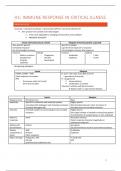
H1: IMMUNE RESPONSE IN CRITICAL ILLNESS
IMMUNOLOGY
Immunity = resistance to disease = discriminate self from non-self or altered self
Aim: protect from outside and inside dangers
IS has to be adaptable to changing environments and conditions
PRESERVE INTEGRITY
Innate immunity (natural, native) Adaptive immunity (specific, acquired)
Non-specific, general Specific to antigen
Immediate response Lag time from exposure to response
No immunological memory Immunological memory after exposure
Humoral Cellular Humoral Cellular
- Pattern receptors - Phagocytes - Antibodies - T cells
- Complement - NK cells - Cytokines - B cells
- Enzymes - Neutrophils
- Cytokines
Recognizing pathogens
Innate Adaptive
PAMPs, DAMPs + PRR B- and T-cells make many BCR and TCR
Quick detection of invaders = generation of diversity
PRR IF: recognize AG
- On immune cells, EnC or EpC clonal selection
- Germ line encoded proliferation of cell line
Tolerance: self/non-self-discrimination
IF doesn’t work => auto immune disease
Innate Adaptive
Response time Minutes/ hours Days
Specificity Specific for molecules and molecular patters Highly specific
associated with pathogens and molecules produced Discriminates between minor structures of
by death/ damaged cells microbial and non microbial molecules
Diversity A limited number of conserved germ-line encoded Highly diverse
receptors Very large number of receptors arising from genetic
recombination of receptor genes in each individual
Memory Some Persistent memory
responses Faster response of greater magnitude on
subsequent exposure
Self/nonself Perfect Very good
discrimination Occasional failures result in auto-immune disease
Soluble AMP Antibodies
components in Proteins Cytokines
blood Other mediators
Major cell types Phagocytes, APC T and B cells
NK cells APC
Epithelial and endothelial cells
1
,ANATOMY OF THE IMMUNE SYSTEM
CELLS OF THE IMMUNE SYSTEM
stem cell (HSC)
- Capacity to self renew
- Capacity to differentiate
- Embryonic: can become every cell type
- Adult: become one type of cell
- HSC: quiescent or activated
Eg. activated by infection
- Ageing: less HSCs
MYELOID CELLS: INNATE IMMUNITY
Granulocytes
- Neutrophils: acute inflammation
- Basophil: anaphylactic, allergy, parasite
- Mastcell: anaphylactic, allergy, parasite
- Eosinophil: anaphylactic, allergy, parasite
Phagocytic, APC
- Monocyte: migrate into tissue to become MF
- Macrophage: name depends on tissue eg. kupfer cell in liver
- Dendritic cell: ingest pathogens -> degrade into peptides -> present
LYMPHOID CELLS: ADAPTIVE IMMUNITY
= regulate adaptive response = T cells, B cells and NK cells
CD4/CD8 = 2/1 BUT: can change due to disease eg. HIV
CD4+ cell: Th1, Th2, Th17, Treg
2
, B cells T cells
Maturate in bone marrow Maturate in thymus
BCR -> activated -> become plasma cells -> secretion TCR + peptides on MHC -> T cell activated
of Ab
Memory cells after encountering AG -> rechallenge
with same AG -> quicker and higher IR
ORGANS OF THE IMMUNE SYSTEM
Primary lymphoid organs Secondary lymphoid organs
Development and education Sites where immune cells make contact with each
Produce immune cells other
Bone marrow Spleen
Thymus Lymphnodes
MALT and GALT
CYTOKINES
= hormones of the IS, glycoproteins
- Autocrine, paracrine and endocrine interactions
- Activation, proliferation and differentiation of cells
Eg. Th1 -> cytokines -> MF and cytotoxic cells
Eg. Th2 -> cytokines -> activate B cells
- Interferons, CSFs, TNF, interleukins, chemokines, growth factors
- Cytokine related diseases: massive release -> massive inflammation
Eg. septic shock
- Pleiotropy: one cytokine, more effects
Redundancy: more cytokines, one effect
Synergy <-> antagonism
Cascade induction
3
, INNATE IMMUNITY
- Defense against infections or danger
- Anatomical barriers, cellular responses and humoral elements
- Basic reaction = inflammation
Necessary for eliminating pathogens or damaged cells
BUT: needs to be highly regulated to prevent harm
BARRIERS
Anatomical Chemical
Epithelial, mucosae Secretions
Cilia, coughing Enzymes, acidic pH
Antimicrobial peptides, surfactant proteins
PHAGOCYTOSIS AND IC KILLING
Oxygen dependent Oxygen independent
ROS, RNS Electrically charged proteins
Lysozimes and lactoferrins
Proteases and hydrolytic enzymes
Pathogen invaded -> PAMPs + PRR on phagocyte ->
phagocytosis or other cellular response
BUT: phagocytosis can also be induced by opsonized
pathogens
4
IMMUNOLOGY
Immunity = resistance to disease = discriminate self from non-self or altered self
Aim: protect from outside and inside dangers
IS has to be adaptable to changing environments and conditions
PRESERVE INTEGRITY
Innate immunity (natural, native) Adaptive immunity (specific, acquired)
Non-specific, general Specific to antigen
Immediate response Lag time from exposure to response
No immunological memory Immunological memory after exposure
Humoral Cellular Humoral Cellular
- Pattern receptors - Phagocytes - Antibodies - T cells
- Complement - NK cells - Cytokines - B cells
- Enzymes - Neutrophils
- Cytokines
Recognizing pathogens
Innate Adaptive
PAMPs, DAMPs + PRR B- and T-cells make many BCR and TCR
Quick detection of invaders = generation of diversity
PRR IF: recognize AG
- On immune cells, EnC or EpC clonal selection
- Germ line encoded proliferation of cell line
Tolerance: self/non-self-discrimination
IF doesn’t work => auto immune disease
Innate Adaptive
Response time Minutes/ hours Days
Specificity Specific for molecules and molecular patters Highly specific
associated with pathogens and molecules produced Discriminates between minor structures of
by death/ damaged cells microbial and non microbial molecules
Diversity A limited number of conserved germ-line encoded Highly diverse
receptors Very large number of receptors arising from genetic
recombination of receptor genes in each individual
Memory Some Persistent memory
responses Faster response of greater magnitude on
subsequent exposure
Self/nonself Perfect Very good
discrimination Occasional failures result in auto-immune disease
Soluble AMP Antibodies
components in Proteins Cytokines
blood Other mediators
Major cell types Phagocytes, APC T and B cells
NK cells APC
Epithelial and endothelial cells
1
,ANATOMY OF THE IMMUNE SYSTEM
CELLS OF THE IMMUNE SYSTEM
stem cell (HSC)
- Capacity to self renew
- Capacity to differentiate
- Embryonic: can become every cell type
- Adult: become one type of cell
- HSC: quiescent or activated
Eg. activated by infection
- Ageing: less HSCs
MYELOID CELLS: INNATE IMMUNITY
Granulocytes
- Neutrophils: acute inflammation
- Basophil: anaphylactic, allergy, parasite
- Mastcell: anaphylactic, allergy, parasite
- Eosinophil: anaphylactic, allergy, parasite
Phagocytic, APC
- Monocyte: migrate into tissue to become MF
- Macrophage: name depends on tissue eg. kupfer cell in liver
- Dendritic cell: ingest pathogens -> degrade into peptides -> present
LYMPHOID CELLS: ADAPTIVE IMMUNITY
= regulate adaptive response = T cells, B cells and NK cells
CD4/CD8 = 2/1 BUT: can change due to disease eg. HIV
CD4+ cell: Th1, Th2, Th17, Treg
2
, B cells T cells
Maturate in bone marrow Maturate in thymus
BCR -> activated -> become plasma cells -> secretion TCR + peptides on MHC -> T cell activated
of Ab
Memory cells after encountering AG -> rechallenge
with same AG -> quicker and higher IR
ORGANS OF THE IMMUNE SYSTEM
Primary lymphoid organs Secondary lymphoid organs
Development and education Sites where immune cells make contact with each
Produce immune cells other
Bone marrow Spleen
Thymus Lymphnodes
MALT and GALT
CYTOKINES
= hormones of the IS, glycoproteins
- Autocrine, paracrine and endocrine interactions
- Activation, proliferation and differentiation of cells
Eg. Th1 -> cytokines -> MF and cytotoxic cells
Eg. Th2 -> cytokines -> activate B cells
- Interferons, CSFs, TNF, interleukins, chemokines, growth factors
- Cytokine related diseases: massive release -> massive inflammation
Eg. septic shock
- Pleiotropy: one cytokine, more effects
Redundancy: more cytokines, one effect
Synergy <-> antagonism
Cascade induction
3
, INNATE IMMUNITY
- Defense against infections or danger
- Anatomical barriers, cellular responses and humoral elements
- Basic reaction = inflammation
Necessary for eliminating pathogens or damaged cells
BUT: needs to be highly regulated to prevent harm
BARRIERS
Anatomical Chemical
Epithelial, mucosae Secretions
Cilia, coughing Enzymes, acidic pH
Antimicrobial peptides, surfactant proteins
PHAGOCYTOSIS AND IC KILLING
Oxygen dependent Oxygen independent
ROS, RNS Electrically charged proteins
Lysozimes and lactoferrins
Proteases and hydrolytic enzymes
Pathogen invaded -> PAMPs + PRR on phagocyte ->
phagocytosis or other cellular response
BUT: phagocytosis can also be induced by opsonized
pathogens
4


