APES Oceans questions with 100% correct answers 2023/2024
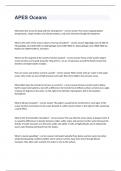
APES OceansWhat does the ocean do along with the atmosphere? - correct answer The oceans regulate global temperatures, shape weather and climate patterns, and cycle elements through the biosphere. What is the order of the ocean's layers, from top to bottom? - correct answer Epipelagic zone (0-200 m), Mesopelagic zone (200-1000 m), Bathypelagic zone ( m), Abyssopelagic zone ( m), Hadal zone ( m, trenches) Where are the majority of the world's trenches located? - correct answer Many of the world's largest ocean trenches are located along the "Ring of Fire," an arc of volcanoes around the Pacific Ocean that denotes convergent plates margins. How are waves and surface currents caused? - correct answer When winds "pile up" water in the upper ocean, they create an area of high pressure and water flows from high to low pressure zones. What effect does the Coriolis force have on currents? - correct answer Ocean currents tend to follow Earth's major wind patterns, but with a difference: the Coriolis force deflects surface currents at an angle of about 45 degrees to the wind—to the right in the Northern Hemisphere, left in the Southern Hemisphere. What is Ekman transport? - correct answer The pattern caused by the Coriolis force--each layer of the ocean transfers momentum to the water beneath it, which moves further to the right (or left), producing a spiral effect. What is the Thermohaline Circulation? - correct answer The way that the ocean mixes at deeper levels; it is caused by differences in density between colder, saltier water and warmer, fresher water. Because the density of water increases as it becomes colder and saltier, it sinks at high latitudes and is replaced by warm water flowing northward from the tropics. What is coastal upwelling? - correct answer Cold water typically flows below warmer water, but when winds blowing along coastlines deflect warm surface currents away from shore through Ekman transport, they allow cold, nutrient-rich water to rise to the surface. Where is coastal upwelling common? - correct answer Along western coastlines in the Atlantic, Pacific, and Indian oceans. What are gyres? - correct answer They are the result of all the forces that drive ocean currents. They centered at about 25° to 30° north and south latitudes. Gyres rotate clockwise in the Northern Hemisphere and counter-clockwise in the Southern Hemisphere, driven by easterly winds at low latitudes and westerly winds at high latitudes. Due to a combination of friction and planetary rotation, currents on the western boundaries of ocean gyres are narrower and flow faster than eastern boundary currents. Warm surface currents flow out of ocean gyres from the tropics to higher latitudes, and cold surface currents flow from colder latitudes toward the equator Where are the 5 major gyres? - correct answer The Indian Ocean, the North Atlantic, the North Pacific, the South Atlantic, and the South Pacific What does the Gulf Stream do? - correct answer It is the current that flows north through the Atlantic Ocean and makes northern Europe much warmer than Canadian provinces lying at the same latitudes. What is one example of coastal upwelling making the climate colder than other climates at the same latitude? - correct answer San Diego, California, and Columbia, South Carolina, lie at the same latitude, but coastal upwelling in the eastern Pacific brings cold water into the California Current system, which runs south along the California coast. This process helps to keep peak summer temperatures in San Diego at about 78°F, compared to 95°F in Columbia. Why do the oceans respond more slowly to temperature change? - correct answer Water has a higher specific heat capacity (SHC) than air, which means that it takes more energy input to increase its temperature (about four times more for liquid water). What impact do the oceans have on climate change? - correct answer By absorbing heat the oceans are delaying the full impact of rising temperatures due to global climate change by decades to centuries. What causes salinity differences? - correct answer evaporation, precipitation, freshwater runoff, and sea ice formation. Evaporation rates are highest in subtropical regions where there are descending currents of warm, dry air. When sea water evaporates or freezes, most of its salt content is left behind in the ocean, so high rates of evaporation in the subtropics raise salinity levels. Sea water is relatively less saline
Written for
- Institution
- Apes
- Course
- Apes
Document information
- Uploaded on
- December 8, 2023
- Number of pages
- 4
- Written in
- 2023/2024
- Type
- Exam (elaborations)
- Contains
- Questions & answers
Subjects

Also available in package deal