5. Positional Information
Overview
- Inspirational experiments
- Lewis Wolpert – definition of positional information
- The French flag model – a conceptional framework to generate hypotheses
- Morphogen: definition
- Positional information and Drosophila
o Early embryonic development
o Maternal genes
o Gradients
o Segmentation genes - converting gradients into stripes
- Implications in biomedicine
o Discovery of signaling pathways
o Understanding teratogens
Goals
EX: French flag model, morphogen,
implications in biomedicine, etc.
Inspirational experiments
Many of these historical experiments always make use of the
Hans Driesch manipulation of embryo’s.
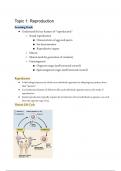
Separated blastomers early in sea urchin development
- Why sea urchin?
You can have many study them in batches.
There’s a distinction between blastomers that are at the
animal pole and those that are at the vegetal pole. If you make
a separation of the animal and the vegetal pole you will see: the top 4 blastomers (animal pole) will
give rise to something called a dauerblastula, it failed to develop any further. If you take the bottom 4
blastomers (vegetal pole) they will develop into a normal pluteus (just name of larva stage in sea
urchin development) larva.
If however you separate the blastomers along the sagittal axis (see right), then you get 2 blastomers
that stem from the animal pole and 2 blastomers that stem from the vegetal pole. Both will develop
into a normal larva.
Blastomers at vegetal vs animal pole have different potential!! And implicitly it also states
that there must be information located on either side that is determinant for what
subsequent development will look like. Blastomers are NOT equally potent.
1
, Hydra = a fresh water polyp, 1-2cm tall, attached
to substrate with basal part, looks like a tube and
at the top they have these arms that are meant to
capture prey that is then brought to the mouth
Lewis Wolpert
and digested.
Experiment: transplantation!
A. Transplant of number of cells from head region to
another hydra also in the head region nothing
happens. Transplant either dies or gets integrated.
B. First removal of head part and tentacles and then
transplant from head region normal head part
grows back but in addition you have a secondary axis. So if you leave the head part it
prevents the transplant from inducing a second axis. But if you remove the head region it
allows a second axis to form. So there must be an inhibitory signal coming from the head
region with the tentacles.
C. If you transplant from the head region more basilly secondary axis gets induced.
Cells from the head region have inducive capacity, are able to induce a secondary axis. But the
ability to induce a secondary axis depends on either presence or absence of the inhibitor coming
from the normal head region. And that inhibitor the further you go away from that head region, the
less of the inhibitor is present and then you can again induce a secondary axis. This suggests that
there will be a gradient, with the highest concentration of inhibitor at the head.
Based on these experiments he defines that the hypostome, region around the mouth, is an
organizer. So it can induce a secondary axis upon transplantation. It produces itself a head activation
signal, it differentiates, and it produces also an inhibition signal to form additional head structures.
John Saunders
He transplanted the apical ectodermal ridge (AER) an additional axis is induced. So that AER
generates or secretes information that is required for the formation of a new axis, so you end up with
bifurcated wings in chickens (wings split into 2 parts).
Sonic hedgehog (Shh) is a secreted molecule, a diffusible morphogen. This one is implicated in the
formation of that secondary axis.
2
Overview
- Inspirational experiments
- Lewis Wolpert – definition of positional information
- The French flag model – a conceptional framework to generate hypotheses
- Morphogen: definition
- Positional information and Drosophila
o Early embryonic development
o Maternal genes
o Gradients
o Segmentation genes - converting gradients into stripes
- Implications in biomedicine
o Discovery of signaling pathways
o Understanding teratogens
Goals
EX: French flag model, morphogen,
implications in biomedicine, etc.
Inspirational experiments
Many of these historical experiments always make use of the
Hans Driesch manipulation of embryo’s.
Separated blastomers early in sea urchin development
- Why sea urchin?
You can have many study them in batches.
There’s a distinction between blastomers that are at the
animal pole and those that are at the vegetal pole. If you make
a separation of the animal and the vegetal pole you will see: the top 4 blastomers (animal pole) will
give rise to something called a dauerblastula, it failed to develop any further. If you take the bottom 4
blastomers (vegetal pole) they will develop into a normal pluteus (just name of larva stage in sea
urchin development) larva.
If however you separate the blastomers along the sagittal axis (see right), then you get 2 blastomers
that stem from the animal pole and 2 blastomers that stem from the vegetal pole. Both will develop
into a normal larva.
Blastomers at vegetal vs animal pole have different potential!! And implicitly it also states
that there must be information located on either side that is determinant for what
subsequent development will look like. Blastomers are NOT equally potent.
1
, Hydra = a fresh water polyp, 1-2cm tall, attached
to substrate with basal part, looks like a tube and
at the top they have these arms that are meant to
capture prey that is then brought to the mouth
Lewis Wolpert
and digested.
Experiment: transplantation!
A. Transplant of number of cells from head region to
another hydra also in the head region nothing
happens. Transplant either dies or gets integrated.
B. First removal of head part and tentacles and then
transplant from head region normal head part
grows back but in addition you have a secondary axis. So if you leave the head part it
prevents the transplant from inducing a second axis. But if you remove the head region it
allows a second axis to form. So there must be an inhibitory signal coming from the head
region with the tentacles.
C. If you transplant from the head region more basilly secondary axis gets induced.
Cells from the head region have inducive capacity, are able to induce a secondary axis. But the
ability to induce a secondary axis depends on either presence or absence of the inhibitor coming
from the normal head region. And that inhibitor the further you go away from that head region, the
less of the inhibitor is present and then you can again induce a secondary axis. This suggests that
there will be a gradient, with the highest concentration of inhibitor at the head.
Based on these experiments he defines that the hypostome, region around the mouth, is an
organizer. So it can induce a secondary axis upon transplantation. It produces itself a head activation
signal, it differentiates, and it produces also an inhibition signal to form additional head structures.
John Saunders
He transplanted the apical ectodermal ridge (AER) an additional axis is induced. So that AER
generates or secretes information that is required for the formation of a new axis, so you end up with
bifurcated wings in chickens (wings split into 2 parts).
Sonic hedgehog (Shh) is a secreted molecule, a diffusible morphogen. This one is implicated in the
formation of that secondary axis.
2