11. Branching Morphogenesis – 22/03/2023
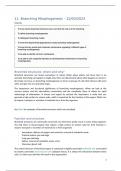
Goals
Branched structures: where and why?
Branched structures are found everywhere in nature (think about plants, but focus here is on
animals). Branching can happen in single cells, then we talk primarily about what happens in neurons.
But today we focus on branching morphogenesis in terms of groups of cells that interact with each
other and give rise to a branched organ.
The importance and functional significance of branching morphogenesis. When we look at the
nervous system and the intercellular connectivity and the complexity there of allows for rapid
interchange of information. In tissues and organs by contrast the importance is really that you
generate a high surface to volume ratio, which is important for the function of the organs. Which can
be import, transport or secretion of materials to or from the organism.
See slides for examples of branched structures which are visualized.
Function and structure
Branched structures are universally conserved, you find them pretty much in every living organism.
You find them in tissues/organs that require a high surface to volume ratio for their function (=
import, transport or secretion of materials to or from organism)
- Vasculature: delivery of oxygen and nutrients, removal of metabolic waste
- Tracheal system: gas exchange
- Lung: gas exchange
- Kidney: removal of metabolic waste, urine
- Mammary gland: milk
The central structure of branched organs is composed of tightly associated epithelial cells surrounded
by loosely connected mesenchymal cells (adipose tissue). It is always the interaction between these
cells, it is that cross talk that will result in the organization.
1
, A number of branched structures that we will discuss have stereotypical branching. Throughout
development branching has been elaborated and it is always more or less the same. But one example
where it is not stereotypical is the Mammary gland for obvious reasons. You have the initial
development of branching but then you have hormones of the menstrual cycle on the one hand and
also during pregnancy they will significantly influence the complexity of branching in the mammary
gland.
Definition
Branching morphogenesis is the developmental process whereby a cell or a group of cells expands its
surface area by forming cellular or tissue extensions during development.
When talking about single cells we think about neurons, when talking about groups of cells
we think about the examples we will discuss further underneath:
Branching morphogenesis is studies using a combination of
approaches
- Genetics (mouse, zebrafish, Drosophila)
- Characterization of causal genes for inherited disorders
o Look at patients that are seen in the genetic clinic that are seen with abnormalities
where branching is affected and then try to discover the underlying gene.
- Tissue recombination experiments
o For example isolate the epithelial cells from one organ and combine it with
mesenchymal derived cells from another branched organ. Mix them together and
then see what branching structure will develop. That will tell us something about
which of those components is the most important in elaborating a branched
structure.
- Cell fate mapping
- Mosaic analysis
o Mutant clones making in an otherwise wild type context and see how they behave.
- Live imaging organ cultures
Modes of branching
Branches can be formed: Most common
- By splitting of an existing tip in two or more daughter branches = bifurcations
- By formation of a new
bud on the side of an existing
tube = lateral branching
- Branches can rotate relative
to each other = strictly not
a branching method
but more a add-on.
2
Goals
Branched structures: where and why?
Branched structures are found everywhere in nature (think about plants, but focus here is on
animals). Branching can happen in single cells, then we talk primarily about what happens in neurons.
But today we focus on branching morphogenesis in terms of groups of cells that interact with each
other and give rise to a branched organ.
The importance and functional significance of branching morphogenesis. When we look at the
nervous system and the intercellular connectivity and the complexity there of allows for rapid
interchange of information. In tissues and organs by contrast the importance is really that you
generate a high surface to volume ratio, which is important for the function of the organs. Which can
be import, transport or secretion of materials to or from the organism.
See slides for examples of branched structures which are visualized.
Function and structure
Branched structures are universally conserved, you find them pretty much in every living organism.
You find them in tissues/organs that require a high surface to volume ratio for their function (=
import, transport or secretion of materials to or from organism)
- Vasculature: delivery of oxygen and nutrients, removal of metabolic waste
- Tracheal system: gas exchange
- Lung: gas exchange
- Kidney: removal of metabolic waste, urine
- Mammary gland: milk
The central structure of branched organs is composed of tightly associated epithelial cells surrounded
by loosely connected mesenchymal cells (adipose tissue). It is always the interaction between these
cells, it is that cross talk that will result in the organization.
1
, A number of branched structures that we will discuss have stereotypical branching. Throughout
development branching has been elaborated and it is always more or less the same. But one example
where it is not stereotypical is the Mammary gland for obvious reasons. You have the initial
development of branching but then you have hormones of the menstrual cycle on the one hand and
also during pregnancy they will significantly influence the complexity of branching in the mammary
gland.
Definition
Branching morphogenesis is the developmental process whereby a cell or a group of cells expands its
surface area by forming cellular or tissue extensions during development.
When talking about single cells we think about neurons, when talking about groups of cells
we think about the examples we will discuss further underneath:
Branching morphogenesis is studies using a combination of
approaches
- Genetics (mouse, zebrafish, Drosophila)
- Characterization of causal genes for inherited disorders
o Look at patients that are seen in the genetic clinic that are seen with abnormalities
where branching is affected and then try to discover the underlying gene.
- Tissue recombination experiments
o For example isolate the epithelial cells from one organ and combine it with
mesenchymal derived cells from another branched organ. Mix them together and
then see what branching structure will develop. That will tell us something about
which of those components is the most important in elaborating a branched
structure.
- Cell fate mapping
- Mosaic analysis
o Mutant clones making in an otherwise wild type context and see how they behave.
- Live imaging organ cultures
Modes of branching
Branches can be formed: Most common
- By splitting of an existing tip in two or more daughter branches = bifurcations
- By formation of a new
bud on the side of an existing
tube = lateral branching
- Branches can rotate relative
to each other = strictly not
a branching method
but more a add-on.
2