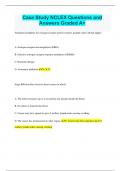
Case Study NCLEX Questions and Answers Graded A+
Case Study NCLEX Questions and Answers Graded A+ Treatment modalities for estrogen-receptor positive tumors include (select all that apply): A. Estrogen-receptor downregulators (ERDs) B. Selective estrogen-receptor response modulators (SERMs) C. Hormone therapy D. Aromatase inhibitors A, B, D Stage IIIB describes invasive breast cancer in which: A. The tumor measures up to 2 cm and has not spread outside the breast B. No tumor is found in the breast C. Cancer may have spread to up to 9 axillary lymph nodes causing swelling D. The cancer has metastasized to other organs C. Cancer may have spread to up to 9 axillary lymph nodes causing swelling In stage IIIB carcinoma of the breast the cancer may have spread to up to 9 axillary lymph nodes. Ms. T has 8 of 12 lymph nodes affected. Answers A or B may occur in stage I, and answer choice D describes stage IV 3.Which of the following are important interventions when caring for a patient with Cushing syndrome? (Select all that apply) A. Increase carbohydrate intake B. Monitoring blood glucose levels C. Observing for signs of hypotension D. Protecting patient from exposure to infection B, D Hyperglycemia occurs with Cushing disease because of glucose intolerance (associated with cortisol-induced insulin resistance) and increased gluconeogenesis by the liver. High levels of corticosteroids increase susceptibility to infection and delay wound healing. In a 29-year-old female client who is being successfully treated for Cushing's syndrome, nurse Lyzette would expect a decline in: A. Menstrual flow B. Bone mineralization C. Hair loss D. Serum glucose level D. Serum glucose level Serum glucose levels tend to be high in patients with Cushing's Syndrome due to excess corticosteroids in the body. When Cushing's syndrome is being treated successfully, a nurse should expect a decline in the patient's serum glucose level Mr. A has been admitted to the hospital with a diagnosis of acute pancreatitis and the nurse is assessing his pain. What type of pain is associated with this diagnosis? A. Burning and aching, located in the left lower quadrant and radiating to the leg B. Severe and unrelenting, located in the epigastric area and radiating to the back C. Burning and aching, located in the epigastric area and radiating to the umbilicus D. Severe and unrelenting, located in the left lower quadrant and radiating to the hip B. Severe and unrelenting, located in the epigastric area and radiating to the back The pain associated with acute pancreatitis is often severe and unrelenting, is located in the epigastric region, and radiates to the back. It is also described as sudden onset, deep piercing, continuous or steady. The other options are incorrect. The nurse is reviewing the prescription for Mr. A., a 55 year-old male admitted to the hospital with a diagnosis of acute pancreatitis. Which interventions would the nurse expect to be prescribed for the client? Select all that apply. A. Administer antacids as prescribed B. Encourage
Written for
- Institution
- Case Study NCLEX
- Module
- Case Study NCLEX
Document information
- Uploaded on
- December 7, 2023
- Number of pages
- 22
- Written in
- 2023/2024
- Type
- Exam (elaborations)
- Contains
- Questions & answers
Subjects
-
case study nclex questions and answers graded a

Also available in package deal