

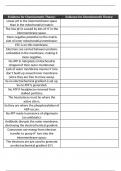
Evidence for Chemiosmotic Theory: Evidence for Chemiosmotic Theory:
Lower pH in the intermembrane space
than in the mitochondrial matrix:
The low pH is caused by lots of H+ in the
intermembrane space.
More negative potential on the matrix
side of inner mitochondrial membrane:
ETC is on this membrane.
Electrons are carried between proteins
embedded in the membrane, making it
more negative.
No ATP in mitoplasts (mitochondria
stripped of their outer membrane):
Lack of outer membrane means H+ ions
don’t build up around inner membrane
(since they are free to move away).
So no electrochemical gradient is set up.
So no ATP is generated.
No ATP if headpieces removed from
stalked particles:
The head pieces must be where the
active site is.
So they are where the phosphorylation of
ADP occurs.
No ATP made in presence of oligomycin
(an antibiotic):
Antibiotic disrupts the outer membrane,
destroying the electrochemical gradient.
Coenzymes use energy from electron
transfer to pump H+ ions into the
intermembrane space:
The electrons are just used to generate
an electrochemical gradient (H+).
Lower pH in the intermembrane space
than in the mitochondrial matrix:
The low pH is caused by lots of H+ in the
intermembrane space.
More negative potential on the matrix
side of inner mitochondrial membrane:
ETC is on this membrane.
Electrons are carried between proteins
embedded in the membrane, making it
more negative.
No ATP in mitoplasts (mitochondria
stripped of their outer membrane):
Lack of outer membrane means H+ ions
don’t build up around inner membrane
(since they are free to move away).
So no electrochemical gradient is set up.
So no ATP is generated.
No ATP if headpieces removed from
stalked particles:
The head pieces must be where the
active site is.
So they are where the phosphorylation of
ADP occurs.
No ATP made in presence of oligomycin
(an antibiotic):
Antibiotic disrupts the outer membrane,
destroying the electrochemical gradient.
Coenzymes use energy from electron
transfer to pump H+ ions into the
intermembrane space:
The electrons are just used to generate
an electrochemical gradient (H+).


