
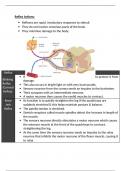
Reflex Actions:
Reflexes are rapid, involuntary responses to stimuli.
They do not involve conscious parts of the brain.
They minimise damage to the body.
Reflex Process
If your cornea is touched your eyelids will briefly close to protect it from
Blinking damage.
Reflex This also occurs in bright light or with very loud sounds.
(Corneal Sensory neurone from the cornea sends an impulse to the brainstem.
Reflex). Theis synapses with an intermediate neurone.
A motor neurone then causes the eyelid muscles to contract.
Knee Its function is to quickly straighten the leg if the quadriceps are
Jerk suddenly stretched & this helps maintain posture & balance.
Reflex The patella tendon is stretched.
Stretch receptors called muscle spindles detect the increase in length of
the muscle.
The sensory neurone directly stimulates a motor neurone which causes
the extensor muscle at the front of the quadriceps to contract,
straightening the leg.
At the same time the sensory neurone sends an impulse to the relay
neurone that inhibits the motor neurone of the flexor muscle, causing it
to relax
Reflexes are rapid, involuntary responses to stimuli.
They do not involve conscious parts of the brain.
They minimise damage to the body.
Reflex Process
If your cornea is touched your eyelids will briefly close to protect it from
Blinking damage.
Reflex This also occurs in bright light or with very loud sounds.
(Corneal Sensory neurone from the cornea sends an impulse to the brainstem.
Reflex). Theis synapses with an intermediate neurone.
A motor neurone then causes the eyelid muscles to contract.
Knee Its function is to quickly straighten the leg if the quadriceps are
Jerk suddenly stretched & this helps maintain posture & balance.
Reflex The patella tendon is stretched.
Stretch receptors called muscle spindles detect the increase in length of
the muscle.
The sensory neurone directly stimulates a motor neurone which causes
the extensor muscle at the front of the quadriceps to contract,
straightening the leg.
At the same time the sensory neurone sends an impulse to the relay
neurone that inhibits the motor neurone of the flexor muscle, causing it
to relax


