
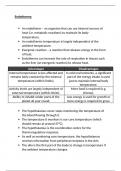
Endotherms:
An endotherm – an organism that can use internal sources of
heat (i.e. metabolic reactions) to maintain its body
temperature.
An endotherms temperature is largely independent of the
ambient temperature.
Exergonic reaction – a reaction that releases energy in the form
of heat.
Endotherms can increase the rate of respiration in tissues such
as the liver (an exergonic reaction) to release heat.
Advantages Disadvantages
Internal temperature is less affected and In cold environments, a significant
remains fairly constant by the external part of the energy intake is used
temperature (within limits). just to maintain internal body
temperature.
Activity levels are largely independent of More food is required (e.g.
external temperature (within limits). shrews).
Ability to inhabit colder parts of the Less energy is used for growth or
planet all year round. more energy is required to grow.
The hypothalamus never stops monitoring the temperature of
the blood flowing through it.
The temperature it monitors is our core temperature (which
should remain at around 37°C).
The hypothalamus is the coordination centre for the
thermoregulatory response.
As well as monitoring core temperature, the hypothalamus
receives information from peripheral receptors in the skin.
The skin is the first part of the body to change in temperature if
the ambient temperature changes.
An endotherm – an organism that can use internal sources of
heat (i.e. metabolic reactions) to maintain its body
temperature.
An endotherms temperature is largely independent of the
ambient temperature.
Exergonic reaction – a reaction that releases energy in the form
of heat.
Endotherms can increase the rate of respiration in tissues such
as the liver (an exergonic reaction) to release heat.
Advantages Disadvantages
Internal temperature is less affected and In cold environments, a significant
remains fairly constant by the external part of the energy intake is used
temperature (within limits). just to maintain internal body
temperature.
Activity levels are largely independent of More food is required (e.g.
external temperature (within limits). shrews).
Ability to inhabit colder parts of the Less energy is used for growth or
planet all year round. more energy is required to grow.
The hypothalamus never stops monitoring the temperature of
the blood flowing through it.
The temperature it monitors is our core temperature (which
should remain at around 37°C).
The hypothalamus is the coordination centre for the
thermoregulatory response.
As well as monitoring core temperature, the hypothalamus
receives information from peripheral receptors in the skin.
The skin is the first part of the body to change in temperature if
the ambient temperature changes.


